

"Shepherding Opportunity That's in Front of You" -- James Lazarovits, PhD, CEO of Archon Biosciences
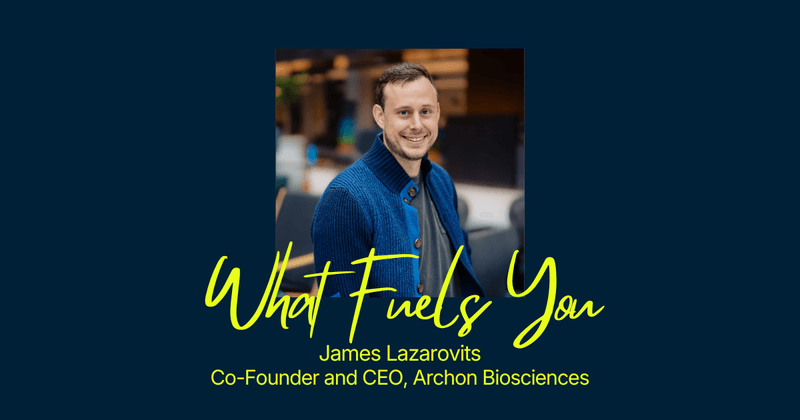
James Lazarovits, CEO and Co-Founder of Archon Biosciences
James Lazarovits will tell you his company is not an AI company, even though generative protein design sits at the center of everything Archon Biosciences does. That distinction, product-led rather than AI-first, is the closest thing he has to a founding philosophy, and it shows up everywhere from how he designs antibodies to how he hires people.
In this episode of What Fuels You, host Shauna Swerland sits down with Lazarovits, PhD, CEO and co-founder of Archon Biosciences, for a conversation that moves from a childhood in an international family in Toronto to a chance meeting at a going-away party that led to a biotech company built on changing the shape of antibodies. Along the way, Lazarovits lays out the six traits he screens every hire against and the belief, planted by his grandfather, that shepherding an opportunity in front of you is both a calling and a responsibility.
📋 Episode Chapters
| 00:00 | Introducing James Lazarovits, PhD, CEO of Archon Biosciences |
| 02:30 | Rapid fire: travel, pet peeves, and speaking three languages |
| 06:00 | Growing up in an international family in Toronto and a childhood built on asking for what you want |
| 11:00 | Grade 5 teacher Ms. Todd and learning to take pushback |
| 16:00 | Being hypercompetitive as a kid and quitting hockey rather than being mediocre |
| 21:00 | A serious first-year injury and turning around an undergraduate slump |
| 25:00 | A PhD in nanotechnology engineering at the University of Toronto under Dr. Warren Chan |
| 29:00 | Day trading and early-stage tech investing as a teenager with best friend Ari |
| 34:00 | Moving to Seattle in 2019 to join David Baker's Institute for Protein Design |
| 38:00 | Meeting co-founder George Ueda at a going-away party and the idea behind Archon Biosciences |
| 43:00 | Building Archon inside the University of Washington's Translational Program on $7 million in grants |
| 48:00 | Antibody cages and why changing a drug's shape changes how it travels through the body |
| 54:00 | Why Archon is product-led, not AI-first, and the 4 Cs and 2 Ys hiring philosophy |
| 59:00 | What fuels James Lazarovits: shepherding the opportunity in front of you |
An Upbringing Built on Asking For What You Want
Lazarovits grew up in Toronto in a family he describes as very international, and the household rule was simple: nothing arrived automatically. He tells Shauna Swerland that around age eight, his mother told him a birthday party would only happen if he organized it himself. That pattern, that access to anything hinged on actively asking for it, shaped how he approaches nearly everything since, including a solo plane trip to France at age seven to meet cousins.
School reinforced the same instinct in a different direction. Lazarovits credits his grade 5 teacher, Ms. Todd, who he says was eventually let go for being too stern, with giving him exactly the pushback he needed.
"So my childhood was very much revolved around these ideas where if you wanted something, you should go work for it and find it."
-- James Lazarovits
That drive to prove himself extended into how he measured his own performance. He describes being flagged by teachers in primary school for an unhealthy work ethic and quitting hockey rather than accept being average at it.
"I just always wanted to be the best. I was just hypercompetitive."
-- James Lazarovits
From Day Trading With a Teenage Best Friend to a PhD at the University of Toronto
Before Archon Biosciences, before the Institute for Protein Design, there was a much earlier education in company building. At 18, Lazarovits started day trading with his friend Ari, who was building a software and music label company at the time. By 22, the two were using their own money to invest directly in early-stage deep tech startups, learning firsthand about product market fit and the power of a clear story, lessons that would later shape how he pitched Archon to investors.
Lazarovits went on to earn his PhD in nanotechnology engineering at the University of Toronto under nanomedicine expert Dr. Warren Chan, focused on how nanomaterials behave once inside the body. He describes the work as training a deep learning model to find patterns in how thousands of blood proteins interact with administered materials, without necessarily knowing why those patterns exist.
He is candid that the day trading years, while formative, ultimately left him unsatisfied because he could not verify the value he was creating. That restlessness, more than any single plan, is what eventually pushed him toward the Institute for Protein Design in Seattle.
A Going-Away Party, George Ueda, and the Start of Archon Biosciences
Lazarovits moved to Seattle on May 13, 2019, to work under David Baker, the protein design pioneer who later won the 2024 Nobel Prize in Chemistry. He started with Baker on June 1 and had quit his postdoc entirely by October 2 to join the Institute for Protein Design's Translational Program full time.
His co-founder, George Ueda, entered the picture by accident. The two met at a going-away party, bonded over a shared familiarity with Japan, and only later realized they had complementary scientific ideas. Lazarovits had spent his PhD studying why materials fail once inside the body. Ueda and colleagues at the Institute for Protein Design had built a technology that Lazarovits immediately recognized could solve that exact problem.
Rather than incorporate a company right away, the two built an academic lab inside the University of Washington and were granted research faculty titles. Over roughly three and a half years, funded by about $7 million in non-dilutive grants, they used the time to test whether they were actually the right people to build a company together, not just the right scientists.
Antibody Cages: Changing How Drugs Travel Through the Body
Archon Biosciences' technology starts from a simple observation: antibodies are the most widely used class of therapeutic on the market, but drugmakers have limited control over where they go once inside a patient. Archon's answer is to attach computationally designed proteins to existing antibodies, letting them self-assemble into new shapes that change how the drug travels and behaves.
"At Archon, we've invented a new class of biologic that changes the way drugs travel inside of your body. So antibodies are the largest class of therapeutic in the market today."
-- James Lazarovits
Lazarovits explains the concept with an analogy he returns to often on the show: how you deliver a message changes how it lands, whether the message is spoken or biological.
"If I want you to do something and I yell at you, you're not going to be very inclined to listen to what I have to say. But if I ask you nicely, you'll be more interested in actually doing what I've asked."
-- James Lazarovits
Archon is currently dosing animals with its preclinical molecules, benchmarking against best-in-class antibodies already on the market to test whether its shape-based approach measurably improves on existing treatments.
Product-Led, Not AI-First
Lazarovits draws a sharp line between Archon and companies he sees investing heavily in AI platforms before proving the underlying product works. His argument is that until you have tested what you have designed in the lab, you cannot know which properties actually matter, so scaling the AI side too early risks optimizing for the wrong metrics entirely.
That same rigor shows up in how he builds the team. Early hires at Archon were chosen for reputation and character first, technical skill second, a sequencing Lazarovits says shaped the company's culture from the outset. He has used the same six-trait filter to screen candidates for over a decade, a shorthand he calls his 4 C's and 2 I's:
"Creative, consistent, competent, compassionate, initiative, and integrity."
-- James Lazarovits
He describes his leadership approach in similarly direct terms: open about admitting fault, uncompromising about accountability, and allergic to internal politics.
"I believe completely in horizontal communication, but vertical hierarchy."
-- James Lazarovits
What Fuels James Lazarovits
Asked the question the show is named for, Lazarovits traces his answer back to his grandfather, a man who spoke ten languages and left him with a simple standard for judging himself: if you can see a chance to help someone and choose not to, you are probably not a good person. It is the same line that opens the episode before the two even sit down.
"I think that there's something about shepherding opportunity that's in front of you to be able to have impact on people's lives is both a calling but also exciting. So what fuels me is my ability to have positive impact on people's lives."
-- James Lazarovits
5 Key Takeaways
Frequently Asked Questions
Who is James Lazarovits and what does he do at Archon Biosciences?
James Lazarovits, PhD, is the CEO and co-founder of Archon Biosciences, a Seattle biotech company working at the intersection of materials engineering and artificial intelligence. He previously worked as a postdoctoral fellow and research faculty member at the University of Washington's Institute for Protein Design under 2024 Nobel laureate David Baker, and he holds a PhD in nanotechnology engineering from the University of Toronto.
What is Archon Biosciences' antibody cage technology?
Archon's technology changes the size and shape of existing antibodies by attaching computationally designed proteins that self-assemble into new structures. Lazarovits explains on the podcast that changing an antibody's shape changes how it travels through the body and what it does once it arrives, potentially reducing side effects while preserving effectiveness.
Why does Archon Biosciences call itself product-led instead of AI-first?
Lazarovits says Archon prioritizes testing designed molecules in the lab before scaling its AI platform, because the properties that matter cannot be known ahead of time for something that has never existed before. He argues that companies which invest heavily in prediction before proving the product often end up optimizing for the wrong metrics.
How did James Lazarovits and George Ueda become co-founders of Archon Biosciences?
Lazarovits and George Ueda met by chance at a going-away party in Seattle and bonded over a shared connection to Japan before realizing they had complementary scientific ideas. They spent roughly three and a half years building an academic lab together at the University of Washington's Institute for Protein Design, funded by about $7 million in non-dilutive grants, before formally starting Archon Biosciences.
What did James Lazarovits say fuels him?
Lazarovits says what fuels him is scientific curiosity paired with the ability to do good, a philosophy he traces to his grandfather, who told him that seeing a chance to help someone and not acting on it makes you a bad person. He describes shepherding the opportunity in front of you as both a calling and something exciting.
James Lazarovits, CEO and Co-Founder of Archon Biosciences
James Lazarovits will tell you his company is not an AI company, even though generative protein design sits at the center of everything Archon Biosciences does. That distinction, product-led rather than AI-first, is the closest thing he has to a founding philosophy, and it shows up everywhere from how he designs antibodies to how he hires people.
In this episode of What Fuels You, host Shauna Swerland sits down with Lazarovits, PhD, CEO and co-founder of Archon Biosciences, for a conversation that moves from a childhood in an international family in Toronto to a chance meeting at a going-away party that led to a biotech company built on changing the shape of antibodies. Along the way, Lazarovits lays out the six traits he screens every hire against and the belief, planted by his grandfather, that shepherding an opportunity in front of you is both a calling and a responsibility.
📋 Episode Chapters
| 00:00 | Introducing James Lazarovits, PhD, CEO of Archon Biosciences |
| 02:30 | Rapid fire: travel, pet peeves, and speaking three languages |
| 06:00 | Growing up in an international family in Toronto and a childhood built on asking for what you want |
| 11:00 | Grade 5 teacher Ms. Todd and learning to take pushback |
| 16:00 | Being hypercompetitive as a kid and quitting hockey rather than being mediocre |
| 21:00 | A serious first-year injury and turning around an undergraduate slump |
| 25:00 | A PhD in nanotechnology engineering at the University of Toronto under Dr. Warren Chan |
| 29:00 | Day trading and early-stage tech investing as a teenager with best friend Ari |
| 34:00 | Moving to Seattle in 2019 to join David Baker's Institute for Protein Design |
| 38:00 | Meeting co-founder George Ueda at a going-away party and the idea behind Archon Biosciences |
| 43:00 | Building Archon inside the University of Washington's Translational Program on $7 million in grants |
| 48:00 | Antibody cages and why changing a drug's shape changes how it travels through the body |
| 54:00 | Why Archon is product-led, not AI-first, and the 4 Cs and 2 Ys hiring philosophy |
| 59:00 | What fuels James Lazarovits: shepherding the opportunity in front of you |
An Upbringing Built on Asking For What You Want
Lazarovits grew up in Toronto in a family he describes as very international, and the household rule was simple: nothing arrived automatically. He tells Shauna Swerland that around age eight, his mother told him a birthday party would only happen if he organized it himself. That pattern, that access to anything hinged on actively asking for it, shaped how he approaches nearly everything since, including a solo plane trip to France at age seven to meet cousins.
School reinforced the same instinct in a different direction. Lazarovits credits his grade 5 teacher, Ms. Todd, who he says was eventually let go for being too stern, with giving him exactly the pushback he needed.
"So my childhood was very much revolved around these ideas where if you wanted something, you should go work for it and find it."
-- James Lazarovits
That drive to prove himself extended into how he measured his own performance. He describes being flagged by teachers in primary school for an unhealthy work ethic and quitting hockey rather than accept being average at it.
"I just always wanted to be the best. I was just hypercompetitive."
-- James Lazarovits
From Day Trading With a Teenage Best Friend to a PhD at the University of Toronto
Before Archon Biosciences, before the Institute for Protein Design, there was a much earlier education in company building. At 18, Lazarovits started day trading with his friend Ari, who was building a software and music label company at the time. By 22, the two were using their own money to invest directly in early-stage deep tech startups, learning firsthand about product market fit and the power of a clear story, lessons that would later shape how he pitched Archon to investors.
Lazarovits went on to earn his PhD in nanotechnology engineering at the University of Toronto under nanomedicine expert Dr. Warren Chan, focused on how nanomaterials behave once inside the body. He describes the work as training a deep learning model to find patterns in how thousands of blood proteins interact with administered materials, without necessarily knowing why those patterns exist.
He is candid that the day trading years, while formative, ultimately left him unsatisfied because he could not verify the value he was creating. That restlessness, more than any single plan, is what eventually pushed him toward the Institute for Protein Design in Seattle.
A Going-Away Party, George Ueda, and the Start of Archon Biosciences
Lazarovits moved to Seattle on May 13, 2019, to work under David Baker, the protein design pioneer who later won the 2024 Nobel Prize in Chemistry. He started with Baker on June 1 and had quit his postdoc entirely by October 2 to join the Institute for Protein Design's Translational Program full time.
His co-founder, George Ueda, entered the picture by accident. The two met at a going-away party, bonded over a shared familiarity with Japan, and only later realized they had complementary scientific ideas. Lazarovits had spent his PhD studying why materials fail once inside the body. Ueda and colleagues at the Institute for Protein Design had built a technology that Lazarovits immediately recognized could solve that exact problem.
Rather than incorporate a company right away, the two built an academic lab inside the University of Washington and were granted research faculty titles. Over roughly three and a half years, funded by about $7 million in non-dilutive grants, they used the time to test whether they were actually the right people to build a company together, not just the right scientists.
Antibody Cages: Changing How Drugs Travel Through the Body
Archon Biosciences' technology starts from a simple observation: antibodies are the most widely used class of therapeutic on the market, but drugmakers have limited control over where they go once inside a patient. Archon's answer is to attach computationally designed proteins to existing antibodies, letting them self-assemble into new shapes that change how the drug travels and behaves.
"At Archon, we've invented a new class of biologic that changes the way drugs travel inside of your body. So antibodies are the largest class of therapeutic in the market today."
-- James Lazarovits
Lazarovits explains the concept with an analogy he returns to often on the show: how you deliver a message changes how it lands, whether the message is spoken or biological.
"If I want you to do something and I yell at you, you're not going to be very inclined to listen to what I have to say. But if I ask you nicely, you'll be more interested in actually doing what I've asked."
-- James Lazarovits
Archon is currently dosing animals with its preclinical molecules, benchmarking against best-in-class antibodies already on the market to test whether its shape-based approach measurably improves on existing treatments.
Product-Led, Not AI-First
Lazarovits draws a sharp line between Archon and companies he sees investing heavily in AI platforms before proving the underlying product works. His argument is that until you have tested what you have designed in the lab, you cannot know which properties actually matter, so scaling the AI side too early risks optimizing for the wrong metrics entirely.
That same rigor shows up in how he builds the team. Early hires at Archon were chosen for reputation and character first, technical skill second, a sequencing Lazarovits says shaped the company's culture from the outset. He has used the same six-trait filter to screen candidates for over a decade, a shorthand he calls his 4 C's and 2 I's:
"Creative, consistent, competent, compassionate, initiative, and integrity."
-- James Lazarovits
He describes his leadership approach in similarly direct terms: open about admitting fault, uncompromising about accountability, and allergic to internal politics.
"I believe completely in horizontal communication, but vertical hierarchy."
-- James Lazarovits
What Fuels James Lazarovits
Asked the question the show is named for, Lazarovits traces his answer back to his grandfather, a man who spoke ten languages and left him with a simple standard for judging himself: if you can see a chance to help someone and choose not to, you are probably not a good person. It is the same line that opens the episode before the two even sit down.
"I think that there's something about shepherding opportunity that's in front of you to be able to have impact on people's lives is both a calling but also exciting. So what fuels me is my ability to have positive impact on people's lives."
-- James Lazarovits
5 Key Takeaways
Frequently Asked Questions
Who is James Lazarovits and what does he do at Archon Biosciences?
James Lazarovits, PhD, is the CEO and co-founder of Archon Biosciences, a Seattle biotech company working at the intersection of materials engineering and artificial intelligence. He previously worked as a postdoctoral fellow and research faculty member at the University of Washington's Institute for Protein Design under 2024 Nobel laureate David Baker, and he holds a PhD in nanotechnology engineering from the University of Toronto.
What is Archon Biosciences' antibody cage technology?
Archon's technology changes the size and shape of existing antibodies by attaching computationally designed proteins that self-assemble into new structures. Lazarovits explains on the podcast that changing an antibody's shape changes how it travels through the body and what it does once it arrives, potentially reducing side effects while preserving effectiveness.
Why does Archon Biosciences call itself product-led instead of AI-first?
Lazarovits says Archon prioritizes testing designed molecules in the lab before scaling its AI platform, because the properties that matter cannot be known ahead of time for something that has never existed before. He argues that companies which invest heavily in prediction before proving the product often end up optimizing for the wrong metrics.
How did James Lazarovits and George Ueda become co-founders of Archon Biosciences?
Lazarovits and George Ueda met by chance at a going-away party in Seattle and bonded over a shared connection to Japan before realizing they had complementary scientific ideas. They spent roughly three and a half years building an academic lab together at the University of Washington's Institute for Protein Design, funded by about $7 million in non-dilutive grants, before formally starting Archon Biosciences.
What did James Lazarovits say fuels him?
Lazarovits says what fuels him is scientific curiosity paired with the ability to do good, a philosophy he traces to his grandfather, who told him that seeing a chance to help someone and not acting on it makes you a bad person. He describes shepherding the opportunity in front of you as both a calling and something exciting.