

"There Should Be These Doctor-Backed, More Comprehensive Products for Women" -- Victoria Thain Gioia, Co-Founder and CEO of Perelel
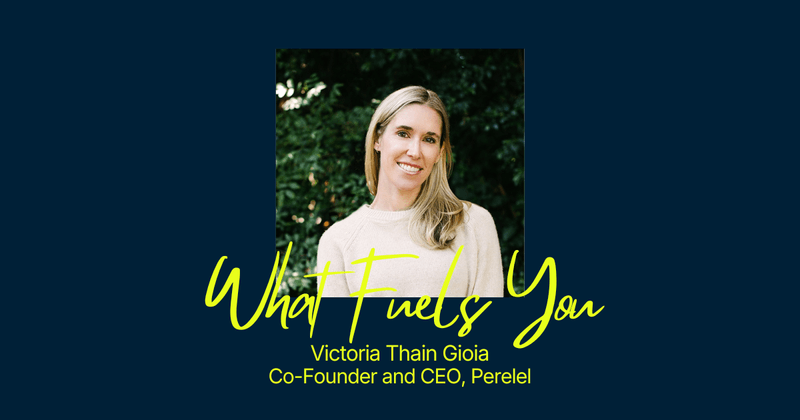
Victoria Thain Gioia Co-Founder and CEO of Perelel
A 20-week ultrasound in 2018 changed the direction of Victoria Thain Gioia's career. Her daughter Imogen was diagnosed in utero with a cleft lip, a condition strongly linked to nutritional deficiency during pregnancy, despite the fact that Victoria had been doing everything she was told to do. What she found when she went looking for answers was not reassurance but an industry without clinical rigor, consistent ingredient standards, or meaningful regulation. The supplement category had placed the full burden of research on the pregnant woman herself, and it had failed her.
In this episode of What Fuels You, host Shauna Swerland sits down with Victoria Thain Gioia, co-founder and CEO of Perelel, the first OB-GYN-founded supplement company for women, for a conversation covering a Duke and Harvard-trained finance career that pivoted into consumer brands, the founding of Perelel in the middle of a global pandemic, a $27 million growth round from Prelude Growth Partners in 2025, and what it looks like to build a mission-driven company of 35 people who are all women. The throughline is a conviction Victoria has held since that ultrasound room: women deserve supplements designed around their actual biology, not around the convenience of manufacturers who have been getting away with a one-size-fits-all model for decades.
📋 Episode Chapters
| 00:00 | Rapid fire: checking her phone at 5 AM, Shopify and Slack as essential apps, a Korea beauty trip for her 40th, and NSYNC with her dad as her first concert |
| 05:00 | Victoria's own supplement routine: collagen, lactoferrin for immunity, electrolytes, and magnesium before bed, and why she built Perelel around the problem she was personally living |
| 10:00 | Growing up in Rye, New York as the third of four siblings, studying math at Duke, and the on-campus recruiting pipeline into investment banking |
| 15:00 | What investment banking actually teaches you about running a profitable business, and why the two-year analyst program still shows up in how Victoria models growth today |
| 19:00 | Harvard Business School, meeting her husband, and why she wanted to move from finance into consumer brands right as D2C companies were exploding in 2013 |
| 23:00 | What Carbon38, The Honest Company, and Olive and June each taught her about business model, brand trust, and how fast consumer credibility can erode when expectations go unmet |
| 28:00 | A private equity partner who told her in a job interview he would hire a man over her because she would probably go the mommy track, and what she has built in response |
| 31:00 | The 20-week ultrasound that changed everything: Imogen's cleft lip diagnosis, the research rabbit hole on prenatal nutrition and ingredient quality, and the conversation with Dr. Banafsheh Bayati that started Perelel |
| 36:00 | Launching in September 2020 with no funding after COVID made fundraising impossible, answering every customer service ticket herself for the first year and a half, and the angel round in early 2021 |
| 40:00 | Go-to-market in a world that was shut down: gifting, select influencers who were pregnant and could tell the story, press hits, and building a full-funnel growth engine with a chief growth officer from Netflix |
| 43:00 | Hiring philosophy at a company where key team leads came from cold outreach emails, including the VP of strategy who wrote a Duke-network note and the COO who responded to an online group post |
| 46:00 | The $27 million Prelude Growth Partners investment, giving early angel investors a return, and what the next chapter of Perelel looks like as the brand moves beyond prenatal into full lifecycle women's health |
| 44:00 | What fuels Victoria: her four kids, her daughters specifically, and the world she wants them to grow up in |
The Ultrasound Room, a Cleft Lip Diagnosis, and the Rabbit Hole That Started a Company
Victoria Thain Gioia has four children: Finn, Imogen, Pippa, and Lachlan, born between 2016 and 2023. She describes the 20-week scan with her second child, Imogen, the way people describe moments they carry for years. She and her husband were in the room. The ultrasound technician was doing the scan, making small talk, and then went quiet. Her husband was cracking jokes, which he always does. The technician stopped responding. Then she stopped the exam. Victoria and her husband asked if they were all done. She said she was going to have to get the doctor.
What the doctor found was a cleft lip. He walked them through what that meant and the critical fork: clefts can be genetic and connected to more complicated underlying risks, or they can be situational, linked to the environment and nutrition during a specific window of fetal development. They would need genetic testing and amnio to know which. A six-week waiting period followed. Victoria went into every corner of the internet she could find. She researched the genetic side, steroids, environmental risk factors. Then she landed on prenatal nutrition and could not get back out.
"I just couldn't get out of my head a lot of the things I was learning about, like the prenatal vitamins and this category where you put so much trust."
-- Victoria Thain Gioia
What she found was a near-complete absence of regulation: no consistent ingredient standards, no transparency about where products were manufactured or the quality of their contents. Her fertility doctor had handed her a printout of supplements she should take. She had to research which brands to buy and guess at what to prioritize. Imogen's cleft lip appeared very likely to be linked to a nutritional deficiency, despite the fact that Victoria had been doing everything she had been told to do. She brought the idea to her OB-GYN, Dr. Banafsheh Bayati, who said she saw exactly the same problem in her practice every day and had no single product she could reliably recommend to patients. That conversation became Perelel.
From Duke Math to Investment Banking to Consumer, by Way of Harvard and a Deliberate Pivot
Victoria grew up in Rye, New York, the third of four siblings, two boys and two girls. Her father worked in finance. She studied math at Duke, graduated, and went through the on-campus recruiting pipeline that feeds naturally into New York financial services. She did a junior banking program as a sophomore and went again as a junior. She graduated into investment banking and then private equity, with a consumer skew from the start. She had interned in women's merchandising at J.Crew. She was always drawn to consumer brands and what drove behavior in the market.
She went to Harvard Business School partly to make a deliberate career shift into consumer, and partly because the firms she worked at placed significant value on the credential. She met her husband there. The year was 2013, and the D2C consumer wave was building in real time. Companies were finding new ways to reach customers directly, packaging a better-for-you message, and building brand trust from the ground up. She came out of business school looking for companies exactly like that.
"The foundation was from banking, but I feel like a lot of today, as the company scales and there's more people, you're dealing with people and strategy and dynamics. And I think that has really been from my business school experience."
-- Victoria Thain Gioia
She went to Carbon38, which was building an athleisure marketplace with very little funding and ahead of the broader trend. She learned how to build buzz without a budget and how to think rigorously about business model and margin. She went to The Honest Company, which had just completed a large fundraise at a very high valuation in a moment when consumer companies were being valued like tech companies. She saw how fast brand trust could be built, and how quickly it could erode when expectations were not met. She went to Olive and June, which showed her what a female-first culture could actually look like when it was built with intention. Three companies in rapid succession, each at a different stage, each teaching her something she would carry into Perelel.
A "Mommy Track" Comment in a Job Interview, and 35 Women Who Proved the Point
When Victoria was interviewing for jobs after Harvard Business School, a partner at a private equity fund told her in the interview itself that he would hire a man over her because she would probably go the mommy track. She was floored: both by the fact that it was said at all, and by how clearly believed it was. She did not take that job. She went on to have four children while building one of the fastest-growing women's health companies in the country. Thirty-five employees, all women.
"We created this company to support women and we wanted to create this company, we had our mission statement of like to create a world with more healthy, supported women, but that had to be internal too."
-- Victoria Thain Gioia
The operating principle is straightforward: trust responsible adults to get the work done. If someone on her team says her daughter is home sick, there is no question about working from home. The expectation is that the work gets done. The assumption is that it will be. Victoria describes the culture she has built as a direct response to every environment she worked in before Perelel: sharp-elbowed investment banking, ego-driven startup dynamics, and the girl boss era that she watched play out at consumer brands in the mid-2010s. None of it was what she wanted to replicate.
Her hiring philosophy is iterative and honest about its imperfections. Most of her team leads came from referrals or people she already knew. Two key exceptions arrived through cold outreach: her VP of strategy, who sent a Duke-network email when looking for an internship and has been with Perelel for four years, and her chief operating officer, who responded to a post Victoria made in an online group and has also been with the company for four and a half years. When a yellow flag appears in an interview, she says, it is almost always trying to tell you something.
Launching in a Pandemic With No Funding and an Answer to Every Customer Ticket
Victoria and her co-founders, Alex Taylor and Dr. Banafsheh Bayati, decided to launch Perelel in January 2020. They planned to fundraise in April to hire a team and build the business. COVID made that fundraise impossible. Victoria took out a loan, pulled together friends and family money, and cobbled together enough capital to launch in September 2020. She answered every customer service ticket herself for the first year and a half. She describes the instinct behind it simply: if she could do something herself, she was going to do it rather than outsource it or pay someone else.
The go-to-market in a world that was completely shut down leaned on gifting, a small number of influencers who were pregnant and could tell the story through their own experience, and press hits that built early credibility. Victoria describes an early moment when she and one employee were on a phone call trying to decide between two influencers by doing rough math with follower counts and engagement rates, because they had no tools and no budget for tools. The angel round came in early 2021. A chief growth officer who eventually joined from Netflix brought a rigorous full-funnel model to a company that had been building on instinct and scrappiness.
"I always had, and maybe this is 'cause I'm one of 4 kids and like all of that, like if I can do it, I'm just gonna do it versus hiring someone else or outsourcing it."
-- Victoria Thain Gioia
The Erewhon partnership illustrates how Perelel approaches retail. Rather than simply applying for shelf space, the company created two co-branded SKUs designed specifically in partnership with Erewhon, one for women and one for men. That joint brand halo gave both parties something to promote together at launch. Perelel subsequently became the number one prenatal brand on Erewhon's shelves. Across five years of operation, the company has achieved profitability and doubled revenue year over year, without running the growth-at-any-cost playbook Victoria watched from the inside at The Honest Company.
A $27 Million Round, a Return for Early Angels, and the Move Beyond Prenatal
In November 2025, Perelel announced a $27 million growth investment from Prelude Growth Partners, with participation from existing investors Unilever Ventures, Willow Growth Partners, and Selva Ventures. Victoria is careful to note on the episode that not all of that money went into the business. A meaningful portion was used to buy out early angel investors, giving them a return after years of support. She describes this as one of the most satisfying moments in the company's history.
Prelude Growth Partners was not a firm Perelel went looking for. They approached Perelel. The firm was co-founded by two women and has a portfolio that includes Sol de Janeiro, Tower28, Summer Fridays, and Blueland. Victoria describes the alignment as genuinely strategic: Prelude understood both the consumer and the category, had deep experience helping brands scale past their founding phase, and shared Perelel's conviction that women's health supplements should be built on clinical rigor rather than influencer reach.
"It's product and like refining what the products are, how we show up in the world, like becoming more of this women's health brand versus a prenatal brand and expanding our reach."
-- Victoria Thain Gioia
The next chapter is a deliberate expansion beyond the prenatal anchor into perimenopause, menopause, and all the hormonal stages in between. The founding insight, that women's nutritional needs change across their lives and that no single formula serves them all, applies just as directly to a 48-year-old managing perimenopause as it does to a woman in her first trimester. To lead the storytelling required to make that transition legible to consumers who know Perelel primarily through prenatal, the company recently hired a chief brand and creative officer. The duality of the brand, clinical rigor and genuine understanding of what women are actually going through, is what Victoria believes no competitor can replicate without having built the way Perelel has built.
5 Key Takeaways
Frequently Asked Questions
What is Perelel and who founded it?
Perelel is the first OB-GYN-founded supplement company for women, built to deliver doctor-formulated, research-backed vitamins designed for the specific nutritional needs of women at each stage of their hormonal journey, from preconception through perimenopause. It was co-founded in 2020 by Victoria Thain Gioia, Alex Taylor, and Dr. Banafsheh Bayati, a practicing OB-GYN who serves as medical co-founder and leads product formulation. The company launched in September 2020, has achieved profitability, and has doubled revenue year over year since then.
Why did Victoria Thain Gioia start Perelel?
Victoria Thain Gioia told Shauna Swerland on What Fuels You that the founding moment came during a 20-week ultrasound when she learned her daughter Imogen would be born with a cleft lip, a condition strongly linked to nutritional deficiency during pregnancy. Despite taking recommended prenatal vitamins, Victoria discovered through her research that the supplement category had almost no ingredient regulation, no consistent quality standards, and placed the full burden of research on the pregnant woman herself. She brought the idea to her OB-GYN, Dr. Banafsheh Bayati, who confirmed she saw the same problem in her practice and had no single product she could reliably recommend to patients.
What did Perelel raise and from whom?
In November 2025, Perelel announced a $27 million growth investment from Prelude Growth Partners, a consumer-focused growth equity firm co-founded by women with a portfolio that includes Sol de Janeiro, Tower28, Summer Fridays, and Blueland. The round also included participation from existing investors Unilever Ventures, Willow Growth Partners, and Selva Ventures. Victoria Thain Gioia noted on What Fuels You that a significant portion of the raise was used to deliver a return to early angel investors rather than going entirely into the business.
How does Perelel maintain product credibility in an unregulated supplement market?
Victoria Thain Gioia explained on What Fuels You that Perelel's medical co-founder, Dr. Banafsheh Bayati, serves as a hard stop on anything without clinical backing, whether it is a product formulation, a piece of content, or a marketing claim. Victoria says the standard has become self-enforcing: the team does not bring things to Dr. Bayati that would not survive her review. She describes knowing what you say no to as one of the most important decisions a brand can make in a supplement category crowded with influencer-driven claims that are not backed by science.
What is Victoria Thain Gioia's view on building a female-first company culture?
On What Fuels You, Victoria described building Perelel's culture as a direct response to every environment she worked in before founding the company, including sharp-elbowed investment banking, ego-driven startup dynamics, and a private equity interview in which a partner told her he would hire a man over her because she would probably go the mommy track. Perelel's 35 employees are all women. The operating principle, she says, is trusting responsible adults to get the work done, so that if someone's child is home sick there is no question about working from home. She describes the mission to create a world with more healthy, supported women as something that had to be lived internally before it could be credibly communicated externally.
Victoria Thain Gioia Co-Founder and CEO of Perelel
A 20-week ultrasound in 2018 changed the direction of Victoria Thain Gioia's career. Her daughter Imogen was diagnosed in utero with a cleft lip, a condition strongly linked to nutritional deficiency during pregnancy, despite the fact that Victoria had been doing everything she was told to do. What she found when she went looking for answers was not reassurance but an industry without clinical rigor, consistent ingredient standards, or meaningful regulation. The supplement category had placed the full burden of research on the pregnant woman herself, and it had failed her.
In this episode of What Fuels You, host Shauna Swerland sits down with Victoria Thain Gioia, co-founder and CEO of Perelel, the first OB-GYN-founded supplement company for women, for a conversation covering a Duke and Harvard-trained finance career that pivoted into consumer brands, the founding of Perelel in the middle of a global pandemic, a $27 million growth round from Prelude Growth Partners in 2025, and what it looks like to build a mission-driven company of 35 people who are all women. The throughline is a conviction Victoria has held since that ultrasound room: women deserve supplements designed around their actual biology, not around the convenience of manufacturers who have been getting away with a one-size-fits-all model for decades.
📋 Episode Chapters
| 00:00 | Rapid fire: checking her phone at 5 AM, Shopify and Slack as essential apps, a Korea beauty trip for her 40th, and NSYNC with her dad as her first concert |
| 05:00 | Victoria's own supplement routine: collagen, lactoferrin for immunity, electrolytes, and magnesium before bed, and why she built Perelel around the problem she was personally living |
| 10:00 | Growing up in Rye, New York as the third of four siblings, studying math at Duke, and the on-campus recruiting pipeline into investment banking |
| 15:00 | What investment banking actually teaches you about running a profitable business, and why the two-year analyst program still shows up in how Victoria models growth today |
| 19:00 | Harvard Business School, meeting her husband, and why she wanted to move from finance into consumer brands right as D2C companies were exploding in 2013 |
| 23:00 | What Carbon38, The Honest Company, and Olive and June each taught her about business model, brand trust, and how fast consumer credibility can erode when expectations go unmet |
| 28:00 | A private equity partner who told her in a job interview he would hire a man over her because she would probably go the mommy track, and what she has built in response |
| 31:00 | The 20-week ultrasound that changed everything: Imogen's cleft lip diagnosis, the research rabbit hole on prenatal nutrition and ingredient quality, and the conversation with Dr. Banafsheh Bayati that started Perelel |
| 36:00 | Launching in September 2020 with no funding after COVID made fundraising impossible, answering every customer service ticket herself for the first year and a half, and the angel round in early 2021 |
| 40:00 | Go-to-market in a world that was shut down: gifting, select influencers who were pregnant and could tell the story, press hits, and building a full-funnel growth engine with a chief growth officer from Netflix |
| 43:00 | Hiring philosophy at a company where key team leads came from cold outreach emails, including the VP of strategy who wrote a Duke-network note and the COO who responded to an online group post |
| 46:00 | The $27 million Prelude Growth Partners investment, giving early angel investors a return, and what the next chapter of Perelel looks like as the brand moves beyond prenatal into full lifecycle women's health |
| 44:00 | What fuels Victoria: her four kids, her daughters specifically, and the world she wants them to grow up in |
The Ultrasound Room, a Cleft Lip Diagnosis, and the Rabbit Hole That Started a Company
Victoria Thain Gioia has four children: Finn, Imogen, Pippa, and Lachlan, born between 2016 and 2023. She describes the 20-week scan with her second child, Imogen, the way people describe moments they carry for years. She and her husband were in the room. The ultrasound technician was doing the scan, making small talk, and then went quiet. Her husband was cracking jokes, which he always does. The technician stopped responding. Then she stopped the exam. Victoria and her husband asked if they were all done. She said she was going to have to get the doctor.
What the doctor found was a cleft lip. He walked them through what that meant and the critical fork: clefts can be genetic and connected to more complicated underlying risks, or they can be situational, linked to the environment and nutrition during a specific window of fetal development. They would need genetic testing and amnio to know which. A six-week waiting period followed. Victoria went into every corner of the internet she could find. She researched the genetic side, steroids, environmental risk factors. Then she landed on prenatal nutrition and could not get back out.
"I just couldn't get out of my head a lot of the things I was learning about, like the prenatal vitamins and this category where you put so much trust."
-- Victoria Thain Gioia
What she found was a near-complete absence of regulation: no consistent ingredient standards, no transparency about where products were manufactured or the quality of their contents. Her fertility doctor had handed her a printout of supplements she should take. She had to research which brands to buy and guess at what to prioritize. Imogen's cleft lip appeared very likely to be linked to a nutritional deficiency, despite the fact that Victoria had been doing everything she had been told to do. She brought the idea to her OB-GYN, Dr. Banafsheh Bayati, who said she saw exactly the same problem in her practice every day and had no single product she could reliably recommend to patients. That conversation became Perelel.
From Duke Math to Investment Banking to Consumer, by Way of Harvard and a Deliberate Pivot
Victoria grew up in Rye, New York, the third of four siblings, two boys and two girls. Her father worked in finance. She studied math at Duke, graduated, and went through the on-campus recruiting pipeline that feeds naturally into New York financial services. She did a junior banking program as a sophomore and went again as a junior. She graduated into investment banking and then private equity, with a consumer skew from the start. She had interned in women's merchandising at J.Crew. She was always drawn to consumer brands and what drove behavior in the market.
She went to Harvard Business School partly to make a deliberate career shift into consumer, and partly because the firms she worked at placed significant value on the credential. She met her husband there. The year was 2013, and the D2C consumer wave was building in real time. Companies were finding new ways to reach customers directly, packaging a better-for-you message, and building brand trust from the ground up. She came out of business school looking for companies exactly like that.
"The foundation was from banking, but I feel like a lot of today, as the company scales and there's more people, you're dealing with people and strategy and dynamics. And I think that has really been from my business school experience."
-- Victoria Thain Gioia
She went to Carbon38, which was building an athleisure marketplace with very little funding and ahead of the broader trend. She learned how to build buzz without a budget and how to think rigorously about business model and margin. She went to The Honest Company, which had just completed a large fundraise at a very high valuation in a moment when consumer companies were being valued like tech companies. She saw how fast brand trust could be built, and how quickly it could erode when expectations were not met. She went to Olive and June, which showed her what a female-first culture could actually look like when it was built with intention. Three companies in rapid succession, each at a different stage, each teaching her something she would carry into Perelel.
A "Mommy Track" Comment in a Job Interview, and 35 Women Who Proved the Point
When Victoria was interviewing for jobs after Harvard Business School, a partner at a private equity fund told her in the interview itself that he would hire a man over her because she would probably go the mommy track. She was floored: both by the fact that it was said at all, and by how clearly believed it was. She did not take that job. She went on to have four children while building one of the fastest-growing women's health companies in the country. Thirty-five employees, all women.
"We created this company to support women and we wanted to create this company, we had our mission statement of like to create a world with more healthy, supported women, but that had to be internal too."
-- Victoria Thain Gioia
The operating principle is straightforward: trust responsible adults to get the work done. If someone on her team says her daughter is home sick, there is no question about working from home. The expectation is that the work gets done. The assumption is that it will be. Victoria describes the culture she has built as a direct response to every environment she worked in before Perelel: sharp-elbowed investment banking, ego-driven startup dynamics, and the girl boss era that she watched play out at consumer brands in the mid-2010s. None of it was what she wanted to replicate.
Her hiring philosophy is iterative and honest about its imperfections. Most of her team leads came from referrals or people she already knew. Two key exceptions arrived through cold outreach: her VP of strategy, who sent a Duke-network email when looking for an internship and has been with Perelel for four years, and her chief operating officer, who responded to a post Victoria made in an online group and has also been with the company for four and a half years. When a yellow flag appears in an interview, she says, it is almost always trying to tell you something.
Launching in a Pandemic With No Funding and an Answer to Every Customer Ticket
Victoria and her co-founders, Alex Taylor and Dr. Banafsheh Bayati, decided to launch Perelel in January 2020. They planned to fundraise in April to hire a team and build the business. COVID made that fundraise impossible. Victoria took out a loan, pulled together friends and family money, and cobbled together enough capital to launch in September 2020. She answered every customer service ticket herself for the first year and a half. She describes the instinct behind it simply: if she could do something herself, she was going to do it rather than outsource it or pay someone else.
The go-to-market in a world that was completely shut down leaned on gifting, a small number of influencers who were pregnant and could tell the story through their own experience, and press hits that built early credibility. Victoria describes an early moment when she and one employee were on a phone call trying to decide between two influencers by doing rough math with follower counts and engagement rates, because they had no tools and no budget for tools. The angel round came in early 2021. A chief growth officer who eventually joined from Netflix brought a rigorous full-funnel model to a company that had been building on instinct and scrappiness.
"I always had, and maybe this is 'cause I'm one of 4 kids and like all of that, like if I can do it, I'm just gonna do it versus hiring someone else or outsourcing it."
-- Victoria Thain Gioia
The Erewhon partnership illustrates how Perelel approaches retail. Rather than simply applying for shelf space, the company created two co-branded SKUs designed specifically in partnership with Erewhon, one for women and one for men. That joint brand halo gave both parties something to promote together at launch. Perelel subsequently became the number one prenatal brand on Erewhon's shelves. Across five years of operation, the company has achieved profitability and doubled revenue year over year, without running the growth-at-any-cost playbook Victoria watched from the inside at The Honest Company.
A $27 Million Round, a Return for Early Angels, and the Move Beyond Prenatal
In November 2025, Perelel announced a $27 million growth investment from Prelude Growth Partners, with participation from existing investors Unilever Ventures, Willow Growth Partners, and Selva Ventures. Victoria is careful to note on the episode that not all of that money went into the business. A meaningful portion was used to buy out early angel investors, giving them a return after years of support. She describes this as one of the most satisfying moments in the company's history.
Prelude Growth Partners was not a firm Perelel went looking for. They approached Perelel. The firm was co-founded by two women and has a portfolio that includes Sol de Janeiro, Tower28, Summer Fridays, and Blueland. Victoria describes the alignment as genuinely strategic: Prelude understood both the consumer and the category, had deep experience helping brands scale past their founding phase, and shared Perelel's conviction that women's health supplements should be built on clinical rigor rather than influencer reach.
"It's product and like refining what the products are, how we show up in the world, like becoming more of this women's health brand versus a prenatal brand and expanding our reach."
-- Victoria Thain Gioia
The next chapter is a deliberate expansion beyond the prenatal anchor into perimenopause, menopause, and all the hormonal stages in between. The founding insight, that women's nutritional needs change across their lives and that no single formula serves them all, applies just as directly to a 48-year-old managing perimenopause as it does to a woman in her first trimester. To lead the storytelling required to make that transition legible to consumers who know Perelel primarily through prenatal, the company recently hired a chief brand and creative officer. The duality of the brand, clinical rigor and genuine understanding of what women are actually going through, is what Victoria believes no competitor can replicate without having built the way Perelel has built.
5 Key Takeaways
Frequently Asked Questions
What is Perelel and who founded it?
Perelel is the first OB-GYN-founded supplement company for women, built to deliver doctor-formulated, research-backed vitamins designed for the specific nutritional needs of women at each stage of their hormonal journey, from preconception through perimenopause. It was co-founded in 2020 by Victoria Thain Gioia, Alex Taylor, and Dr. Banafsheh Bayati, a practicing OB-GYN who serves as medical co-founder and leads product formulation. The company launched in September 2020, has achieved profitability, and has doubled revenue year over year since then.
Why did Victoria Thain Gioia start Perelel?
Victoria Thain Gioia told Shauna Swerland on What Fuels You that the founding moment came during a 20-week ultrasound when she learned her daughter Imogen would be born with a cleft lip, a condition strongly linked to nutritional deficiency during pregnancy. Despite taking recommended prenatal vitamins, Victoria discovered through her research that the supplement category had almost no ingredient regulation, no consistent quality standards, and placed the full burden of research on the pregnant woman herself. She brought the idea to her OB-GYN, Dr. Banafsheh Bayati, who confirmed she saw the same problem in her practice and had no single product she could reliably recommend to patients.
What did Perelel raise and from whom?
In November 2025, Perelel announced a $27 million growth investment from Prelude Growth Partners, a consumer-focused growth equity firm co-founded by women with a portfolio that includes Sol de Janeiro, Tower28, Summer Fridays, and Blueland. The round also included participation from existing investors Unilever Ventures, Willow Growth Partners, and Selva Ventures. Victoria Thain Gioia noted on What Fuels You that a significant portion of the raise was used to deliver a return to early angel investors rather than going entirely into the business.
How does Perelel maintain product credibility in an unregulated supplement market?
Victoria Thain Gioia explained on What Fuels You that Perelel's medical co-founder, Dr. Banafsheh Bayati, serves as a hard stop on anything without clinical backing, whether it is a product formulation, a piece of content, or a marketing claim. Victoria says the standard has become self-enforcing: the team does not bring things to Dr. Bayati that would not survive her review. She describes knowing what you say no to as one of the most important decisions a brand can make in a supplement category crowded with influencer-driven claims that are not backed by science.
What is Victoria Thain Gioia's view on building a female-first company culture?
On What Fuels You, Victoria described building Perelel's culture as a direct response to every environment she worked in before founding the company, including sharp-elbowed investment banking, ego-driven startup dynamics, and a private equity interview in which a partner told her he would hire a man over her because she would probably go the mommy track. Perelel's 35 employees are all women. The operating principle, she says, is trusting responsible adults to get the work done, so that if someone's child is home sick there is no question about working from home. She describes the mission to create a world with more healthy, supported women as something that had to be lived internally before it could be credibly communicated externally.