

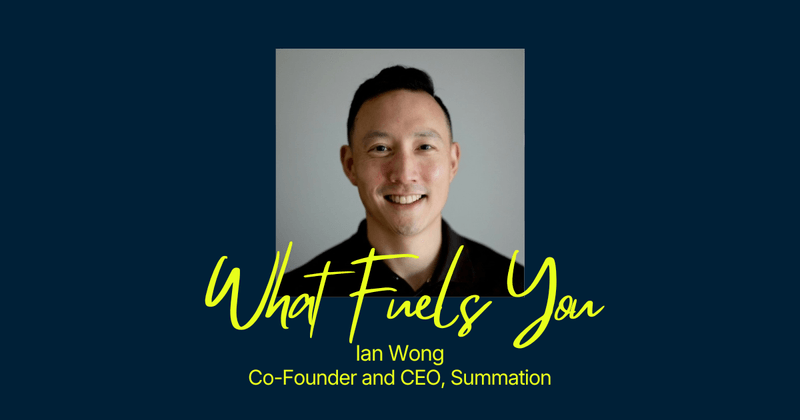
Ian Wong, Co-Founder and CEO of Summation
Every job has a skill bar you can write down on a rubric: coding ability, algorithms, whatever the technical basics happen to be. What can't be assessed on a form is whether someone actually wants it badly enough to grind through the stretches where nothing is working.
In this episode of What Fuels You, host Shauna Swerland sits down with Ian Wong, co-founder and CEO of Summation, for a conversation that traces his path from Hong Kong and Vancouver to Stanford, Square, Opendoor, and now the AI analyst company he built to fix a problem that used to keep him up at night as a CTO. Across every hiring decision he's made, from Square to Opendoor to Summation, Wong keeps coming back to the same idea: skill gets you in the room, but will is what actually separates people.
📋 Episode Chapters
| 00:00 | Cold open: culture as "setting yourself up to win" |
| 01:15 | Introducing Ian Wong: Square, Opendoor, and now Summation |
| 03:00 | Rapid fire: morning walks in Bellevue and the Cantonese saying that keeps him grounded |
| 07:00 | Growing up in Hong Kong before the 1997 handover, then Vancouver |
| 14:00 | A mentor, financial aid, and getting into Stanford |
| 16:00 | "There are levels to this game": the physics class that humbled him |
| 19:00 | Switching from physics to statistics and interning on Facebook's data science team |
| 22:00 | Pitching himself to Keith Rabois on Quora, Jack Dorsey's unusual interview question, and why "the X factor is almost always will" |
| 29:00 | Leaving Square to co-found Opendoor with Keith Rabois, Eric Wu, and JD Ross |
| 33:00 | Scaling Opendoor to $10 billion in revenue, going public, and the mailers that saved growth |
| 41:00 | The "Monday morning problem" that led him to start Summation |
| 46:00 | Naming Summation, raising from Benchmark and Kleiner, and hiring a 35-person team |
| 52:00 | Barrel versus ammunition, leadership feedback, and what fuels Ian Wong now |
Early Resilience: Growing Up Between Hong Kong and Vancouver
Ian Wong spent his early years in Hong Kong during its boom years in the late 1980s and early 1990s, when the city accounted for roughly a quarter of China's GDP. His family left around 1997, when Hong Kong was handed back to China, and settled in Richmond, a suburb of Vancouver known for its friendly immigration policies. Wong was ten, old enough to feel the contrast between a dense, bustling city and a quiet Canadian suburb where, as he puts it, there wasn't very much there.
The adjustment had its rough edges. He was still improving his English when he arrived, and by his own account, fifth graders were not the warmest crowd. But he describes the period just as plainly as a good one: solid schools, a strong support network, kids being kids. His father, who had worked in import and export, passed away around the time the family moved to Canada, and his mother, previously a flight stewardess, raised Wong and his two younger brothers.
"I learned resilience very quickly that way."
-- Ian Wong
His mother went on to attend college in Canada herself, something no one else in the family had done. Wong describes the period matter-of-factly, as simply what it took to get established in a new country. It's a thread he returns to near the end of the episode when he talks about what fuels him now that he has kids of his own.
"There Are Levels to This Game": Stanford and the Facebook Internship
Wong got into Stanford with no family precedent, largely because a friend's summer test-prep plans pulled him along almost by accident. That path led him to a retired University of British Columbia physics professor, Dr. Sun, who taught him to derive equations from scratch instead of memorizing formulas from a worksheet.
Arriving at Stanford confident in his physics background, Wong got an early lesson in scale. In his first honors physics class, he noticed several classmates already knew each other, and it turned out they had met competing at the International Physics Olympiad.
"There are levels to this game. Like, there are levels."
-- Ian Wong
He majored in electrical engineering, then realized junior year that what he actually loved was the math behind physics and engineering, not the fields themselves. That pulled him into a master's and PhD program in statistics, and eventually an internship on Facebook's 14-person data science team, back when the company had about 1,600 employees. It was there, counting happy-emoji volume across petabytes of data instead of running traditional statistical inference, that he decided to leave his PhD for industry.
The X Factor Is Almost Always Will
Wong's own path into Square did not run through a recruiter. As a bored graduate student, he had been answering statistics questions on Quora. That led to an invite to a power-user party, where he met Keith Rabois without knowing who he was. After a few beers, Wong told Rabois he was dropping out of grad school and asked directly if Rabois had a job for him. Rabois emailed him that same night, and the interviews that followed, first with Rabois, then with Jack Dorsey, stuck with him for very different reasons. Rabois asked concrete, algorithmic questions. Dorsey opened with something else entirely: what would you do if you knew about every single transaction in the world?
That experience, and the hundreds of interviews Wong has run since across Square, Opendoor, and Summation, distilled into a hiring philosophy he comes back to again and again on the episode.
"There is very crudely like skill and will, right? And skill, you need to have a basic bar that you need to pass. But the X factor is almost always will, right? Like, how hungry are you? And do you really want it?"
-- Ian Wong
Wong joined Square when the company was around 40 to 50 people, roughly nine months after launch, as its first data scientist, tasked with building fraud detection algorithms for a company that barely had any fraud cases yet to learn from. Skill got him in the door. What he argues actually separated the people who lasted through the harder years was something no rubric measures.
Building Opendoor to a $10 Billion Business
In 2014, Wong left Square to co-found Opendoor alongside Rabois, Eric Wu, and JD Ross. The founding insight, which Wong credits to Rabois and Wu, was that real estate was a massive market where the transaction experience was uniquely miserable: 90 days of stress for sellers, often longer for buyers, in an era when almost every other kind of transaction had gotten faster.
Opendoor's model let homeowners get a same-day offer on their house and close within days, with the company buying the home, collecting a fee, and generating margin largely through the title, escrow, and service layer around the transaction.
"The peak was doing over $10 billion of revenue. It was like pretty substantial business. We took it public."
-- Ian Wong
Growth was not automatic. Wong recalled a stretch where he had convinced engineers to leave companies like Google and Apple to join Opendoor, only to hit a period with no growth traction. The company's first real lock came from an unglamorous channel: because Opendoor knew exactly where homeowners lived, direct mail worked. From there, the company scaled to a few thousand employees against a real estate market Wong describes as brutally low-margin and competitive, with Zillow, Redfin, and Offerpad all attempting versions of the same iBuying model.
The Monday Morning Problem Behind Summation
Wong traces the idea for Summation back to a recurring pattern from his nine years at Opendoor, one he calls the Monday morning problem. Every Monday, the executive leadership team, including the CEO and CFO, would review the prior week's scorecard. A red metric would prompt a chain of "why" questions that analysts had spent the entire weekend preparing for, and even then, the team would exhaust the obvious hypotheses within the first fifteen minutes.
"I call this the Monday morning problem because like that's when everything starts to kind of fall apart for me."
-- Ian Wong
As Opendoor's CTO, Wong found it embarrassing that despite overseeing the company's data infrastructure, he could not get a full answer at the exact moment leadership needed one. Summation, which he co-founded with Ramachandran Ramarathinam, known as RC, deploys teams of AI analysts to help operations and finance leaders diagnose complex businesses in something closer to real time. Wong is direct about why he thinks the category will grow rather than shrink the analyst function.
"The dawn of spreadsheets did not eliminate accountants. If anything, it created more accountants."
-- Ian Wong
It took roughly a hundred emails over three months just to buy the domain summation.com, a detail Wong attributes to an early investor's one piece of advice: pick whatever name works, as long as the .com is available.
Barrel Versus Ammunition: How Ian Wong Hires and What Fuels Him
Asked how his hiring priorities differ at Summation's current stage, roughly 35 people, mostly based in Bellevue with teams in India and New York, Wong reaches for a metaphor he credits to his co-founder, RC (Ramachandran Ramarathinam), one that extends the same skill-versus-will logic to a company at a specific stage of growth.
"It's basically a gun, right? Like more ammunition doesn't let you shoot faster. Right? You actually need more barrels, like people who can solve problems 0 to 1."
-- Ian Wong
Wong also names his own operating weakness without much hedging: a tendency to dive deep into details, which past teams have read as a lack of trust or autonomy. He has come to see it as a matter of setting expectations rather than a flaw to fix, saying he has learned to build systems around his strengths instead of trying to patch his weaknesses. Asked what fuels him now, his answer is short and unguarded: his kids, and the resilience he learned watching his mother raise the family after their move to Canada.
5 Key Takeaways
Frequently Asked Questions
What does Ian Wong mean when he says "the X factor is almost always will"?
Ian Wong uses this to describe what separates candidates who pass a basic skill bar, whether that's coding ability or another technical baseline, from the ones who actually succeed long term. He says the deciding factor is will: how hungry someone is and whether they genuinely want the job, not just their technical qualifications.
What is Summation and what does it do?
Summation is the AI analyst company co-founded and led by Ian Wong. On the show, Wong described it as deploying teams of AI analysts to support operationally complex businesses, working with operations and finance leaders who don't have enough human analysts to fully diagnose their own numbers.
What is the "Monday morning problem" Ian Wong describes?
It's Wong's name for a recurring struggle from his time as Opendoor's CTO: weekly executive leadership meetings where a red metric would prompt endless "why" questions that a full weekend of analyst prep still couldn't fully answer. He built Summation to close that exact gap.
How did Ian Wong get his job at Square?
Wong met Keith Rabois at a Quora power-user party while he was a bored graduate student answering statistics questions on the site. He told Rabois he was dropping out of his PhD program and directly asked if there was a job for him. Rabois emailed him that same night to invite him to Square's office.
What was Ian Wong's role at Opendoor?
Wong co-founded Opendoor in 2014 with Keith Rabois, Eric Wu, and JD Ross, and served as chief technology officer. He said the company scaled to a few thousand employees and hit over $10 billion in revenue at its peak before going public.
Ian Wong, Co-Founder and CEO of Summation
Every job has a skill bar you can write down on a rubric: coding ability, algorithms, whatever the technical basics happen to be. What can't be assessed on a form is whether someone actually wants it badly enough to grind through the stretches where nothing is working.
In this episode of What Fuels You, host Shauna Swerland sits down with Ian Wong, co-founder and CEO of Summation, for a conversation that traces his path from Hong Kong and Vancouver to Stanford, Square, Opendoor, and now the AI analyst company he built to fix a problem that used to keep him up at night as a CTO. Across every hiring decision he's made, from Square to Opendoor to Summation, Wong keeps coming back to the same idea: skill gets you in the room, but will is what actually separates people.
📋 Episode Chapters
| 00:00 | Cold open: culture as "setting yourself up to win" |
| 01:15 | Introducing Ian Wong: Square, Opendoor, and now Summation |
| 03:00 | Rapid fire: morning walks in Bellevue and the Cantonese saying that keeps him grounded |
| 07:00 | Growing up in Hong Kong before the 1997 handover, then Vancouver |
| 14:00 | A mentor, financial aid, and getting into Stanford |
| 16:00 | "There are levels to this game": the physics class that humbled him |
| 19:00 | Switching from physics to statistics and interning on Facebook's data science team |
| 22:00 | Pitching himself to Keith Rabois on Quora, Jack Dorsey's unusual interview question, and why "the X factor is almost always will" |
| 29:00 | Leaving Square to co-found Opendoor with Keith Rabois, Eric Wu, and JD Ross |
| 33:00 | Scaling Opendoor to $10 billion in revenue, going public, and the mailers that saved growth |
| 41:00 | The "Monday morning problem" that led him to start Summation |
| 46:00 | Naming Summation, raising from Benchmark and Kleiner, and hiring a 35-person team |
| 52:00 | Barrel versus ammunition, leadership feedback, and what fuels Ian Wong now |
Early Resilience: Growing Up Between Hong Kong and Vancouver
Ian Wong spent his early years in Hong Kong during its boom years in the late 1980s and early 1990s, when the city accounted for roughly a quarter of China's GDP. His family left around 1997, when Hong Kong was handed back to China, and settled in Richmond, a suburb of Vancouver known for its friendly immigration policies. Wong was ten, old enough to feel the contrast between a dense, bustling city and a quiet Canadian suburb where, as he puts it, there wasn't very much there.
The adjustment had its rough edges. He was still improving his English when he arrived, and by his own account, fifth graders were not the warmest crowd. But he describes the period just as plainly as a good one: solid schools, a strong support network, kids being kids. His father, who had worked in import and export, passed away around the time the family moved to Canada, and his mother, previously a flight stewardess, raised Wong and his two younger brothers.
"I learned resilience very quickly that way."
-- Ian Wong
His mother went on to attend college in Canada herself, something no one else in the family had done. Wong describes the period matter-of-factly, as simply what it took to get established in a new country. It's a thread he returns to near the end of the episode when he talks about what fuels him now that he has kids of his own.
"There Are Levels to This Game": Stanford and the Facebook Internship
Wong got into Stanford with no family precedent, largely because a friend's summer test-prep plans pulled him along almost by accident. That path led him to a retired University of British Columbia physics professor, Dr. Sun, who taught him to derive equations from scratch instead of memorizing formulas from a worksheet.
Arriving at Stanford confident in his physics background, Wong got an early lesson in scale. In his first honors physics class, he noticed several classmates already knew each other, and it turned out they had met competing at the International Physics Olympiad.
"There are levels to this game. Like, there are levels."
-- Ian Wong
He majored in electrical engineering, then realized junior year that what he actually loved was the math behind physics and engineering, not the fields themselves. That pulled him into a master's and PhD program in statistics, and eventually an internship on Facebook's 14-person data science team, back when the company had about 1,600 employees. It was there, counting happy-emoji volume across petabytes of data instead of running traditional statistical inference, that he decided to leave his PhD for industry.
The X Factor Is Almost Always Will
Wong's own path into Square did not run through a recruiter. As a bored graduate student, he had been answering statistics questions on Quora. That led to an invite to a power-user party, where he met Keith Rabois without knowing who he was. After a few beers, Wong told Rabois he was dropping out of grad school and asked directly if Rabois had a job for him. Rabois emailed him that same night, and the interviews that followed, first with Rabois, then with Jack Dorsey, stuck with him for very different reasons. Rabois asked concrete, algorithmic questions. Dorsey opened with something else entirely: what would you do if you knew about every single transaction in the world?
That experience, and the hundreds of interviews Wong has run since across Square, Opendoor, and Summation, distilled into a hiring philosophy he comes back to again and again on the episode.
"There is very crudely like skill and will, right? And skill, you need to have a basic bar that you need to pass. But the X factor is almost always will, right? Like, how hungry are you? And do you really want it?"
-- Ian Wong
Wong joined Square when the company was around 40 to 50 people, roughly nine months after launch, as its first data scientist, tasked with building fraud detection algorithms for a company that barely had any fraud cases yet to learn from. Skill got him in the door. What he argues actually separated the people who lasted through the harder years was something no rubric measures.
Building Opendoor to a $10 Billion Business
In 2014, Wong left Square to co-found Opendoor alongside Rabois, Eric Wu, and JD Ross. The founding insight, which Wong credits to Rabois and Wu, was that real estate was a massive market where the transaction experience was uniquely miserable: 90 days of stress for sellers, often longer for buyers, in an era when almost every other kind of transaction had gotten faster.
Opendoor's model let homeowners get a same-day offer on their house and close within days, with the company buying the home, collecting a fee, and generating margin largely through the title, escrow, and service layer around the transaction.
"The peak was doing over $10 billion of revenue. It was like pretty substantial business. We took it public."
-- Ian Wong
Growth was not automatic. Wong recalled a stretch where he had convinced engineers to leave companies like Google and Apple to join Opendoor, only to hit a period with no growth traction. The company's first real lock came from an unglamorous channel: because Opendoor knew exactly where homeowners lived, direct mail worked. From there, the company scaled to a few thousand employees against a real estate market Wong describes as brutally low-margin and competitive, with Zillow, Redfin, and Offerpad all attempting versions of the same iBuying model.
The Monday Morning Problem Behind Summation
Wong traces the idea for Summation back to a recurring pattern from his nine years at Opendoor, one he calls the Monday morning problem. Every Monday, the executive leadership team, including the CEO and CFO, would review the prior week's scorecard. A red metric would prompt a chain of "why" questions that analysts had spent the entire weekend preparing for, and even then, the team would exhaust the obvious hypotheses within the first fifteen minutes.
"I call this the Monday morning problem because like that's when everything starts to kind of fall apart for me."
-- Ian Wong
As Opendoor's CTO, Wong found it embarrassing that despite overseeing the company's data infrastructure, he could not get a full answer at the exact moment leadership needed one. Summation, which he co-founded with Ramachandran Ramarathinam, known as RC, deploys teams of AI analysts to help operations and finance leaders diagnose complex businesses in something closer to real time. Wong is direct about why he thinks the category will grow rather than shrink the analyst function.
"The dawn of spreadsheets did not eliminate accountants. If anything, it created more accountants."
-- Ian Wong
It took roughly a hundred emails over three months just to buy the domain summation.com, a detail Wong attributes to an early investor's one piece of advice: pick whatever name works, as long as the .com is available.
Barrel Versus Ammunition: How Ian Wong Hires and What Fuels Him
Asked how his hiring priorities differ at Summation's current stage, roughly 35 people, mostly based in Bellevue with teams in India and New York, Wong reaches for a metaphor he credits to his co-founder, RC (Ramachandran Ramarathinam), one that extends the same skill-versus-will logic to a company at a specific stage of growth.
"It's basically a gun, right? Like more ammunition doesn't let you shoot faster. Right? You actually need more barrels, like people who can solve problems 0 to 1."
-- Ian Wong
Wong also names his own operating weakness without much hedging: a tendency to dive deep into details, which past teams have read as a lack of trust or autonomy. He has come to see it as a matter of setting expectations rather than a flaw to fix, saying he has learned to build systems around his strengths instead of trying to patch his weaknesses. Asked what fuels him now, his answer is short and unguarded: his kids, and the resilience he learned watching his mother raise the family after their move to Canada.
5 Key Takeaways
Frequently Asked Questions
What does Ian Wong mean when he says "the X factor is almost always will"?
Ian Wong uses this to describe what separates candidates who pass a basic skill bar, whether that's coding ability or another technical baseline, from the ones who actually succeed long term. He says the deciding factor is will: how hungry someone is and whether they genuinely want the job, not just their technical qualifications.
What is Summation and what does it do?
Summation is the AI analyst company co-founded and led by Ian Wong. On the show, Wong described it as deploying teams of AI analysts to support operationally complex businesses, working with operations and finance leaders who don't have enough human analysts to fully diagnose their own numbers.
What is the "Monday morning problem" Ian Wong describes?
It's Wong's name for a recurring struggle from his time as Opendoor's CTO: weekly executive leadership meetings where a red metric would prompt endless "why" questions that a full weekend of analyst prep still couldn't fully answer. He built Summation to close that exact gap.
How did Ian Wong get his job at Square?
Wong met Keith Rabois at a Quora power-user party while he was a bored graduate student answering statistics questions on the site. He told Rabois he was dropping out of his PhD program and directly asked if there was a job for him. Rabois emailed him that same night to invite him to Square's office.
What was Ian Wong's role at Opendoor?
Wong co-founded Opendoor in 2014 with Keith Rabois, Eric Wu, and JD Ross, and served as chief technology officer. He said the company scaled to a few thousand employees and hit over $10 billion in revenue at its peak before going public.