

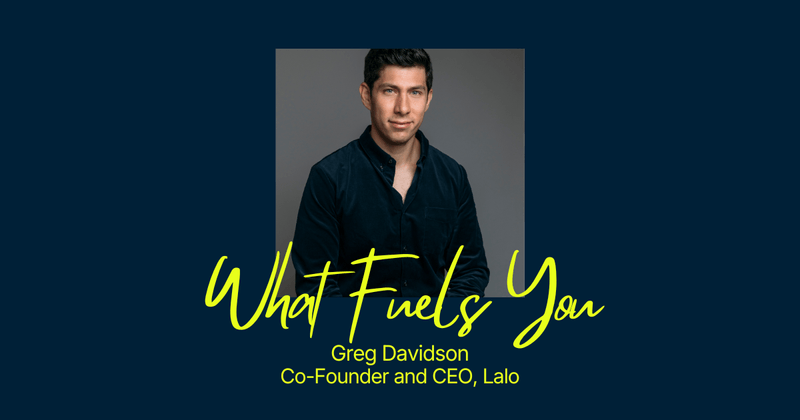
Greg Davidson
Co-Founder and CEO, Lalo
Greg Davidson
Co-Founder and CEO, Lalo
Greg Davidson co-founded Lalo in 2017 with Michael Wieder, his former colleague from WayUp, building a premium baby and toddler brand around the idea that new parents deserve better design and guidance. Neither founder had children when they started the company. Lalo launched its first product, a stroller, in March 2019, followed by its best-selling high chair that July, and grew 400% in its first year despite launching just before the pandemic. The company has raised approximately $23 million from roughly 130 investors, including a Series A led by Spin Master, the third-largest toy company in the world, and has expanded into Target, Babylist, Pottery Barn Kids, and Amazon. Greg studied at Northeastern University, previously worked in sales and partnerships at Elastic, Crossover, WayUp, and Artsy, and is based in Miami with his wife and three children.
400%
Growth in Lalo's first year of business
$23M
Raised across approximately 130 investors
60+
Investors who came in before Lalo officially launched
3
Voting board members, including Greg and Michael
| Time | Topic |
|---|---|
| 00:00 | Rapid fire -- Breakfast duty with avocado toast, a calendar app that runs itself, three words his team would use, and Lalo's best-selling product of all time |
| 06:00 | Growing up in Livingston, New Jersey -- A father who was the first Taco Bell franchisee in New Jersey, then ran movie theaters, a cosmetics company, and Wet Brush, and why Greg never felt scared to enter an industry he knew nothing about |
| 12:00 | The job literally called The Hustler -- Cold calling for Elastic, managing 35 people at 25 with no formal training, and growing Crossover from $5 million to $30 million in revenue |
| 18:00 | WayUp, the house with roommates, and meeting Michael -- Living together as employee number 4 and number 5, a fired colleague, and how a casual work friendship turned into a business partnership |
| 25:00 | The Buy Buy Baby walkthrough that started it all -- Two single men with no kids walking around a baby store, identifying a vulnerable customer being marketed to through fear, and a dinner where Michael named the company in two seconds |
| 31:00 | The first check, from a stranger at a bar in Africa -- Raising the first round on a deck with a stroller render, a best man speech joke that became real money, and the $300K friends-and-family round |
| 36:00 | The high chair that defined the brand -- Launching a stroller first for validation, then the high chair that actually took off, and why bundling value mattered more than nickel-and-diming accessories |
| 41:00 | $23 million, 130 investors, and a Series A led by a toy giant -- The pros and cons of a massive cap table, why Spin Master came in to lead the Series A, and how the venture landscape shifted under their feet |
| 46:00 | Mastige pricing and the Coach playbook -- Why Lalo refused to be a luxury brand, the pricing strategy that protects against Amazon and Target knockoffs, and what "mastige" means in practice |
| 51:00 | What fuels Greg -- A chip on his shoulder from people who would not invest early, hiring generalists who think like founders, and believing Lalo will be on shelves for the next 30 years |
A Father Who Ran Everything from Taco Bell to Wet Brush
Greg Davidson grew up in Livingston, New Jersey, a suburb outside New York City he describes as a great place to be a kid: outside often, good friends, good memories. His role model was his father, an entrepreneur whose career touched an almost comically wide range of industries. He was the first Taco Bell franchisee in New Jersey, then sold that to start a chain of movie theaters, then ran a cosmetics line called Townley that sold into Claire's, then spent time in venture, and most recently served as CEO of BBI, the company behind Wet Brush and Goody, before he passed away.
Greg credits this variety directly with his own comfort entering an industry he knew nothing about. When he decided he wanted to build a baby brand, it did not feel reckless to him the way it might to someone without that example. He ran small entrepreneurial schemes as a kid, including a sneaker resale business and a portable DVD player operation, almost getting kicked out of camp for trading pizza for other kids' chips. His father encouraged all of it.
"When I was like, oh, I want to be in baby, it wasn't like, don't go because you don't know, you're not a parent or you don't know much. It was kind of like, okay, this is pretty cool."
He attended Northeastern University, drawn specifically by its co-op program, which placed him in six-month internships at Credit Suisse and Morgan Stanley while his friends finished traditional four-year degrees and entered the workforce. He admits he did not perform especially well academically. What the program gave him instead was real exposure to traditional finance and marketing, neither of which he found fulfilling. The experience clarified what he did not want to do more than it clarified what he did.
The Job Literally Called "The Hustler"
Greg's first job out of college had an official title: The Hustler. The company was Elastic, a sales consultancy that later became the CRM company Close.io, and the work was cold calling on behalf of clients including StubHub, eBay, and a sports analytics platform called Crossover. He moved to San Francisco to take the job, working East Coast hours, building call infrastructure with two close friends he had made in the city, and eventually pitching themselves as a package deal to Crossover, who hired all three full-time to run their entire sales and marketing operation. Greg was managing 35 people at age 25 with, in his words, no idea what he was doing beyond confidence that he could sell the product better than anyone else. The trio grew Crossover's revenue from roughly $5 million to $30 million before Greg left for a new opportunity.
That opportunity was WayUp, a marketplace for student internships and entry-level jobs, where Greg became employee number four. The company's fifth employee, Michael Wieder, was literally his roommate in a shared house funded by the company. The two did not work together directly at WayUp; Greg ran sales and partnerships while Michael ran brand partnerships and marketing. Their relationship formed casually, over lunch walks and dinners, talking through business ideas and complaining about work, the way two ambitious people in adjacent roles often do. Neither of them planned to start a company together. It happened slowly, through proximity.
"It wasn't until I had a breath of an idea that I had dinner with him and I was like, what do you think about this? He was like, that sounds cool. Let's do it."
Greg then moved to Artsy, an online art marketplace, where he had zero prior knowledge of the art world but was given significant autonomy: reporting directly to the CEO, eventually managing 60 people across New York, Berlin, Los Angeles, and Hong Kong. He calls it one of his favorite jobs. The pattern across Elastic, Crossover, WayUp, and Artsy was consistent: take responsibility for something he did not fully understand yet, and build the operational infrastructure to make it work anyway. That pattern would define Lalo from day one.
A Buy Buy Baby Walkthrough, a Two-Second Name, and a Check from a Stranger in Africa
Neither Greg nor Michael had children when they started thinking seriously about the baby category in 2017. Greg had just gone through his own wedding registry process and noticed the contrast: he could buy a beautiful All-Clad pan, but a friend who had just had a baby was surrounded by boxes of mismatched plastic products in primary colors that nobody could explain. Before bringing the idea to Michael, Greg walked around a Buy Buy Baby alone on a Sunday, by his own description looking like a creepy single man with no reason to be there, studying how brands in the category talked to customers. He concluded that the customer was vulnerable in the sense of being uncertain and information-seeking, ready to spend, and being marketed to almost entirely through fear and anxiety rather than warmth.
At dinner, Greg raised the idea with Michael. Michael, who was not yet a father either, responded within seconds: they would name it Momo, short for a Hebrew word for pacifier, and he built a rough landing page that same week. A trademark conflict later forced a rename. Michael stumbled across the word Lalo at a wedding in Mexico and immediately landed on the backronym: Love All Little Ones. The naming exercise that had stalled for weeks resolved in a moment, which Greg describes as classically Michael.
"I'm a mom, I'm a dad, I have this problem and I'm just going to assume everyone else does. We were like, how do we build something that is attractive to the masses, not just to one specific pain point."
The first capital came from Greg and Michael themselves, followed by a check from a man named Eduardo Schroeder, whom Greg and his wife had met at a bar while on their honeymoon in Africa. Greg's brother joked about a literal box for cash donations at Greg's wedding. The first formal round came to roughly $300,000 on a deck that contained only renders of a stroller and a high chair. Before Lalo had even officially launched, the company had more than 60 individual investors, a number Greg attributes to relentless, unglamorous fundraising hustle: ask for $10,000, get it, ask the next person for $20,000, repeat.
The Stroller That Validated the Brand, and the High Chair That Made It
Lalo launched its first product, a stroller, in March 2019. The stroller created brand validation more than it created sales velocity; Jessica Alba commented on a launch post without any prior relationship with the company, and press attention built a drumbeat even as actual purchases lagged behind the natural delay of baby registries, which can take months to convert into purchases. The real inflection point came in July 2019 with the launch of Lalo's high chair, which converted into a play chair using interchangeable legs at the right price point and aesthetic. Greg describes the bundling strategy explicitly: rather than nickel-and-diming customers with separate charges for cup holders, organizers, and adapters the way legacy brands did, Lalo built products where everything needed came included.
The pandemic hit four months after the high chair launched, and Greg admits the company's first reaction was fear that they would go out of business. Instead, baby hard goods became one of the fastest-growing online categories during COVID, and because Lalo was already digitally native while most of its category competitors still depended on traditional retail distribution, the company captured outsized growth from the shift. The company grew 400% in that first year.
"We thought we can create more value by saying you're buying everything together. You don't have to blink. Everything you need is in this package to ultimately get what you need."
Lalo has since raised approximately $23 million across roughly 130 investors, including a Series A led by Spin Master, the third-largest toy company in the world behind Hasbro and Mattel and the company behind Paw Patrol. Greg is candid that a large cap table has both advantages and real costs, particularly when it comes to securing the majority preferred approval needed for new funding rounds. He also points out that Lalo does not fit the typical venture-backed consumer profile, which usually involves subscription models or high-turn CPG products; Lalo's durable, infrequently repurchased hard goods made fundraising harder but ultimately led the company to unconventional, valuable strategic partners.
Mastige Pricing, Generalist Hiring, and a Chip on the Shoulder That Never Goes Away
Greg describes Lalo's pricing philosophy using a term he and Michael coined internally: mastige, the deliberate middle ground between mass and prestige. Lalo never wanted to be the luxury option at $400 for a high chair. Instead, the strategy was to be the most premium product available within mass retail distribution, occupying a price point high enough that competitors like Amazon and Target's white-label lines would not bother undercutting it, because retailers need a certain margin dollar per unit and can earn that from one premium Lalo product instead of three cheaper alternatives. Greg compares the approach explicitly to how Coach built its customer base: bringing a Rimowa or Tumi-level customer down to a $200 price point that still feels like membership in something premium, while a Target shopper trades up to feel the same thing.
On hiring, Greg and Michael have consistently favored generalists over specialists, looking for people with the same instinct to take on a task outside their formal job description. Greg is direct that this approach does not work for everyone and has not always been hired for correctly. The company gives nearly every candidate, regardless of role, a case study designed to reveal how they think rather than just what they know. Greg and Michael are also vocal internally about AI adoption, texting each other constantly about new use cases and pushing employees to go further than surface-level implementation.
"I believe regardless what happens in the next 5 years, that the Lalo brand will live on. These brands have been around for 30, 40, 50 years. Lalo's going to be that brand. They'll continue being on the shelves of X retailer for, you know, 20, 30, 40 years."
When Shauna Swerland asks what fuels him, Greg names a chip on his shoulder that has never gone away, traced back to the early fundraising days when close family friends declined to invest even small amounts. He describes that rejection not as discouraging but as motivating: he wanted to prove those specific people wrong, and credits the eventual 130-person cap table as evidence that he did. He admits to a degree of professional restlessness that makes it hard to feel satisfied even after real wins, describing the entrepreneurial dilemma as one where a Target launch immediately gives way to the next fire that needs to be put out. What grounds the ambition, he says, is the physical, durable nature of what he has built: a product his own children use every day and recognize by name, something he believes will outlast his own involvement in the company.
5 Key Takeaways
🛒
Walk the category before you build the product
Greg spent a Sunday alone walking the aisles of Buy Buy Baby before pitching Michael on the idea, studying how existing brands talked to a customer he and Michael both identified as vulnerable but ready to spend. That direct observation, not market research reports, shaped Lalo's entire brand voice.
🎯
Mastige pricing protects against being undercut
By deliberately positioning Lalo between mass and prestige rather than at either extreme, Greg and Michael built a price point high enough that retailers earn comparable margin dollars from one Lalo product as they would from three cheaper alternatives, reducing the incentive for Amazon or Target to simply copy and undercut them.
📦
Bundle value instead of nickel-and-diming accessories
Lalo's core product thesis rejected the industry standard of charging separately for cup holders, organizers, and adapters. Including everything needed in the base purchase became a defining trust signal for new parents who were already overwhelmed by choice.
🤝
A 130-person cap table is a network, not just capital
Greg is candid that having dozens of small investors creates real friction during future fundraising rounds requiring majority preferred approval. But he also credits the network effect of that broad cap table, plus a strategic Series A from Spin Master, with opening doors a smaller, cleaner cap table would not have.
😤
A chip on the shoulder can be a durable fuel source
Greg traces his ongoing motivation directly to people who declined to invest in the company's earliest days. He treats that early rejection as a permanent, productive source of drive rather than something to resolve or move past.
Greg Davidson Lalo Michael Wieder What Fuels You Shauna Swerland Fuel Talent Baby Gear D2C Brand Consumer Brand Target Retail Spin Master Startup Fundraising Northeastern University Miami Brand Building Pricing Strategy Parenting Products Founder Story Co-Founder Partnership Entrepreneurship CPG
Frequently Asked Questions
Who is Greg Davidson and what is Lalo?
Greg Davidson is the co-founder and CEO of Lalo, a premium baby and toddler brand he started in 2017 with Michael Wieder, his former colleague from WayUp. Neither founder had children when the company launched. Lalo's first product, a stroller, launched in March 2019, followed by its breakout high chair in July 2019, and the company grew 400% in its first year. Lalo has raised approximately $23 million from around 130 investors, including a Series A led by toy company Spin Master, and is sold in Target, Babylist, Pottery Barn Kids, and Amazon.
How did Lalo get its name?
Greg Davidson explained on What Fuels You that the company was originally going to be named Momo, short for a Hebrew word for pacifier, until a trademark conflict forced a change. Co-founder Michael Wieder came across the word Lalo while at a wedding in Mexico and immediately suggested it should stand for Love All Little Ones. Greg describes the moment as classic Michael, resolving a stalled naming exercise within seconds.
What is Lalo's pricing strategy and what does "mastige" mean?
On What Fuels You, Greg Davidson described Lalo's pricing approach using a term he and his co-founder coined: mastige, a deliberate middle position between mass-market and prestige pricing. Rather than positioning Lalo as a luxury brand, the company aims to be the most premium option available within mass retail distribution, which Greg says protects against retailers like Amazon or Target simply copying and undercutting their products, since retailers earn comparable margin dollars from fewer, higher-priced units.
How did Greg Davidson and Michael Wieder raise Lalo's first funding?
Greg Davidson told Shauna Swerland on What Fuels You that Lalo's first outside check came from a man named Eduardo Schroeder, whom Greg and his wife met at a bar while on their honeymoon in Africa. The company's first formal round raised approximately $300,000 on a deck containing only product renders. Before Lalo officially launched, the company had attracted more than 60 individual investors, a process Greg attributes to persistent, incremental fundraising rather than a single large institutional check.
What does Greg Davidson say fuels him as a founder?
When asked what fuels him on What Fuels You, Greg Davidson pointed to a persistent chip on his shoulder originating from family friends who declined to invest in Lalo's earliest days. He describes that early rejection as ongoing motivation rather than something resolved by the company's later success, and credits the resulting determination with helping build a cap table of roughly 130 investors over time.
Greg Davidson
Co-Founder and CEO, Lalo
Greg Davidson
Co-Founder and CEO, Lalo
Greg Davidson co-founded Lalo in 2017 with Michael Wieder, his former colleague from WayUp, building a premium baby and toddler brand around the idea that new parents deserve better design and guidance. Neither founder had children when they started the company. Lalo launched its first product, a stroller, in March 2019, followed by its best-selling high chair that July, and grew 400% in its first year despite launching just before the pandemic. The company has raised approximately $23 million from roughly 130 investors, including a Series A led by Spin Master, the third-largest toy company in the world, and has expanded into Target, Babylist, Pottery Barn Kids, and Amazon. Greg studied at Northeastern University, previously worked in sales and partnerships at Elastic, Crossover, WayUp, and Artsy, and is based in Miami with his wife and three children.
400%
Growth in Lalo's first year of business
$23M
Raised across approximately 130 investors
60+
Investors who came in before Lalo officially launched
3
Voting board members, including Greg and Michael
| Time | Topic |
|---|---|
| 00:00 | Rapid fire -- Breakfast duty with avocado toast, a calendar app that runs itself, three words his team would use, and Lalo's best-selling product of all time |
| 06:00 | Growing up in Livingston, New Jersey -- A father who was the first Taco Bell franchisee in New Jersey, then ran movie theaters, a cosmetics company, and Wet Brush, and why Greg never felt scared to enter an industry he knew nothing about |
| 12:00 | The job literally called The Hustler -- Cold calling for Elastic, managing 35 people at 25 with no formal training, and growing Crossover from $5 million to $30 million in revenue |
| 18:00 | WayUp, the house with roommates, and meeting Michael -- Living together as employee number 4 and number 5, a fired colleague, and how a casual work friendship turned into a business partnership |
| 25:00 | The Buy Buy Baby walkthrough that started it all -- Two single men with no kids walking around a baby store, identifying a vulnerable customer being marketed to through fear, and a dinner where Michael named the company in two seconds |
| 31:00 | The first check, from a stranger at a bar in Africa -- Raising the first round on a deck with a stroller render, a best man speech joke that became real money, and the $300K friends-and-family round |
| 36:00 | The high chair that defined the brand -- Launching a stroller first for validation, then the high chair that actually took off, and why bundling value mattered more than nickel-and-diming accessories |
| 41:00 | $23 million, 130 investors, and a Series A led by a toy giant -- The pros and cons of a massive cap table, why Spin Master came in to lead the Series A, and how the venture landscape shifted under their feet |
| 46:00 | Mastige pricing and the Coach playbook -- Why Lalo refused to be a luxury brand, the pricing strategy that protects against Amazon and Target knockoffs, and what "mastige" means in practice |
| 51:00 | What fuels Greg -- A chip on his shoulder from people who would not invest early, hiring generalists who think like founders, and believing Lalo will be on shelves for the next 30 years |
A Father Who Ran Everything from Taco Bell to Wet Brush
Greg Davidson grew up in Livingston, New Jersey, a suburb outside New York City he describes as a great place to be a kid: outside often, good friends, good memories. His role model was his father, an entrepreneur whose career touched an almost comically wide range of industries. He was the first Taco Bell franchisee in New Jersey, then sold that to start a chain of movie theaters, then ran a cosmetics line called Townley that sold into Claire's, then spent time in venture, and most recently served as CEO of BBI, the company behind Wet Brush and Goody, before he passed away.
Greg credits this variety directly with his own comfort entering an industry he knew nothing about. When he decided he wanted to build a baby brand, it did not feel reckless to him the way it might to someone without that example. He ran small entrepreneurial schemes as a kid, including a sneaker resale business and a portable DVD player operation, almost getting kicked out of camp for trading pizza for other kids' chips. His father encouraged all of it.
"When I was like, oh, I want to be in baby, it wasn't like, don't go because you don't know, you're not a parent or you don't know much. It was kind of like, okay, this is pretty cool."
He attended Northeastern University, drawn specifically by its co-op program, which placed him in six-month internships at Credit Suisse and Morgan Stanley while his friends finished traditional four-year degrees and entered the workforce. He admits he did not perform especially well academically. What the program gave him instead was real exposure to traditional finance and marketing, neither of which he found fulfilling. The experience clarified what he did not want to do more than it clarified what he did.
The Job Literally Called "The Hustler"
Greg's first job out of college had an official title: The Hustler. The company was Elastic, a sales consultancy that later became the CRM company Close.io, and the work was cold calling on behalf of clients including StubHub, eBay, and a sports analytics platform called Crossover. He moved to San Francisco to take the job, working East Coast hours, building call infrastructure with two close friends he had made in the city, and eventually pitching themselves as a package deal to Crossover, who hired all three full-time to run their entire sales and marketing operation. Greg was managing 35 people at age 25 with, in his words, no idea what he was doing beyond confidence that he could sell the product better than anyone else. The trio grew Crossover's revenue from roughly $5 million to $30 million before Greg left for a new opportunity.
That opportunity was WayUp, a marketplace for student internships and entry-level jobs, where Greg became employee number four. The company's fifth employee, Michael Wieder, was literally his roommate in a shared house funded by the company. The two did not work together directly at WayUp; Greg ran sales and partnerships while Michael ran brand partnerships and marketing. Their relationship formed casually, over lunch walks and dinners, talking through business ideas and complaining about work, the way two ambitious people in adjacent roles often do. Neither of them planned to start a company together. It happened slowly, through proximity.
"It wasn't until I had a breath of an idea that I had dinner with him and I was like, what do you think about this? He was like, that sounds cool. Let's do it."
Greg then moved to Artsy, an online art marketplace, where he had zero prior knowledge of the art world but was given significant autonomy: reporting directly to the CEO, eventually managing 60 people across New York, Berlin, Los Angeles, and Hong Kong. He calls it one of his favorite jobs. The pattern across Elastic, Crossover, WayUp, and Artsy was consistent: take responsibility for something he did not fully understand yet, and build the operational infrastructure to make it work anyway. That pattern would define Lalo from day one.
A Buy Buy Baby Walkthrough, a Two-Second Name, and a Check from a Stranger in Africa
Neither Greg nor Michael had children when they started thinking seriously about the baby category in 2017. Greg had just gone through his own wedding registry process and noticed the contrast: he could buy a beautiful All-Clad pan, but a friend who had just had a baby was surrounded by boxes of mismatched plastic products in primary colors that nobody could explain. Before bringing the idea to Michael, Greg walked around a Buy Buy Baby alone on a Sunday, by his own description looking like a creepy single man with no reason to be there, studying how brands in the category talked to customers. He concluded that the customer was vulnerable in the sense of being uncertain and information-seeking, ready to spend, and being marketed to almost entirely through fear and anxiety rather than warmth.
At dinner, Greg raised the idea with Michael. Michael, who was not yet a father either, responded within seconds: they would name it Momo, short for a Hebrew word for pacifier, and he built a rough landing page that same week. A trademark conflict later forced a rename. Michael stumbled across the word Lalo at a wedding in Mexico and immediately landed on the backronym: Love All Little Ones. The naming exercise that had stalled for weeks resolved in a moment, which Greg describes as classically Michael.
"I'm a mom, I'm a dad, I have this problem and I'm just going to assume everyone else does. We were like, how do we build something that is attractive to the masses, not just to one specific pain point."
The first capital came from Greg and Michael themselves, followed by a check from a man named Eduardo Schroeder, whom Greg and his wife had met at a bar while on their honeymoon in Africa. Greg's brother joked about a literal box for cash donations at Greg's wedding. The first formal round came to roughly $300,000 on a deck that contained only renders of a stroller and a high chair. Before Lalo had even officially launched, the company had more than 60 individual investors, a number Greg attributes to relentless, unglamorous fundraising hustle: ask for $10,000, get it, ask the next person for $20,000, repeat.
The Stroller That Validated the Brand, and the High Chair That Made It
Lalo launched its first product, a stroller, in March 2019. The stroller created brand validation more than it created sales velocity; Jessica Alba commented on a launch post without any prior relationship with the company, and press attention built a drumbeat even as actual purchases lagged behind the natural delay of baby registries, which can take months to convert into purchases. The real inflection point came in July 2019 with the launch of Lalo's high chair, which converted into a play chair using interchangeable legs at the right price point and aesthetic. Greg describes the bundling strategy explicitly: rather than nickel-and-diming customers with separate charges for cup holders, organizers, and adapters the way legacy brands did, Lalo built products where everything needed came included.
The pandemic hit four months after the high chair launched, and Greg admits the company's first reaction was fear that they would go out of business. Instead, baby hard goods became one of the fastest-growing online categories during COVID, and because Lalo was already digitally native while most of its category competitors still depended on traditional retail distribution, the company captured outsized growth from the shift. The company grew 400% in that first year.
"We thought we can create more value by saying you're buying everything together. You don't have to blink. Everything you need is in this package to ultimately get what you need."
Lalo has since raised approximately $23 million across roughly 130 investors, including a Series A led by Spin Master, the third-largest toy company in the world behind Hasbro and Mattel and the company behind Paw Patrol. Greg is candid that a large cap table has both advantages and real costs, particularly when it comes to securing the majority preferred approval needed for new funding rounds. He also points out that Lalo does not fit the typical venture-backed consumer profile, which usually involves subscription models or high-turn CPG products; Lalo's durable, infrequently repurchased hard goods made fundraising harder but ultimately led the company to unconventional, valuable strategic partners.
Mastige Pricing, Generalist Hiring, and a Chip on the Shoulder That Never Goes Away
Greg describes Lalo's pricing philosophy using a term he and Michael coined internally: mastige, the deliberate middle ground between mass and prestige. Lalo never wanted to be the luxury option at $400 for a high chair. Instead, the strategy was to be the most premium product available within mass retail distribution, occupying a price point high enough that competitors like Amazon and Target's white-label lines would not bother undercutting it, because retailers need a certain margin dollar per unit and can earn that from one premium Lalo product instead of three cheaper alternatives. Greg compares the approach explicitly to how Coach built its customer base: bringing a Rimowa or Tumi-level customer down to a $200 price point that still feels like membership in something premium, while a Target shopper trades up to feel the same thing.
On hiring, Greg and Michael have consistently favored generalists over specialists, looking for people with the same instinct to take on a task outside their formal job description. Greg is direct that this approach does not work for everyone and has not always been hired for correctly. The company gives nearly every candidate, regardless of role, a case study designed to reveal how they think rather than just what they know. Greg and Michael are also vocal internally about AI adoption, texting each other constantly about new use cases and pushing employees to go further than surface-level implementation.
"I believe regardless what happens in the next 5 years, that the Lalo brand will live on. These brands have been around for 30, 40, 50 years. Lalo's going to be that brand. They'll continue being on the shelves of X retailer for, you know, 20, 30, 40 years."
When Shauna Swerland asks what fuels him, Greg names a chip on his shoulder that has never gone away, traced back to the early fundraising days when close family friends declined to invest even small amounts. He describes that rejection not as discouraging but as motivating: he wanted to prove those specific people wrong, and credits the eventual 130-person cap table as evidence that he did. He admits to a degree of professional restlessness that makes it hard to feel satisfied even after real wins, describing the entrepreneurial dilemma as one where a Target launch immediately gives way to the next fire that needs to be put out. What grounds the ambition, he says, is the physical, durable nature of what he has built: a product his own children use every day and recognize by name, something he believes will outlast his own involvement in the company.
5 Key Takeaways
🛒
Walk the category before you build the product
Greg spent a Sunday alone walking the aisles of Buy Buy Baby before pitching Michael on the idea, studying how existing brands talked to a customer he and Michael both identified as vulnerable but ready to spend. That direct observation, not market research reports, shaped Lalo's entire brand voice.
🎯
Mastige pricing protects against being undercut
By deliberately positioning Lalo between mass and prestige rather than at either extreme, Greg and Michael built a price point high enough that retailers earn comparable margin dollars from one Lalo product as they would from three cheaper alternatives, reducing the incentive for Amazon or Target to simply copy and undercut them.
📦
Bundle value instead of nickel-and-diming accessories
Lalo's core product thesis rejected the industry standard of charging separately for cup holders, organizers, and adapters. Including everything needed in the base purchase became a defining trust signal for new parents who were already overwhelmed by choice.
🤝
A 130-person cap table is a network, not just capital
Greg is candid that having dozens of small investors creates real friction during future fundraising rounds requiring majority preferred approval. But he also credits the network effect of that broad cap table, plus a strategic Series A from Spin Master, with opening doors a smaller, cleaner cap table would not have.
😤
A chip on the shoulder can be a durable fuel source
Greg traces his ongoing motivation directly to people who declined to invest in the company's earliest days. He treats that early rejection as a permanent, productive source of drive rather than something to resolve or move past.
Greg Davidson Lalo Michael Wieder What Fuels You Shauna Swerland Fuel Talent Baby Gear D2C Brand Consumer Brand Target Retail Spin Master Startup Fundraising Northeastern University Miami Brand Building Pricing Strategy Parenting Products Founder Story Co-Founder Partnership Entrepreneurship CPG
Frequently Asked Questions
Who is Greg Davidson and what is Lalo?
Greg Davidson is the co-founder and CEO of Lalo, a premium baby and toddler brand he started in 2017 with Michael Wieder, his former colleague from WayUp. Neither founder had children when the company launched. Lalo's first product, a stroller, launched in March 2019, followed by its breakout high chair in July 2019, and the company grew 400% in its first year. Lalo has raised approximately $23 million from around 130 investors, including a Series A led by toy company Spin Master, and is sold in Target, Babylist, Pottery Barn Kids, and Amazon.
How did Lalo get its name?
Greg Davidson explained on What Fuels You that the company was originally going to be named Momo, short for a Hebrew word for pacifier, until a trademark conflict forced a change. Co-founder Michael Wieder came across the word Lalo while at a wedding in Mexico and immediately suggested it should stand for Love All Little Ones. Greg describes the moment as classic Michael, resolving a stalled naming exercise within seconds.
What is Lalo's pricing strategy and what does "mastige" mean?
On What Fuels You, Greg Davidson described Lalo's pricing approach using a term he and his co-founder coined: mastige, a deliberate middle position between mass-market and prestige pricing. Rather than positioning Lalo as a luxury brand, the company aims to be the most premium option available within mass retail distribution, which Greg says protects against retailers like Amazon or Target simply copying and undercutting their products, since retailers earn comparable margin dollars from fewer, higher-priced units.
How did Greg Davidson and Michael Wieder raise Lalo's first funding?
Greg Davidson told Shauna Swerland on What Fuels You that Lalo's first outside check came from a man named Eduardo Schroeder, whom Greg and his wife met at a bar while on their honeymoon in Africa. The company's first formal round raised approximately $300,000 on a deck containing only product renders. Before Lalo officially launched, the company had attracted more than 60 individual investors, a process Greg attributes to persistent, incremental fundraising rather than a single large institutional check.
What does Greg Davidson say fuels him as a founder?
When asked what fuels him on What Fuels You, Greg Davidson pointed to a persistent chip on his shoulder originating from family friends who declined to invest in Lalo's earliest days. He describes that early rejection as ongoing motivation rather than something resolved by the company's later success, and credits the resulting determination with helping build a cap table of roughly 130 investors over time.