

"You Don't See It Yourself, But You're Ready" -- Dawn Lepore, Board Chair of Amperity and Former CEO of drugstore.com
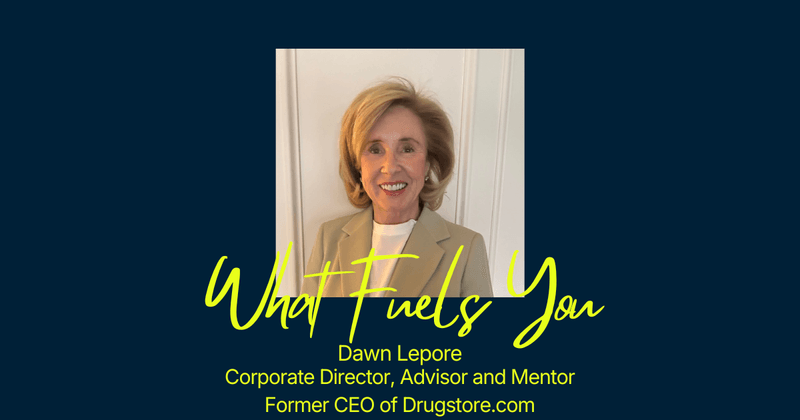
Board Chair of Amperity, Former CEO of drugstore.com, Former Vice Chairman and CIO of Charles Schwab
Howard Schultz told her she was ready to be a CEO. She told him he was wrong. Dawn Lepore spent 21 years rising through Charles Schwab, helped launch the company's internet trading platform when the internet could barely do more than hotel reservations, and still could not see in herself what the people around her already recognized. That gap between perceived capability and self-belief is one of the throughlines of this conversation, and it shows up in her cancer diagnosis, her husband's multiple myeloma, and her decision to keep running a public company through all of it.
In this episode of What Fuels You, host Shauna Swerland sits down with Dawn Lepore, Board Chair of Amperity and one of the most decorated female technology executives in American business history, for a conversation that covers internet pioneering at Schwab, the turnaround of drugstore.com, the dual cancer crises that hit her family during her tenure as CEO, and why she believes 11% of low-income students in Washington reading at grade level is a national emergency. The thread connecting all of it is a career built on pattern recognition, intellectual honesty, and a willingness to believe in people before they believe in themselves.
📋 Episode Chapters
| 00:00 | Introduction and rapid fire: Dent Island getaways, piano recitals, and a music major whose father predicted she would never get a job |
| 06:30 | Reading habits and the book that changed how Dawn understood entrepreneurs after a disastrous meeting with Chuck Schwab |
| 12:00 | Growing up Canadian-American, transferring from UVA to Smith College, and why a women's college was the right environment at the right time |
| 18:30 | Education equity and why only 11% of low-income Washington State students read at grade level, and what Teach for America is doing about it |
| 26:00 | How Dawn got her first job at Charles Schwab, how her husband's career created a conflict, and his decision to leave so she could advance |
| 32:00 | Launching Schwab's internet trading in the mid-90s, being ridiculed at industry conferences, and growing infrastructure 1,000% in a single year |
| 38:00 | Howard Schultz telling Dawn she was ready to be a CEO, and why she disagreed, on a vacation in Hawaii with a newborn |
| 43:00 | Moving the family to Seattle to take the drugstore.com CEO role, competing against Amazon, and what made the turnaround so hard |
| 48:00 | Dawn's cancer diagnosis, the decision not to disclose it publicly, and the day her husband called from the doctor with over 100 lesions and a blood cancer diagnosis |
| 54:00 | Board service philosophy, the Rob Walton question about confidence, and how Dawn evaluates board opportunities and the mistakes she made early on |
| 58:00 | AI as a force bigger than the internet, the risk of companies doing more with fewer people, and why Dawn is studying AI in education as fast as she can |
| 62:00 | What fuels Dawn: her children, the intellectual stimulation of living in an era of constant transformation, and mentoring the next generation of women in business |
The Piano Player Whose Father Said She Would Never Get a Job
Dawn Lepore graduated from Smith College as a music major. Her father was convinced this was a professional death sentence. Her mother was the only one who thought Dawn was talented enough to make a living at the piano. Neither parent turned out to be entirely right, and the arc of that mismatch, between what others expect of you and what you actually become, runs through this entire conversation.
What came through in the rapid-fire portion of this episode was not just wit but a kind of deliberate humility. Dawn deflects attention. She talks about her team before she talks about herself. When Shauna Swerland asked about her best character trait, Dawn said she hoped it was empathy, and then immediately attributed the growth of that empathy to becoming a mother. The piano is on the shelf. She has not played in years. But her husband found the tapes of her senior recital in college and had them digitized as a Christmas gift, and the way she tells that story says more about who she is than any resume line.
"The only person who thought I was good enough to earn a living from the piano was my mother, which is a wonderful characteristic in your mother. My father thought I would never get a job because I majored in music."
-- Dawn Lepore
She transferred from the University of Virginia, where she was one of the first classes of women admitted, to Smith because UVA felt overwhelming at 17. The women's college was smaller, more nurturing, and, she says, probably the right call for who she was at that particular moment. A Smith classmate she recently had lunch with said she never would have majored in chemistry had she not been in that environment. Dawn's parallel is quieter. She is not sure she would have had the foundation to do what she went on to do without it.
21 Years at Schwab, and a Helicopter Blade in a Meeting with Chuck
Dawn joined Charles Schwab at a low level, partly through a connection her husband had while he was consulting there. She had told him not to take a permanent job at the same company. He agreed. Then, about a month after she started, he took the permanent job. She was, in her words, really pissed. They both ended up in the technology organization, and for a stretch of years, his presence created a ceiling on how far she could advance. Schwab's leadership eventually told her plainly that as long as her husband stayed, she could not go any further. Her husband left on his own initiative. He said he was holding her back.
This was the environment in which Dawn spent two decades building the skills that would define her career. She describes Schwab in the 1980s as West Coast, scrappy, and different from what she would have encountered in traditional East Coast financial services. Chuck Schwab cared about results, and the company was progressive in ways that were genuinely unusual for the era. Early in her tenure, she attended a meeting with Chuck Schwab that went badly. A voicemail from her boss afterward told her she had hit a helicopter blade and that she needed to go home that weekend and read a book about entrepreneurs. She does not remember the title of the book. She has never forgotten the lesson.
"I love the nonlinear thinking, the risk taking, seeing things people don't see and other people don't see in white space. I've worked with a lot of entrepreneurs over my career and I'm just fascinated by them."
-- Dawn Lepore
By the time Dawn was promoted into the CIO role, Schwab was doing something no one in financial services had done before. The company launched internet trading in the mid-1990s, when internet trading was not a phrase people used, and when the internet itself could barely support hotel reservations and email. She stood at a CIO conference and was ridiculed. Colleagues told her she was putting customers' money at risk. She describes the growth that followed as one of the most stressful but most exciting periods of her career. Schwab grew its infrastructure by 1,000% in a single year and was adding trades at roughly 3% per day. She had access to CEOs across the technology industry, including Steve Jobs, who called her directly, and John Chambers and Scott McNealy. She gave them each a deal: the first half hour was theirs to sell her whatever they wanted. The second half hour was hers. She asked how they built their companies, what their cultures looked like, how they led. She considers those conversations one of the best informal MBAs she could have received, and she is emphatic that she never got an actual MBA, which surprised people throughout her career.
Howard Schultz in Hawaii, and the CEO She Did Not Know She Was Ready to Be
Dawn was on the eBay board. Howard Schultz was also on the eBay board. She was on vacation in Hawaii with her husband and their newborn daughter and their four-year-old. Howard Schultz, she notes, looked like he had just come off the cover of GQ. She was barely keeping it together. They ran into each other, had dinner with their spouses, and Schultz looked at her across the table and told her she should be a CEO. She told him he was kidding. Nobody would hire her as a CEO. She was not ready. He disagreed.
"He was one of 3 or 4 people in my career who really believed in me before I believed in myself."
-- Dawn Lepore
Schultz made introductions. Maveron, which he was part of, had invested early in drugstore.com. The connection gave Dawn a pathway to the CEO role at drugstore.com, which she took in 2004. She moved her family from San Francisco to Seattle, children aged 2 and 6, husband retired and serving as primary caregiver. He had two rules for the move: they all go together, or nobody goes, and they keep the California house. Both conditions were met. She describes the early days of the drugstore.com role as a company that had been without a CEO for too long, that was competing directly against Amazon, and that needed a turnaround. She does not sugarcoat how hard that is: not just building something from nothing, but reversing momentum that has been moving in the wrong direction. She sold the company to Walgreens in 2011. The team she built there, she says, is what she is most proud of. She still stays in touch with them.
Running a Public Company Through Two Cancer Diagnoses at Once
Dawn had a premonition. She was in her office late one night, aware of how stressed she was, aware that her children were young, and decided without any symptoms to ask for some tests. The tests found cancer. Appendix cancer, which she describes as obscure and very hard to find. She was a relatively new public company CEO. She went to her board. They had a long conversation about disclosure and decided to wait until after surgery to see how far it had spread. It had not spread. She did not need chemotherapy. They chose not to disclose it publicly because it did not materially affect her ability to do her job.
A few years later, her husband called her at work. He never called her at work. Her assistant came in and said he had to talk to her. She picked up the phone. He was at the doctor. They had found more than 100 lesions. He had multiple myeloma, a blood cancer. The prognosis at the time was very poor. This was before the Affordable Care Act. All of their health insurance came through her job. Both of them were effectively uninsurable. She asked him if he wanted her to quit. He said absolutely not.
"He said very clearly, absolutely not. This is what you do. And he said, if you quit, the cancer will have won and I will not let the cancer win."
-- Dawn Lepore
He went through a bone marrow transplant. He is now in remission. Seattle turned out to be one of the best places in the country for blood cancer treatment. The doctor who found Dawn's own cancer in San Francisco called her every week asking whether she had put her children in therapy yet. Dawn kept saying the children were fine. The doctor kept calling. Eventually Dawn made the appointment. Her daughter was in kindergarten. Her son was in third grade. Children that age, Dawn explains, often believe they have somehow caused a parent's cancer. The family counseling was, she says, one of the best decisions she ever made. She credits that doctor, whom she still stays in touch with, for insisting on it.
What a Career on Major Boards Taught Her About When to Talk and When to Stop
Rob Walton asked Dawn, during her process to join the Walmart board, whether she had enough confidence to not talk in a board meeting. She calls it the best question she has ever been asked. She had enough self-awareness to understand it was also a useful challenge directed at her specifically. She critiques her own board performance openly. There are meetings she looks back on and thinks she talked too much. She has gotten better. She now chairs committees. She understands governance in ways she did not when she was first starting.
Her framework for evaluating board opportunities has evolved considerably since the early days, when she took on too much because she was afraid that if she said no, no one would ask again. She felt a dual pressure: the fear of missing the window, and the weight of representing women in rooms where women were rare. She mentions two boards she joined during her husband's illness that she should not have taken. She was not a good board member in that period. She could not focus. She did not have the energy. The lesson she took from it was that being on a board badly is worse than not being on it at all.
"You should never go on a board where you don't believe in the CEO. You don't believe in their ethics. I want to have interesting, smart people on the board with interesting strategic problems in the company."
-- Dawn Lepore
She also describes being talked over in board meetings. Her response is worth noting: she does not only externalize the problem. She asks herself whether she was being an effective communicator, whether she presented her idea in a way that made it easy for the room to receive it, whether the issue was dynamics or delivery or both. A male colleague on one board noticed the pattern and told her privately he had seen it, was sorry he had not spoken up sooner, and would do so going forward. She uses this as evidence that there are extraordinary allies everywhere, and that the problem of being talked over in rooms is real and worth naming, while still insisting on personal accountability for the quality of what you contribute.
AI, Education Equity, and the Stat That Should Be a National Emergency
Only 11% of low-income students in Washington State read at grade level. Dawn Lepore says this repeatedly and with increasing urgency. She connects it directly to third grade reading benchmarks, eighth grade algebra access, and the long-term consequences of closing or blocking the pathway into STEM careers. She serves as co-chair of Teach for America Washington, and she uses her platform on boards and in the tech community to make this visible to people who, she argues, are not indifferent but simply do not know what is happening in public education. She has watched her own son, who has a learning difference, navigate a system with the benefit of tutors, therapists, and resources that most families do not have. That experience, more than anything, radicalized her around the question of what we want for other people's children.
On AI, she is frank about both the optimism and the fear. She watched the internet emerge at Schwab when it could barely process a hotel reservation. John Doerr said the internet was 2% realized at that point. She said 5%. The lesson she took was how little anyone can see of a transformation when they are inside it. She believes AI is 1,000 times bigger. Her daughter works at an AI startup and has been educating Dawn from the inside. Dawn is studying AI in education with particular intensity, hoping that better tools might reach kids with learning differences and kids in under-resourced schools in ways that traditional systems have failed to do.
"We need to want for other people's children what we want for our own."
-- Dawn Lepore
She is watching the AI transformation with a particular kind of structural awareness born from having seen Schwab get undercut by E-Trade and Ameritrade the moment internet trading got crowded. She warned Meg Whitman at eBay about the risk of raising take rates in a way that would invite someone to come in underneath. She does not claim to have steered Whitman's decisions. She says Whitman told her the point made her think. Dawn treats that as a high-water mark. For companies that are four or five years old today, her advice is blunt: you are going to be competing against native AI companies that can do with three people what you have twenty people doing. Go hire the young people who have been using AI for years and actually know how to work with it.
5 Key Takeaways
Frequently Asked Questions
Who is Dawn Lepore and what is she known for?
Dawn Lepore is a Seattle-based technology executive and corporate director best known for serving as CEO and Board Chair of drugstore.com from 2004 until its sale to Walgreens in 2011, and for her 21 years at Charles Schwab, where she served as Vice Chairman and Chief Information Officer and played a central role in launching Schwab's internet trading platform. She has been named one of Fortune's 50 Most Powerful Women in Business four times. She currently serves as Board Chair of Amperity and co-chairs the Teach for America Washington board.
What did Dawn Lepore say about Howard Schultz and becoming a CEO?
On this episode of What Fuels You, Dawn Lepore described running into Howard Schultz on a vacation in Hawaii while she was managing a newborn and a four-year-old. Schultz told her over dinner that she should be a CEO. She told him nobody would hire her for that role and that she was not ready. He disagreed, said she just could not see it herself, and told her he was going to make a few introductions. She credits him as one of three or four people in her career who believed in her before she believed in herself, and distinguishes his role as a sponsor, not just a mentor, because he took action rather than only offering encouragement.
How did Dawn Lepore handle dual cancer diagnoses while running drugstore.com?
Dawn Lepore shared on What Fuels You that she sought testing without any symptoms around 2005 due to a sense of unease, and was diagnosed with appendix cancer shortly after becoming CEO of drugstore.com. Because the cancer was found early and did not spread, she did not need chemotherapy and chose, with her board's support, not to disclose it publicly. A few years later, her husband was diagnosed with multiple myeloma, a blood cancer, with more than 100 lesions detected. He underwent a bone marrow transplant and is now in remission. When Dawn asked if he wanted her to quit her job, he told her the cancer would win if she did, and he refused to let that happen.
What is Dawn Lepore's view on education equity in Washington State?
Dawn Lepore co-chairs the Teach for America Washington board and has made education equity one of her primary areas of advocacy. She stated on What Fuels You that only 11% of low-income students in Washington State read at grade level, and she describes this as a national emergency that is not being treated as one. She connects third grade reading and eighth grade algebra access as two critical structural gates to long-term economic mobility, and argues that the tech community, which is both affluent and philanthropic, largely does not understand what is happening in public schools because its children mostly attend private schools.
What does Dawn Lepore think about AI and its impact on business?
Dawn Lepore told Shauna Swerland on What Fuels You that she believes AI is approximately 1,000 times bigger than the internet revolution, drawing on her experience at Schwab where she and John Doerr both dramatically underestimated how far internet adoption would go. She expressed concern about the social implications, particularly given what she has observed social media do to a generation, but describes herself as an optimist. Her specific warning to executives is that companies four or five years old will soon compete against native AI companies that can accomplish the same work with a fraction of the headcount, and she recommends hiring young people who have been using AI throughout their careers as a structural response.
Board Chair of Amperity, Former CEO of drugstore.com, Former Vice Chairman and CIO of Charles Schwab
Howard Schultz told her she was ready to be a CEO. She told him he was wrong. Dawn Lepore spent 21 years rising through Charles Schwab, helped launch the company's internet trading platform when the internet could barely do more than hotel reservations, and still could not see in herself what the people around her already recognized. That gap between perceived capability and self-belief is one of the throughlines of this conversation, and it shows up in her cancer diagnosis, her husband's multiple myeloma, and her decision to keep running a public company through all of it.
In this episode of What Fuels You, host Shauna Swerland sits down with Dawn Lepore, Board Chair of Amperity and one of the most decorated female technology executives in American business history, for a conversation that covers internet pioneering at Schwab, the turnaround of drugstore.com, the dual cancer crises that hit her family during her tenure as CEO, and why she believes 11% of low-income students in Washington reading at grade level is a national emergency. The thread connecting all of it is a career built on pattern recognition, intellectual honesty, and a willingness to believe in people before they believe in themselves.
📋 Episode Chapters
| 00:00 | Introduction and rapid fire: Dent Island getaways, piano recitals, and a music major whose father predicted she would never get a job |
| 06:30 | Reading habits and the book that changed how Dawn understood entrepreneurs after a disastrous meeting with Chuck Schwab |
| 12:00 | Growing up Canadian-American, transferring from UVA to Smith College, and why a women's college was the right environment at the right time |
| 18:30 | Education equity and why only 11% of low-income Washington State students read at grade level, and what Teach for America is doing about it |
| 26:00 | How Dawn got her first job at Charles Schwab, how her husband's career created a conflict, and his decision to leave so she could advance |
| 32:00 | Launching Schwab's internet trading in the mid-90s, being ridiculed at industry conferences, and growing infrastructure 1,000% in a single year |
| 38:00 | Howard Schultz telling Dawn she was ready to be a CEO, and why she disagreed, on a vacation in Hawaii with a newborn |
| 43:00 | Moving the family to Seattle to take the drugstore.com CEO role, competing against Amazon, and what made the turnaround so hard |
| 48:00 | Dawn's cancer diagnosis, the decision not to disclose it publicly, and the day her husband called from the doctor with over 100 lesions and a blood cancer diagnosis |
| 54:00 | Board service philosophy, the Rob Walton question about confidence, and how Dawn evaluates board opportunities and the mistakes she made early on |
| 58:00 | AI as a force bigger than the internet, the risk of companies doing more with fewer people, and why Dawn is studying AI in education as fast as she can |
| 62:00 | What fuels Dawn: her children, the intellectual stimulation of living in an era of constant transformation, and mentoring the next generation of women in business |
The Piano Player Whose Father Said She Would Never Get a Job
Dawn Lepore graduated from Smith College as a music major. Her father was convinced this was a professional death sentence. Her mother was the only one who thought Dawn was talented enough to make a living at the piano. Neither parent turned out to be entirely right, and the arc of that mismatch, between what others expect of you and what you actually become, runs through this entire conversation.
What came through in the rapid-fire portion of this episode was not just wit but a kind of deliberate humility. Dawn deflects attention. She talks about her team before she talks about herself. When Shauna Swerland asked about her best character trait, Dawn said she hoped it was empathy, and then immediately attributed the growth of that empathy to becoming a mother. The piano is on the shelf. She has not played in years. But her husband found the tapes of her senior recital in college and had them digitized as a Christmas gift, and the way she tells that story says more about who she is than any resume line.
"The only person who thought I was good enough to earn a living from the piano was my mother, which is a wonderful characteristic in your mother. My father thought I would never get a job because I majored in music."
-- Dawn Lepore
She transferred from the University of Virginia, where she was one of the first classes of women admitted, to Smith because UVA felt overwhelming at 17. The women's college was smaller, more nurturing, and, she says, probably the right call for who she was at that particular moment. A Smith classmate she recently had lunch with said she never would have majored in chemistry had she not been in that environment. Dawn's parallel is quieter. She is not sure she would have had the foundation to do what she went on to do without it.
21 Years at Schwab, and a Helicopter Blade in a Meeting with Chuck
Dawn joined Charles Schwab at a low level, partly through a connection her husband had while he was consulting there. She had told him not to take a permanent job at the same company. He agreed. Then, about a month after she started, he took the permanent job. She was, in her words, really pissed. They both ended up in the technology organization, and for a stretch of years, his presence created a ceiling on how far she could advance. Schwab's leadership eventually told her plainly that as long as her husband stayed, she could not go any further. Her husband left on his own initiative. He said he was holding her back.
This was the environment in which Dawn spent two decades building the skills that would define her career. She describes Schwab in the 1980s as West Coast, scrappy, and different from what she would have encountered in traditional East Coast financial services. Chuck Schwab cared about results, and the company was progressive in ways that were genuinely unusual for the era. Early in her tenure, she attended a meeting with Chuck Schwab that went badly. A voicemail from her boss afterward told her she had hit a helicopter blade and that she needed to go home that weekend and read a book about entrepreneurs. She does not remember the title of the book. She has never forgotten the lesson.
"I love the nonlinear thinking, the risk taking, seeing things people don't see and other people don't see in white space. I've worked with a lot of entrepreneurs over my career and I'm just fascinated by them."
-- Dawn Lepore
By the time Dawn was promoted into the CIO role, Schwab was doing something no one in financial services had done before. The company launched internet trading in the mid-1990s, when internet trading was not a phrase people used, and when the internet itself could barely support hotel reservations and email. She stood at a CIO conference and was ridiculed. Colleagues told her she was putting customers' money at risk. She describes the growth that followed as one of the most stressful but most exciting periods of her career. Schwab grew its infrastructure by 1,000% in a single year and was adding trades at roughly 3% per day. She had access to CEOs across the technology industry, including Steve Jobs, who called her directly, and John Chambers and Scott McNealy. She gave them each a deal: the first half hour was theirs to sell her whatever they wanted. The second half hour was hers. She asked how they built their companies, what their cultures looked like, how they led. She considers those conversations one of the best informal MBAs she could have received, and she is emphatic that she never got an actual MBA, which surprised people throughout her career.
Howard Schultz in Hawaii, and the CEO She Did Not Know She Was Ready to Be
Dawn was on the eBay board. Howard Schultz was also on the eBay board. She was on vacation in Hawaii with her husband and their newborn daughter and their four-year-old. Howard Schultz, she notes, looked like he had just come off the cover of GQ. She was barely keeping it together. They ran into each other, had dinner with their spouses, and Schultz looked at her across the table and told her she should be a CEO. She told him he was kidding. Nobody would hire her as a CEO. She was not ready. He disagreed.
"He was one of 3 or 4 people in my career who really believed in me before I believed in myself."
-- Dawn Lepore
Schultz made introductions. Maveron, which he was part of, had invested early in drugstore.com. The connection gave Dawn a pathway to the CEO role at drugstore.com, which she took in 2004. She moved her family from San Francisco to Seattle, children aged 2 and 6, husband retired and serving as primary caregiver. He had two rules for the move: they all go together, or nobody goes, and they keep the California house. Both conditions were met. She describes the early days of the drugstore.com role as a company that had been without a CEO for too long, that was competing directly against Amazon, and that needed a turnaround. She does not sugarcoat how hard that is: not just building something from nothing, but reversing momentum that has been moving in the wrong direction. She sold the company to Walgreens in 2011. The team she built there, she says, is what she is most proud of. She still stays in touch with them.
Running a Public Company Through Two Cancer Diagnoses at Once
Dawn had a premonition. She was in her office late one night, aware of how stressed she was, aware that her children were young, and decided without any symptoms to ask for some tests. The tests found cancer. Appendix cancer, which she describes as obscure and very hard to find. She was a relatively new public company CEO. She went to her board. They had a long conversation about disclosure and decided to wait until after surgery to see how far it had spread. It had not spread. She did not need chemotherapy. They chose not to disclose it publicly because it did not materially affect her ability to do her job.
A few years later, her husband called her at work. He never called her at work. Her assistant came in and said he had to talk to her. She picked up the phone. He was at the doctor. They had found more than 100 lesions. He had multiple myeloma, a blood cancer. The prognosis at the time was very poor. This was before the Affordable Care Act. All of their health insurance came through her job. Both of them were effectively uninsurable. She asked him if he wanted her to quit. He said absolutely not.
"He said very clearly, absolutely not. This is what you do. And he said, if you quit, the cancer will have won and I will not let the cancer win."
-- Dawn Lepore
He went through a bone marrow transplant. He is now in remission. Seattle turned out to be one of the best places in the country for blood cancer treatment. The doctor who found Dawn's own cancer in San Francisco called her every week asking whether she had put her children in therapy yet. Dawn kept saying the children were fine. The doctor kept calling. Eventually Dawn made the appointment. Her daughter was in kindergarten. Her son was in third grade. Children that age, Dawn explains, often believe they have somehow caused a parent's cancer. The family counseling was, she says, one of the best decisions she ever made. She credits that doctor, whom she still stays in touch with, for insisting on it.
What a Career on Major Boards Taught Her About When to Talk and When to Stop
Rob Walton asked Dawn, during her process to join the Walmart board, whether she had enough confidence to not talk in a board meeting. She calls it the best question she has ever been asked. She had enough self-awareness to understand it was also a useful challenge directed at her specifically. She critiques her own board performance openly. There are meetings she looks back on and thinks she talked too much. She has gotten better. She now chairs committees. She understands governance in ways she did not when she was first starting.
Her framework for evaluating board opportunities has evolved considerably since the early days, when she took on too much because she was afraid that if she said no, no one would ask again. She felt a dual pressure: the fear of missing the window, and the weight of representing women in rooms where women were rare. She mentions two boards she joined during her husband's illness that she should not have taken. She was not a good board member in that period. She could not focus. She did not have the energy. The lesson she took from it was that being on a board badly is worse than not being on it at all.
"You should never go on a board where you don't believe in the CEO. You don't believe in their ethics. I want to have interesting, smart people on the board with interesting strategic problems in the company."
-- Dawn Lepore
She also describes being talked over in board meetings. Her response is worth noting: she does not only externalize the problem. She asks herself whether she was being an effective communicator, whether she presented her idea in a way that made it easy for the room to receive it, whether the issue was dynamics or delivery or both. A male colleague on one board noticed the pattern and told her privately he had seen it, was sorry he had not spoken up sooner, and would do so going forward. She uses this as evidence that there are extraordinary allies everywhere, and that the problem of being talked over in rooms is real and worth naming, while still insisting on personal accountability for the quality of what you contribute.
AI, Education Equity, and the Stat That Should Be a National Emergency
Only 11% of low-income students in Washington State read at grade level. Dawn Lepore says this repeatedly and with increasing urgency. She connects it directly to third grade reading benchmarks, eighth grade algebra access, and the long-term consequences of closing or blocking the pathway into STEM careers. She serves as co-chair of Teach for America Washington, and she uses her platform on boards and in the tech community to make this visible to people who, she argues, are not indifferent but simply do not know what is happening in public education. She has watched her own son, who has a learning difference, navigate a system with the benefit of tutors, therapists, and resources that most families do not have. That experience, more than anything, radicalized her around the question of what we want for other people's children.
On AI, she is frank about both the optimism and the fear. She watched the internet emerge at Schwab when it could barely process a hotel reservation. John Doerr said the internet was 2% realized at that point. She said 5%. The lesson she took was how little anyone can see of a transformation when they are inside it. She believes AI is 1,000 times bigger. Her daughter works at an AI startup and has been educating Dawn from the inside. Dawn is studying AI in education with particular intensity, hoping that better tools might reach kids with learning differences and kids in under-resourced schools in ways that traditional systems have failed to do.
"We need to want for other people's children what we want for our own."
-- Dawn Lepore
She is watching the AI transformation with a particular kind of structural awareness born from having seen Schwab get undercut by E-Trade and Ameritrade the moment internet trading got crowded. She warned Meg Whitman at eBay about the risk of raising take rates in a way that would invite someone to come in underneath. She does not claim to have steered Whitman's decisions. She says Whitman told her the point made her think. Dawn treats that as a high-water mark. For companies that are four or five years old today, her advice is blunt: you are going to be competing against native AI companies that can do with three people what you have twenty people doing. Go hire the young people who have been using AI for years and actually know how to work with it.
5 Key Takeaways
Frequently Asked Questions
Who is Dawn Lepore and what is she known for?
Dawn Lepore is a Seattle-based technology executive and corporate director best known for serving as CEO and Board Chair of drugstore.com from 2004 until its sale to Walgreens in 2011, and for her 21 years at Charles Schwab, where she served as Vice Chairman and Chief Information Officer and played a central role in launching Schwab's internet trading platform. She has been named one of Fortune's 50 Most Powerful Women in Business four times. She currently serves as Board Chair of Amperity and co-chairs the Teach for America Washington board.
What did Dawn Lepore say about Howard Schultz and becoming a CEO?
On this episode of What Fuels You, Dawn Lepore described running into Howard Schultz on a vacation in Hawaii while she was managing a newborn and a four-year-old. Schultz told her over dinner that she should be a CEO. She told him nobody would hire her for that role and that she was not ready. He disagreed, said she just could not see it herself, and told her he was going to make a few introductions. She credits him as one of three or four people in her career who believed in her before she believed in herself, and distinguishes his role as a sponsor, not just a mentor, because he took action rather than only offering encouragement.
How did Dawn Lepore handle dual cancer diagnoses while running drugstore.com?
Dawn Lepore shared on What Fuels You that she sought testing without any symptoms around 2005 due to a sense of unease, and was diagnosed with appendix cancer shortly after becoming CEO of drugstore.com. Because the cancer was found early and did not spread, she did not need chemotherapy and chose, with her board's support, not to disclose it publicly. A few years later, her husband was diagnosed with multiple myeloma, a blood cancer, with more than 100 lesions detected. He underwent a bone marrow transplant and is now in remission. When Dawn asked if he wanted her to quit her job, he told her the cancer would win if she did, and he refused to let that happen.
What is Dawn Lepore's view on education equity in Washington State?
Dawn Lepore co-chairs the Teach for America Washington board and has made education equity one of her primary areas of advocacy. She stated on What Fuels You that only 11% of low-income students in Washington State read at grade level, and she describes this as a national emergency that is not being treated as one. She connects third grade reading and eighth grade algebra access as two critical structural gates to long-term economic mobility, and argues that the tech community, which is both affluent and philanthropic, largely does not understand what is happening in public schools because its children mostly attend private schools.
What does Dawn Lepore think about AI and its impact on business?
Dawn Lepore told Shauna Swerland on What Fuels You that she believes AI is approximately 1,000 times bigger than the internet revolution, drawing on her experience at Schwab where she and John Doerr both dramatically underestimated how far internet adoption would go. She expressed concern about the social implications, particularly given what she has observed social media do to a generation, but describes herself as an optimist. Her specific warning to executives is that companies four or five years old will soon compete against native AI companies that can accomplish the same work with a fraction of the headcount, and she recommends hiring young people who have been using AI throughout their careers as a structural response.