
"Their Success Is Our Success" -- Debra Benton & Amanda Shutzbank, Co-Founders and General Partners of Willow Growth Partners
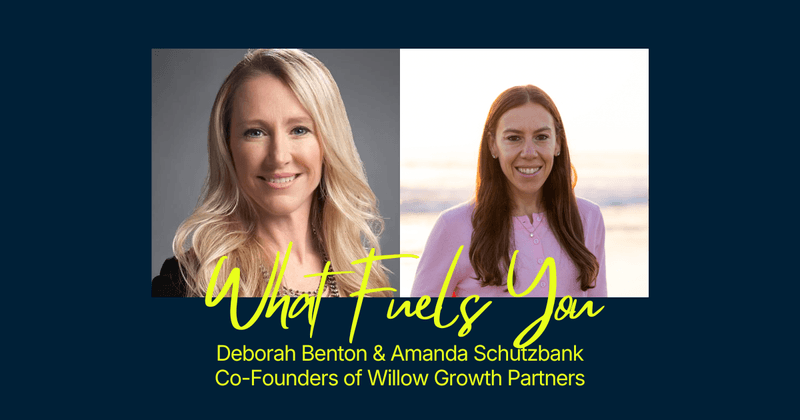
Co-Founders and General Partners of Willow Growth Partners
What happens when two of the only five women actively investing in consumer in Los Angeles sit down over coffee in Malibu and one of them says: stop angel investing alone and go raise a real fund? You get Willow Growth Partners -- a $100 million vehicle built specifically to write the first institutional check that consumer brands almost never get right.
In this episode of What Fuels You, host Shauna Swerland sits down with Debra Benton and Amanda Shutzbank, co-founders and general partners of Willow Growth Partners, for a conversation that covers horse stalls at 5:30am, Goldman Sachs Hunger Games internships, raising a $30 million fund entirely over Zoom during COVID, why tech VCs nearly broke the consumer brand ecosystem, what founder values alignment actually means in practice, and how AI is compressing brand-building timelines from six years to three. The throughline across both of their stories is simple: operators investing in operators, betting on brands that people wake up and cannot live without.
📋 Episode Chapters
| 00:00 | Opening: what fuels Debra Benton and Amanda Shutzbank -- sharing in founders' success and difficulty |
| 02:30 | Rapid fire: brand loyalty, German cars, and why Deb doesn't have a single lifelong brand |
| 07:00 | What makes a brand sticky: community, emotional connection, and the millennial mom consumer |
| 12:00 | Willow portfolio brands they use daily: Coterie diapers, Parallel multivitamins, Goodles, Day Haircare, Wise Beauty |
| 18:00 | Morning routines: Amanda's 4:45am wake-up, Deb's inbox-zero ritual, and Superhuman email |
| 24:00 | Deb's origin story: born in Malawi, raised in Winnipeg, competitive equestrian, parents who retired as school superintendents |
| 31:00 | Amanda's origin story: Long Island suburbs, dial-up internet, hypercompetitive athlete, early decision to Wharton |
| 38:00 | Goldman Sachs during Bear Stearns: internship Hunger Games, LinkedIn IPO, and why Amanda walked away from banking at 24 |
| 44:00 | Techstars NYC and Karma: choosing the harder route, living in Amsterdam, and learning to be the Swiss Army knife |
| 49:00 | How Willow was founded: five women investing in LA, 100-plus deals reviewed together, and a Malibu coffee meeting that changed everything |
| 54:00 | Investment mechanics: 50/50 gut vs. data, founder values alignment, and why collaboration and transparency are non-negotiable |
| 59:00 | What makes a great pitch: why Deb skips the deck and Amanda wants to know what makes you tick |
| 63:00 | AI in consumer brands: A/B testing at speed, supply chain modernization, and the "$100M with 12 employees" bet |
| 66:00 | What fuels you: great teams, the honor of the founder's journey, and never putting the fund ahead of the founder |
From Malawi to Malibu: Two Operators Who Built the Fund They Wished Had Existed
Debra Benton did not set out to become a venture investor. She spent more than 15 years as an operator -- President and COO at Nasty Gal, COO at ShoeDazzle, EVP at Teleflora -- accumulating the kind of operating muscle that most consumer VCs talk about but have never actually used. When she stepped back from those roles around 2014 and started investing off her own balance sheet, she was following instinct into angel checks and board work, and noticing a gap that nobody seemed to be filling. The first institutional check for a consumer brand -- the lead round for a company doing $1 to $3 million in revenue -- was being written by tech VCs who expected tech-like returns and applied tech-like valuations. The results were mostly bad.
Amanda Shutzbank took a more deliberate path. She did early decision at Wharton, spent her summers at Goldman Sachs during the Bear Stearns collapse, joined Bank of America Merrill Lynch in equity capital markets, and worked on transactions including the LinkedIn IPO. Then at 24 or 25 -- fresh off a bad breakup, by her own admission -- she quit the traditional path entirely to help David Tisch run the founding years of Techstars NYC. From there she joined the consumer hardware startup Karma as first employee, then invested in consumer at Amplify and Primary Venture Partners in New York before relocating to Los Angeles. A mutual colleague, noting there were only about five women actively investing in consumer in LA at the time, introduced her to Deb. They started reviewing deals together. They co-invested. And then, sitting in Malibu over coffee, Amanda told Deb she needed to stop angel investing alone and go raise a real fund.
"I was like, why don't you start a fund? I'm not the one who should be doing these deals. You should do these deals, but you need to write a bigger check."
-- Amanda Shutzbank
Deb's initial response was honest and a little funny: "I have a good life. I like my angel investing. I don't know." Amanda kept pushing. Eventually Deb said yes, but only if Amanda came with her. That is how Willow Growth Partners was born.
Raising $30 Million Over Zoom During COVID, With a Diaper Brand as the Anchor
Willow launched its first fund in May 2020. The timing was not planned. Deb and Amanda had spent about a year building the fund structure, completed in-person meetings in Seattle and New York between February and March 2020 -- and then the world shut down. Amanda had already quit her job. They looked at each other, decided to go forward, and raised the entire $30 million over Zoom, across time zones, in back-to-back calls running until 8 or 9 at night. Neither of them had used Zoom before the pandemic.
The investment that catalyzed their first close was Coterie, a premium diaper brand Amanda had discovered through an influencer she followed. She ordered a box, felt the product, and knew it was different. When Deb came over to her house while they were building the fund, Amanda handed her a diaper and told her to feel it. They did the Coterie deal in May 2020, at the height of COVID, locked in their respective homes. That investment -- and the story of how Amanda found it -- became the proof of concept for the entire Willow thesis: invest behind brands that consumers wake up and feel they cannot live without.
"I tried it and immediately when I felt it, I was like, oh my God, this is different. Like it is just a way better product than anything on the market."
-- Amanda Shutzbank
The Willow Thesis: Fix the First Check, Fix the Category
Willow's stated approach is specific: lead the first institutional round for consumer brands doing $1 to $5 million in trailing twelve-month revenue, write checks of $2 to $3 million, often take a board seat, and build alongside the company toward a rational exit. The fund does not do pre-launch as a rule -- though Deb noted they have made exceptions twice and are preparing to do so two more times -- because some evidence of market resonance matters at this stage. Reviews exist. Customer data exists. At least a year of operating history usually does too.
What makes Willow distinct from what came before is the explicit rejection of the growth-at-all-costs mentality that tech VCs brought into consumer investing during the 2019 through 2022 period. Deb watched that era from the inside and saw valuations set too high, exit expectations misaligned with how consumer brands actually scale, and well-made products blowing up because nobody in the boardroom understood the category. Willow was built on a direct counter-premise: consumer brands need a lead investor who has actually operated one. The fund reviews roughly 100 deals for every one it funds -- approximately 1% of what crosses their desk.
"It was a tech VC that were dabbling in consumer coming in and writing those first checks and honestly, really not doing them service, like not doing well by them. Valuations were too high. They expected tech-like exits."
-- Debra Benton
Founder Values Alignment Has Become the Deciding Factor
Over seven years of investing, both Deb and Amanda have moved founder values alignment higher in their framework. They are looking for collaboration, communication, and transparency -- not as preferences but as predictors of working relationship quality and investment outcome. When Shauna Swerland asked them to get specific about what values alignment actually means, Deb said they start with a simple question: is this fundamentally a good person? They have learned to pattern-recognize what the absence of those traits costs them downstream.
"I think we have been able to pattern recognize that that generally for us leads to success. And not having that, not only is probably, you know, frustrating experience for us and probably for the founder as well. I just think it's a lower likelihood of success when you don't have that."
-- Debra Benton
What a Great Pitch Looks Like -- and Why Deb Wants to Skip the Deck
Neither Deb nor Amanda needs a polished pitch when they agree to a first call. They are not looking for a clean model or a perfectly formatted deck walked through slide by slide. By the time they take the call, they have already reviewed the materials. What Deb wants in those first one or two conversations is to understand who the founder is: where they came from, why they are doing this, why they believe they are the right person to build this particular brand, and whether they have the tenacity to survive the journey ahead.
Amanda puts it slightly differently. She gives founders the benefit of the doubt and lets them lead the meeting. If going through the deck is how a nervous founder performs best, she will follow them. But she is clear about what she finds most effective. The goal of the first meeting is a second meeting, and the most direct path there is a founder who can talk honestly about what makes them tick.
"I personally resonate with people, so I want to hear them talk. I want to get a sense of who they are. I want to get a sense of of why are they doing this. We know it's going to be an incredibly difficult journey. We, we need to believe that they're doing it for what we think are the right reasons."
-- Debra Benton
AI Is Compressing Consumer Brand Timelines -- And Willow Is Watching Closely
Deb has raised AI unprompted multiple times across the conversation, drawing a direct parallel to the late-1990s e-commerce inflection she lived through at eToys, when the company went public in late 1999 and the market collapsed in March 2000. She was a mid-level manager at the time, surrounded by some of the smartest people she had ever worked with, and she describes that era the same way she describes AI now: a fundamental shift in how business operates, not a tactical tool, with implications far beyond the obvious surface-level use case.
Inside the Willow portfolio, AI is showing up most concretely in marketing -- specifically in the speed and cost of A/B testing. Brands that are using it effectively can generate many creative variations, dynamically test them against each other, and implement the winners without the manual cycles that previously made testing slow and expensive. AI is also being applied to market research, competitive positioning, and pricing analysis. On the supply chain side, Deb is paying close attention to a new category of tools aimed at modernizing what has historically been a legacy, communication-siloed function. She is direct about the workforce implication: these tools will reduce headcount on brand teams. She views that primarily as a margin story.
One of Willow's newest portfolio companies has set a goal of reaching $100 million in revenue with fewer than 12 full-time employees -- a number that would have been unthinkable five years ago. Amanda added that companies are scaling faster overall, compressing what used to be a six-year journey to the $100 million revenue mark down to roughly three years. That speed creates a sourcing challenge for Willow: they need to identify great brands earlier than ever before.
"Very similar, by the way, to how I feel now with AI. Major, major inflection point that is not just -- it went far beyond just kind of e-commerce. I feel very similarly, maybe even more right now with AI and the impact that it's going to have on our lives."
-- Debra Benton
Growing Up: Horses at Dawn, Long Island Kitchens, and Learning What Hard Work Actually Costs
The two founders have different origin stories that shaped them in complementary ways. Deb was born in Malawi, moved to Winnipeg, Manitoba as a young child, then relocated to Ontario at age 10. Her parents were both British-born teachers who retired as superintendents of education responsible for multimillion-dollar budgets. Her mother, now 84, ran a significant organization with what Deb described as modesty and grace -- so much so that Deb did not fully understand how unusual her mother's career was until she was an adult looking back. Deb was a competitive swimmer and then a competitive equestrian, riding until she left for university. When the family moved to Ontario they had their own stable, their own horses, and a horse trailer. Her mother drove them to shows across the region. Deb was up at 5:30am before school feeding and grooming horses, then doing it again when she got home.
Amanda grew up on Long Island in a close community where she rode her bike to friends' houses and remembers getting her first dial-up computer and AOL screen name right at the start of middle school. Her father was an entrepreneur who woke up at 5am and ran multiple businesses. She described herself as hypercompetitive from childhood -- captain of multiple sports teams, early decision to Wharton, "most likely to be successful" in her graduating class of 512. She was also entirely self-motivated. Nobody told her to do her homework. She was already working toward goals she had set for herself before most of her peers had thought about what they wanted.
"I mean, without a doubt, my parents were my greatest role models. Without a doubt. Like, in every single way. Every single way."
-- Debra Benton
Deb also did not flinch from the harder admission. She told Shauna Swerland that she missed out on a lot with her children during her operating years -- days when the nanny arrived at 7am while the kids were still sleeping and Deb got home at 9 or 10pm, long after they were in bed. She has no regrets in the formal sense, she said, but she is clear-eyed about what she sacrificed. She spoke openly about her admiration for Amanda and her husband Jason for operating as a real team with three young children, something Deb said she did not have in that same way twenty years earlier.
5 Key Takeaways
Frequently Asked Questions
What is Willow Growth Partners and what stage do they invest at?
Willow Growth Partners is a Los Angeles-based venture fund co-founded by Debra Benton and Amanda Shutzbank that invests exclusively in early-stage consumer brands. The fund leads first institutional rounds for companies generating approximately $1 to $5 million in trailing twelve-month revenue, writing initial checks of $2 to $3 million and often taking a board seat. Their second fund, closed at the end of 2024, is just under $100 million.
How did Debra Benton and Amanda Shutzbank start Willow Growth Partners?
The two met around 2016 when a mutual colleague introduced them in Los Angeles, noting there were only about five women actively investing in consumer in the city at the time. Over the next few years they co-reviewed more than 100 deals together and co-invested across their respective funds. The fund idea crystallized during a coffee meeting in Malibu where Amanda pushed Deb to stop investing individually and raise an institutional fund. They launched in May 2020, raised their first $30 million entirely over Zoom during the COVID lockdown, and anchored that first close with their investment in Coterie diapers.
What does Debra Benton say makes a great pitch to Willow Growth Partners?
Deb Benton said that by the time she takes a first call, she has already reviewed the materials and does not need founders to walk her through the deck slide by slide. What she actually wants is to understand who the founder is, where they came from, why they are doing this, and whether they have the tenacity to survive what she described as an "incredibly difficult journey." She said the most effective first conversation is one where the founder talks openly about what makes them tick, because the goal of that meeting is simply to earn a second one.
How is Willow Growth Partners seeing AI affect their consumer brand portfolio?
Deb Benton said the most practical near-term applications in their portfolio are AI-driven A/B testing in marketing, market research, competitive positioning analysis, and supply chain modernization. She noted that one of Willow's newest portfolio companies is targeting $100 million in revenue with fewer than 12 full-time employees, a scale that would have been impossible five years ago. Amanda Shutzbank added that companies are scaling to $100 million in roughly three years rather than six, which is compressing the window Willow has to identify great brands and creating pressure to source earlier.
What consumer categories does Willow Growth Partners focus on?
Willow concentrates on personal care, food and beverage, and health and wellness, with a preference for high-repeat-purchase consumables that consumers integrate into their daily lives. Their portfolio includes Coterie diapers, Parallel multivitamins, Goodles mac and cheese, Day Haircare, Jesse and Ben's frozen fries, Dojo kids personal care, and Wise Beauty. Amanda Shutzbank said they invest heavily behind the Gen Alpha movement and the millennial mom consumer, a segment she described as community-driven and brand-conscious across every category of their lives.
``` ---
Co-Founders and General Partners of Willow Growth Partners
What happens when two of the only five women actively investing in consumer in Los Angeles sit down over coffee in Malibu and one of them says: stop angel investing alone and go raise a real fund? You get Willow Growth Partners -- a $100 million vehicle built specifically to write the first institutional check that consumer brands almost never get right.
In this episode of What Fuels You, host Shauna Swerland sits down with Debra Benton and Amanda Shutzbank, co-founders and general partners of Willow Growth Partners, for a conversation that covers horse stalls at 5:30am, Goldman Sachs Hunger Games internships, raising a $30 million fund entirely over Zoom during COVID, why tech VCs nearly broke the consumer brand ecosystem, what founder values alignment actually means in practice, and how AI is compressing brand-building timelines from six years to three. The throughline across both of their stories is simple: operators investing in operators, betting on brands that people wake up and cannot live without.
📋 Episode Chapters
| 00:00 | Opening: what fuels Debra Benton and Amanda Shutzbank -- sharing in founders' success and difficulty |
| 02:30 | Rapid fire: brand loyalty, German cars, and why Deb doesn't have a single lifelong brand |
| 07:00 | What makes a brand sticky: community, emotional connection, and the millennial mom consumer |
| 12:00 | Willow portfolio brands they use daily: Coterie diapers, Parallel multivitamins, Goodles, Day Haircare, Wise Beauty |
| 18:00 | Morning routines: Amanda's 4:45am wake-up, Deb's inbox-zero ritual, and Superhuman email |
| 24:00 | Deb's origin story: born in Malawi, raised in Winnipeg, competitive equestrian, parents who retired as school superintendents |
| 31:00 | Amanda's origin story: Long Island suburbs, dial-up internet, hypercompetitive athlete, early decision to Wharton |
| 38:00 | Goldman Sachs during Bear Stearns: internship Hunger Games, LinkedIn IPO, and why Amanda walked away from banking at 24 |
| 44:00 | Techstars NYC and Karma: choosing the harder route, living in Amsterdam, and learning to be the Swiss Army knife |
| 49:00 | How Willow was founded: five women investing in LA, 100-plus deals reviewed together, and a Malibu coffee meeting that changed everything |
| 54:00 | Investment mechanics: 50/50 gut vs. data, founder values alignment, and why collaboration and transparency are non-negotiable |
| 59:00 | What makes a great pitch: why Deb skips the deck and Amanda wants to know what makes you tick |
| 63:00 | AI in consumer brands: A/B testing at speed, supply chain modernization, and the "$100M with 12 employees" bet |
| 66:00 | What fuels you: great teams, the honor of the founder's journey, and never putting the fund ahead of the founder |
From Malawi to Malibu: Two Operators Who Built the Fund They Wished Had Existed
Debra Benton did not set out to become a venture investor. She spent more than 15 years as an operator -- President and COO at Nasty Gal, COO at ShoeDazzle, EVP at Teleflora -- accumulating the kind of operating muscle that most consumer VCs talk about but have never actually used. When she stepped back from those roles around 2014 and started investing off her own balance sheet, she was following instinct into angel checks and board work, and noticing a gap that nobody seemed to be filling. The first institutional check for a consumer brand -- the lead round for a company doing $1 to $3 million in revenue -- was being written by tech VCs who expected tech-like returns and applied tech-like valuations. The results were mostly bad.
Amanda Shutzbank took a more deliberate path. She did early decision at Wharton, spent her summers at Goldman Sachs during the Bear Stearns collapse, joined Bank of America Merrill Lynch in equity capital markets, and worked on transactions including the LinkedIn IPO. Then at 24 or 25 -- fresh off a bad breakup, by her own admission -- she quit the traditional path entirely to help David Tisch run the founding years of Techstars NYC. From there she joined the consumer hardware startup Karma as first employee, then invested in consumer at Amplify and Primary Venture Partners in New York before relocating to Los Angeles. A mutual colleague, noting there were only about five women actively investing in consumer in LA at the time, introduced her to Deb. They started reviewing deals together. They co-invested. And then, sitting in Malibu over coffee, Amanda told Deb she needed to stop angel investing alone and go raise a real fund.
"I was like, why don't you start a fund? I'm not the one who should be doing these deals. You should do these deals, but you need to write a bigger check."
-- Amanda Shutzbank
Deb's initial response was honest and a little funny: "I have a good life. I like my angel investing. I don't know." Amanda kept pushing. Eventually Deb said yes, but only if Amanda came with her. That is how Willow Growth Partners was born.
Raising $30 Million Over Zoom During COVID, With a Diaper Brand as the Anchor
Willow launched its first fund in May 2020. The timing was not planned. Deb and Amanda had spent about a year building the fund structure, completed in-person meetings in Seattle and New York between February and March 2020 -- and then the world shut down. Amanda had already quit her job. They looked at each other, decided to go forward, and raised the entire $30 million over Zoom, across time zones, in back-to-back calls running until 8 or 9 at night. Neither of them had used Zoom before the pandemic.
The investment that catalyzed their first close was Coterie, a premium diaper brand Amanda had discovered through an influencer she followed. She ordered a box, felt the product, and knew it was different. When Deb came over to her house while they were building the fund, Amanda handed her a diaper and told her to feel it. They did the Coterie deal in May 2020, at the height of COVID, locked in their respective homes. That investment -- and the story of how Amanda found it -- became the proof of concept for the entire Willow thesis: invest behind brands that consumers wake up and feel they cannot live without.
"I tried it and immediately when I felt it, I was like, oh my God, this is different. Like it is just a way better product than anything on the market."
-- Amanda Shutzbank
The Willow Thesis: Fix the First Check, Fix the Category
Willow's stated approach is specific: lead the first institutional round for consumer brands doing $1 to $5 million in trailing twelve-month revenue, write checks of $2 to $3 million, often take a board seat, and build alongside the company toward a rational exit. The fund does not do pre-launch as a rule -- though Deb noted they have made exceptions twice and are preparing to do so two more times -- because some evidence of market resonance matters at this stage. Reviews exist. Customer data exists. At least a year of operating history usually does too.
What makes Willow distinct from what came before is the explicit rejection of the growth-at-all-costs mentality that tech VCs brought into consumer investing during the 2019 through 2022 period. Deb watched that era from the inside and saw valuations set too high, exit expectations misaligned with how consumer brands actually scale, and well-made products blowing up because nobody in the boardroom understood the category. Willow was built on a direct counter-premise: consumer brands need a lead investor who has actually operated one. The fund reviews roughly 100 deals for every one it funds -- approximately 1% of what crosses their desk.
"It was a tech VC that were dabbling in consumer coming in and writing those first checks and honestly, really not doing them service, like not doing well by them. Valuations were too high. They expected tech-like exits."
-- Debra Benton
Founder Values Alignment Has Become the Deciding Factor
Over seven years of investing, both Deb and Amanda have moved founder values alignment higher in their framework. They are looking for collaboration, communication, and transparency -- not as preferences but as predictors of working relationship quality and investment outcome. When Shauna Swerland asked them to get specific about what values alignment actually means, Deb said they start with a simple question: is this fundamentally a good person? They have learned to pattern-recognize what the absence of those traits costs them downstream.
"I think we have been able to pattern recognize that that generally for us leads to success. And not having that, not only is probably, you know, frustrating experience for us and probably for the founder as well. I just think it's a lower likelihood of success when you don't have that."
-- Debra Benton
What a Great Pitch Looks Like -- and Why Deb Wants to Skip the Deck
Neither Deb nor Amanda needs a polished pitch when they agree to a first call. They are not looking for a clean model or a perfectly formatted deck walked through slide by slide. By the time they take the call, they have already reviewed the materials. What Deb wants in those first one or two conversations is to understand who the founder is: where they came from, why they are doing this, why they believe they are the right person to build this particular brand, and whether they have the tenacity to survive the journey ahead.
Amanda puts it slightly differently. She gives founders the benefit of the doubt and lets them lead the meeting. If going through the deck is how a nervous founder performs best, she will follow them. But she is clear about what she finds most effective. The goal of the first meeting is a second meeting, and the most direct path there is a founder who can talk honestly about what makes them tick.
"I personally resonate with people, so I want to hear them talk. I want to get a sense of who they are. I want to get a sense of of why are they doing this. We know it's going to be an incredibly difficult journey. We, we need to believe that they're doing it for what we think are the right reasons."
-- Debra Benton
AI Is Compressing Consumer Brand Timelines -- And Willow Is Watching Closely
Deb has raised AI unprompted multiple times across the conversation, drawing a direct parallel to the late-1990s e-commerce inflection she lived through at eToys, when the company went public in late 1999 and the market collapsed in March 2000. She was a mid-level manager at the time, surrounded by some of the smartest people she had ever worked with, and she describes that era the same way she describes AI now: a fundamental shift in how business operates, not a tactical tool, with implications far beyond the obvious surface-level use case.
Inside the Willow portfolio, AI is showing up most concretely in marketing -- specifically in the speed and cost of A/B testing. Brands that are using it effectively can generate many creative variations, dynamically test them against each other, and implement the winners without the manual cycles that previously made testing slow and expensive. AI is also being applied to market research, competitive positioning, and pricing analysis. On the supply chain side, Deb is paying close attention to a new category of tools aimed at modernizing what has historically been a legacy, communication-siloed function. She is direct about the workforce implication: these tools will reduce headcount on brand teams. She views that primarily as a margin story.
One of Willow's newest portfolio companies has set a goal of reaching $100 million in revenue with fewer than 12 full-time employees -- a number that would have been unthinkable five years ago. Amanda added that companies are scaling faster overall, compressing what used to be a six-year journey to the $100 million revenue mark down to roughly three years. That speed creates a sourcing challenge for Willow: they need to identify great brands earlier than ever before.
"Very similar, by the way, to how I feel now with AI. Major, major inflection point that is not just -- it went far beyond just kind of e-commerce. I feel very similarly, maybe even more right now with AI and the impact that it's going to have on our lives."
-- Debra Benton
Growing Up: Horses at Dawn, Long Island Kitchens, and Learning What Hard Work Actually Costs
The two founders have different origin stories that shaped them in complementary ways. Deb was born in Malawi, moved to Winnipeg, Manitoba as a young child, then relocated to Ontario at age 10. Her parents were both British-born teachers who retired as superintendents of education responsible for multimillion-dollar budgets. Her mother, now 84, ran a significant organization with what Deb described as modesty and grace -- so much so that Deb did not fully understand how unusual her mother's career was until she was an adult looking back. Deb was a competitive swimmer and then a competitive equestrian, riding until she left for university. When the family moved to Ontario they had their own stable, their own horses, and a horse trailer. Her mother drove them to shows across the region. Deb was up at 5:30am before school feeding and grooming horses, then doing it again when she got home.
Amanda grew up on Long Island in a close community where she rode her bike to friends' houses and remembers getting her first dial-up computer and AOL screen name right at the start of middle school. Her father was an entrepreneur who woke up at 5am and ran multiple businesses. She described herself as hypercompetitive from childhood -- captain of multiple sports teams, early decision to Wharton, "most likely to be successful" in her graduating class of 512. She was also entirely self-motivated. Nobody told her to do her homework. She was already working toward goals she had set for herself before most of her peers had thought about what they wanted.
"I mean, without a doubt, my parents were my greatest role models. Without a doubt. Like, in every single way. Every single way."
-- Debra Benton
Deb also did not flinch from the harder admission. She told Shauna Swerland that she missed out on a lot with her children during her operating years -- days when the nanny arrived at 7am while the kids were still sleeping and Deb got home at 9 or 10pm, long after they were in bed. She has no regrets in the formal sense, she said, but she is clear-eyed about what she sacrificed. She spoke openly about her admiration for Amanda and her husband Jason for operating as a real team with three young children, something Deb said she did not have in that same way twenty years earlier.
5 Key Takeaways
Frequently Asked Questions
What is Willow Growth Partners and what stage do they invest at?
Willow Growth Partners is a Los Angeles-based venture fund co-founded by Debra Benton and Amanda Shutzbank that invests exclusively in early-stage consumer brands. The fund leads first institutional rounds for companies generating approximately $1 to $5 million in trailing twelve-month revenue, writing initial checks of $2 to $3 million and often taking a board seat. Their second fund, closed at the end of 2024, is just under $100 million.
How did Debra Benton and Amanda Shutzbank start Willow Growth Partners?
The two met around 2016 when a mutual colleague introduced them in Los Angeles, noting there were only about five women actively investing in consumer in the city at the time. Over the next few years they co-reviewed more than 100 deals together and co-invested across their respective funds. The fund idea crystallized during a coffee meeting in Malibu where Amanda pushed Deb to stop investing individually and raise an institutional fund. They launched in May 2020, raised their first $30 million entirely over Zoom during the COVID lockdown, and anchored that first close with their investment in Coterie diapers.
What does Debra Benton say makes a great pitch to Willow Growth Partners?
Deb Benton said that by the time she takes a first call, she has already reviewed the materials and does not need founders to walk her through the deck slide by slide. What she actually wants is to understand who the founder is, where they came from, why they are doing this, and whether they have the tenacity to survive what she described as an "incredibly difficult journey." She said the most effective first conversation is one where the founder talks openly about what makes them tick, because the goal of that meeting is simply to earn a second one.
How is Willow Growth Partners seeing AI affect their consumer brand portfolio?
Deb Benton said the most practical near-term applications in their portfolio are AI-driven A/B testing in marketing, market research, competitive positioning analysis, and supply chain modernization. She noted that one of Willow's newest portfolio companies is targeting $100 million in revenue with fewer than 12 full-time employees, a scale that would have been impossible five years ago. Amanda Shutzbank added that companies are scaling to $100 million in roughly three years rather than six, which is compressing the window Willow has to identify great brands and creating pressure to source earlier.
What consumer categories does Willow Growth Partners focus on?
Willow concentrates on personal care, food and beverage, and health and wellness, with a preference for high-repeat-purchase consumables that consumers integrate into their daily lives. Their portfolio includes Coterie diapers, Parallel multivitamins, Goodles mac and cheese, Day Haircare, Jesse and Ben's frozen fries, Dojo kids personal care, and Wise Beauty. Amanda Shutzbank said they invest heavily behind the Gen Alpha movement and the millennial mom consumer, a segment she described as community-driven and brand-conscious across every category of their lives.
``` ---