

"To Really Be a Lifelong Learner, You Have to Push Yourself Outside Your Comfort Zone" -- Mitch Gold, Co-Founder and CEO of Alpine Immune Sciences
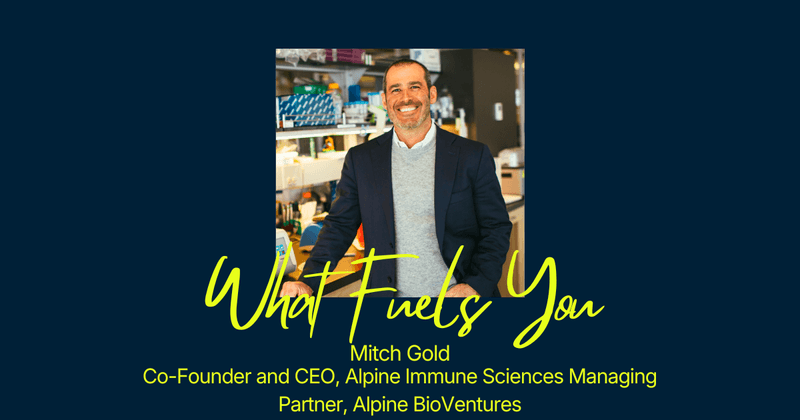
Mitch Gold Co-Founder and CEO, Alpine Immune Sciences; Managing Partner, Alpine BioVentures
Mitch Gold, MD
Co-Founder and CEO, Alpine Immune Sciences; Managing Partner, Alpine BioVentures
Mitchell H. Gold, MD, is a Seattle-based biotech entrepreneur and investor who served as President and CEO of Dendreon for a decade, where he led the development of Provenge, the first FDA-approved cancer immunotherapy, and helped establish Seattle as a global hub for cellular therapy. He co-founded Alpine BioVentures in 2012 and Alpine Immune Sciences in 2015, both named after his mother Andrea Lynn Paradise, whose initials they carry. He was named runner-up to Steve Jobs and Jeff Bezos for Fortune's Smartest CEO award, Entrepreneur of the Year in the Pacific Northwest by Ernst and Young in 2011, and Top Influencer in Medicine by Seattle Magazine in 2010. He trained at Rush Presbyterian St. Luke's Medical School in Chicago and completed his urology residency at the University of Washington, where he arrived in 1993.
10
Years as President and CEO of Dendreon
$400M
Annual revenue from Provenge at peak
4
Age when Mitch lost his mother to breast cancer
$100M
Funding raised by Alpine Immune Sciences
| Time | Topic |
|---|---|
| 00:00 | Rapid fire -- Heli-skiing outside Nelson BC, the Jetsons, being born in the '60s, and what Mitch is studying right now about humanity's innovation curve |
| 05:00 | Growing up in Highland Park, Illinois -- A middle-class kid in an affluent suburb, a grandfather who founded one of the first condom manufacturing businesses, and the vicarious learning that drove Mitch to succeed |
| 10:00 | Losing his mother at age 4 -- How Andrea Lynn Paradise died of breast cancer in 1971 when she was 26 and the doctor dismissed her lump, and why every company Mitch built carries her initials |
| 15:00 | From all Ds in high school to straight As -- The football teammate Peter Zylis who changed everything, and the commitment Mitch made at 13 to dedicate his life to curing cancer |
| 21:00 | Medicine meets business -- The internship with BC Jordan who discovered tamoxifen, the urology residency at UW, and starting a healthcare internet company with 80 employees while still a full-time resident in 1995 |
| 28:00 | Getting to Dendreon by airplane seat -- Sending a cold application that was never answered, then sitting next to a biotech analyst on a flight to New Orleans who introduced him to the CEO a week later |
| 33:00 | Building Provenge and proving immunotherapy works -- How Dendreon became the first company to show the immune system could make prostate cancer patients live longer, and why that changed every immunotherapy trial that followed |
| 39:00 | CRISPR, gene editing, and the species changing itself -- For the first time in 200,000 years of human history, we can now edit our own evolution, what that means for disease, and why China is already doing it |
| 45:00 | Alpine Immune Sciences and the mother behind the name -- How a whiteboard idea and a lacrosse dad connection became a company targeting lupus, Sjogren's disease, and graft-versus-host disease |
| 50:00 | Building culture around failure and thinking big -- Why mediocrity is the most dangerous place, why failure is required for great things, and what Dendreon taught Mitch about swinging for the fence |
| 54:00 | What fuels Mitch -- Being a lifelong learner, pushing outside the comfort zone, and why the natural world is the one place where nothing is artificial |
The Mother Behind Every Company Name
Most people assume Mitch Gold named his companies Alpine BioVentures and Alpine Immune Sciences after the mountains he loves to ski. He lets them assume that. The truth is different and more personal. His mother was Andrea Lynn Paradise. Her initials are A.L.P. Every company he has built carries those three letters. She died of breast cancer in 1971 at age 26. Mitch was 4 years old. She had gone to her doctor with a lump in her breast. The doctor told her she was 25 years old and there was no way she could have breast cancer. Her own mother had also died of breast cancer. The BRCA mutation linking Ashkenazi Jewish women to elevated breast cancer risk was not yet understood. The doctor was wrong, and Mitch's mother was dead within a year.
He describes what followed as a deep, dark period. Emerging from it took time. By the time he was 13, he had also lost both paternal grandparents to cancer. He made a commitment to his father: he was going to dedicate his life to trying to cure cancer. He has kept that commitment for more than 40 years across a career that moved through medicine, internet startups, pharmaceutical development, venture capital, and company founding. The thread connecting all of it is his mother's name spelled out in the names of the companies he built.
"All of my companies, her name was Andrea Lynn Paradise. So people think I named my companies Alpine Bioventures, Alpine Immune Sciences, you know, after my love of skiing in the mountains. Yeah, but they're all actually named after her. They're her initials."
Mitch's sister, years later, tested positive for the BRCA mutation that likely killed their mother. She underwent bilateral mastectomies and an oophorectomy in her late 30s. Mitch describes the trajectory of medicine on this specific issue with the mix of grief and optimism that runs through the whole conversation: in the future, the test will be done in utero and the gene will simply be edited out. He considers this a natural and unambiguous application of CRISPR technology. The harder ethical questions, he acknowledges, come when the same tool gets used to select for traits rather than eliminate disease.
From All Ds to Straight As, and a Promise Made at 13
Mitch grew up in Highland Park, a suburb north of Chicago he describes as relatively affluent. His family was middle class within that context, which he says drove him while also giving him visible models of what success looked like through vicarious learning. His grandfather had started one of the first condom manufacturing businesses in the country, called Protex, a direct competitor to Trojan. His father took over that business. Mitch was, in his words, the star of high school for reasons that required no further explanation.
He was not, however, a good student. His freshman year of high school he was getting all Ds and Es and had no interest in academia. A teammate on the football team, a bright kid named Peter Zylis, pulled him aside and told him directly: he believed in Mitch, and if they both got straight As they could do whatever they wanted with their lives. Mitch dedicated himself to that standard and never got a B again. He went to the University of Wisconsin, completed pre-med, and then followed the path to medical school at Rush Presbyterian St. Luke's in Chicago, where a urology department head named Paul Marik made him feel like a colleague from day one and drew him into the surgical subspecialty. It was, he says, entirely a function of the people he met.
"They say there's like a handful of people that really determine how your life goes. Paul Merrick was one of them. There's been a number of others along the way."
He matched to the University of Washington for his urology residency in 1993, giving his wife Dawn the choice between USC and Seattle. Her brother was living in Seattle. She chose Seattle. He was going to be working all the time anyway. He arrived in a city he describes as a very different place from what it is today, and immediately fell in love with the mountains, the mountain biking, and a chairman of the UW urology department named Paul Lang who he still meets for breakfast every quarter. By his second year of residency, he had already started building a company that put healthcare records on the internet.
A Cold Application, an Airplane Seat, and the Company That Changed Immunotherapy
After his internet healthcare company was acquired by what became a division of General Electric, Mitch spent a year there and hated every day of it. He wanted to get into biotech. He sent a cold application to Dendreon for a business development role. No one ever called him back. He would later become the company's CEO. The bridge between those two facts is a man named Mark Monahan, an analyst covering Dendreon at a New York bank, whom Mitch happened to sit next to on a flight home from a healthcare conference in New Orleans. Mitch mentioned he wanted to get into Dendreon. Monahan offered to introduce him to the CEO. A week later Mitch had the job.
At Dendreon, Mitch inherited a concept that the scientific community had been skeptical of for decades: using the immune system to fight cancer. The foundational idea dated to a surgeon in the 1800s named Coley, who noticed that patients who developed the most serious post-surgical infections often had the most significant cancer regressions. The mechanism was immune activation. Dendreon's approach was to take a patient's own cells outside the body, activate them against a specific prostate cancer protein, and reinfuse them. Mitch took over as CEO around 2001 when the company was struggling, dug through the data, and found a pathway forward. Thirteen years later, the resulting drug, Provenge, was generating $400 million in annual revenue and helping thousands of prostate cancer patients live longer.
"We were the first company to really show in the prostate cancer space that we can get patients to live longer on an immunotherapy. And that concept was new, and that really changed the whole field. So now all the immunotherapy trials are based on survival."
He is clear-eyed about what Dendreon also taught him. Nothing happens without significant friction. He was young and inexperienced as a CEO. A lot of people did not believe it was going to work. He describes himself as a dog with a bone, someone who was not going to let the company lose regardless of how hard the fight got. He credits Liz Smith, Rob Hirschberg, and Mark Froelich as the operational leaders who made it possible. The broader legacy, in his view, is that Dendreon proved cellular immunotherapy could work, which became the scientific foundation for Juno Therapeutics, Lyell Immunopharma, and the generation of Seattle biotech companies that followed. Seattle's position as a global hub for cellular therapy, he says, traces directly back to Dendreon kicking the can down the road.
Alpine, the Whiteboard, and a Lacrosse Dad with the Right Connection
When Mitch decided to start Alpine Immune Sciences, he began with a whiteboard. He had concluded that the field of immune system modulation had gotten crowded and undisciplined, with companies throwing things against the wall without rigorous scientific thought behind the targeting strategy. He wanted a new way to modulate the immune system that people were not yet thinking about. The connection that made it real came from his son's lacrosse teammate's father, who called to say two scientists were leaving Amgen and wanted to pitch their idea. The idea was not exactly what Mitch had in mind. But the science was close enough. He and his partners spent nine months with the team shaping the application, then seeded the company with $1.2 million. Nine months after that, they had done a major deal with a pharmaceutical partner.
The companies funded by Alpine BioVentures have all followed variations of this model: back an early-stage science team, shape the application around a rigorous immunological thesis, and build toward an exit. Alpine Biosciences, which used nanoparticles licensed from Sandia National Labs to deliver proteins directly to cells, sold to Cascadian Therapeutics, which was later acquired by Seattle Genetics. Mavupharma, which targeted innate immunity as a pathway in cancer, was acquired by AbbVie in Chicago. At the time of this episode, Alpine Immune Sciences was targeting serious autoimmune conditions including lupus, Sjogren's disease, and graft-versus-host disease, with what Mitch describes as a novel cancer drug in the pipeline as well. He says the company feels the way Dendreon felt at a key inflection point, and that this time he has a great team and can actually sleep at night.
"What I've learned over the years is you hire great people and it'll let you sleep at night."
His framework for building culture is direct: mediocrity is the most dangerous place a team can be, and the antidote is giving people explicit permission to fail. He tells his teams that if they are not really failing, they are not really trying. Every meaningful transformative product, he says, was created by someone pushing it forward in the face of a very high probability of failure. Swinging for singles and doubles is safe. It is also not how you change a field.
The Lifelong Learner, the Mountains, and What Is Actually Real
Mitch reads across a wide range of subjects without always finishing the books he starts, pulling ideas and then moving on. At the time of this episode he was reading Thomas Friedman's Thank You for Being Late, which he describes as essential for understanding the current innovation inflection point and the convergence of big technology companies with biology and data. He listens to Joe Rogan, Naval Ravikant, and Dan Levitan. He emails his oldest son Aiden weekly to ask what podcast he has been listening to. He went to Singularity University in San Francisco with Aiden, where the convergence of global healthcare, climate change, and space travel came together in a single week. He teaches a class once a year at Lakeside School on where science is going. He says he learns more when he teaches than at any other point, partly because of the preparation required and partly because high school students immediately go after the same ethical questions adults avoid.
The thing he returns to consistently, in business and in parenting, is the natural world. He takes his sons mountain biking and backcountry skiing. He spent a night trapped in a valley between two avalanche zones with his dog Boaz after inadequate planning on an early-season ski tour, and came within 12 to 18 hours of dying. His response was to gather his entire ski team, acknowledge they had been pushing beyond their training, and take everyone through Level 1 and Level 2 avalanche certification. He sees direct parallels between that response and how he leads companies: something goes wrong, you name it, you learn it, you go back out.
"The natural world is so real that when you're in it, you can't help but kind of feel alive. And so when you go through those experiences together, that's really outside of your control. It's not a controlled environment. You tend to really grow close with not just your kids, but whoever you're back there with."
When Shauna Swerland asks what fuels him, his answer is being a lifelong learner, and he immediately qualifies it. It is a phrase that gets used casually and does not mean much unless you are actually doing it: associating with the right people, being proactive about finding new knowledge, and pushing yourself outside your comfort zone when it would be easy to stop. He says this is especially true for people who have made enough money to phone it in. He has watched people do that. He does not intend to.
5 Key Takeaways
🧬
Turn a personal loss into the organizing principle of a career
Mitch Gold lost his mother to a misdiagnosed breast cancer at age 4, made a commitment at 13 to dedicate his life to curing cancer, and named every company he built after her initials. That origin story is not background; it is the operating system.
✈️
The cold application that fails can still lead to the job
Mitch sent a cold application to Dendreon and never heard back. He ended up sitting next to a Dendreon-covering analyst on a flight home from a conference in New Orleans, mentioned he wanted in, and had the job a week later. He eventually became CEO.
🏔️
When you nearly die in the mountains, get certified and go back
After getting trapped overnight between two avalanche zones, Mitch's response was not to stop going. He gathered his entire ski team, acknowledged they had been outrunning their training, and got everyone through avalanche certification. He applies the same logic to how teams respond to failure in the lab.
🎯
Mediocrity is the most dangerous place for a company to be
Mitch tells his teams that swinging for singles and doubles is safe, not fun, and not how you change a field. His explicit cultural message is that real failure means you were actually trying, and that every transformative product in history was built by someone pushing forward against a high probability of failure.
📚
Lifelong learning requires actually pushing outside your comfort zone
Mitch is direct that the phrase gets used casually and does not mean much unless you are proactive about it: associating with the right people, seeking out new knowledge, and resisting the temptation to phone it in once you have enough money and credibility to coast.
Mitch Gold Alpine Immune Sciences Alpine BioVentures Dendreon Provenge What Fuels You Shauna Swerland Fuel Talent Cancer Immunotherapy Biotech CEO Venture Capital Prostate Cancer Immune System CRISPR Seattle Biotech Fred Hutch Lifelong Learning University of Washington University of Wisconsin Entrepreneurship FDA Approval Pacific Northwest Company Culture Autoimmune Disease
Frequently Asked Questions
Who is Mitch Gold and what is he known for in biotech?
Mitchell H. Gold, MD, is a Seattle-based biotech entrepreneur and investor best known for serving as President and CEO of Dendreon for a decade, where he led the development of Provenge, the first FDA-approved cancer immunotherapy, which demonstrated for the first time that the immune system could extend survival in prostate cancer patients. He co-founded Alpine BioVentures in 2012 and Alpine Immune Sciences in 2015, both named after his mother Andrea Lynn Paradise, who died of breast cancer when he was 4 years old. He has been named runner-up to Steve Jobs and Jeff Bezos for Fortune's Smartest CEO award and Entrepreneur of the Year in the Pacific Northwest by Ernst and Young.
Why did Mitch Gold name his companies Alpine BioVentures and Alpine Immune Sciences?
Most people assume the name comes from Mitch Gold's love of skiing and the mountains. The actual reason is his mother, Andrea Lynn Paradise, who died of breast cancer at age 26 when Mitch was 4 years old. He revealed on What Fuels You with Shauna Swerland that every company he has built carries her initials: A.L.P. The naming is a tribute and a motivational anchor that connects his career in cancer research directly to the personal loss that started it.
What did Dendreon accomplish and why did it matter for cancer treatment?
Under Mitch Gold's leadership, Dendreon developed Provenge, which became the first FDA-approved cancer immunotherapy in 2010 and the first treatment to demonstrate in a clinical trial that the immune system could make prostate cancer patients live longer. Before Provenge, clinical trials typically measured whether a tumor stopped growing, not whether patients survived longer. Dendreon's success changed that standard, and Mitch says on What Fuels You that all modern immunotherapy trials are now designed around survival as the primary endpoint. He also credits Dendreon with establishing Seattle as a global hub for cellular therapy, providing the scientific foundation for companies including Juno Therapeutics and Lyell Immunopharma.
What does Alpine Immune Sciences do?
Alpine Immune Sciences is a Seattle-based biotech company co-founded by Mitch Gold in 2015 that targets serious autoimmune and inflammatory diseases, including lupus, Sjogren's disease, and graft-versus-host disease, as well as cancer. The company uses a novel approach to immune modulation developed by scientists who left Amgen's Seattle campus, focused on engineering proteins that can modulate immune cell interactions at the surface level. On What Fuels You, Mitch describes the company as being at a key inflection point similar to where Dendreon was before it proved immunotherapy could work.
What does Mitch Gold think about CRISPR and the future of human evolution?
Mitch Gold told Shauna Swerland on What Fuels You that for the first time in 200,000 years of human history, our species can now change its own evolution using CRISPR gene editing, rather than being shaped purely by external environmental pressures. He sees the natural starting point as eliminating disease-causing genetic mutations, citing the BRCA mutation that killed his mother as a clear and defensible application. He acknowledges the ethical complexity grows significantly when the same technology is used to select for traits, but he is direct that there is no stopping it, that China is already moving forward, and that the species will look materially different as a result within the lifetimes of people alive today.
Mitch Gold Co-Founder and CEO, Alpine Immune Sciences; Managing Partner, Alpine BioVentures
Mitch Gold, MD
Co-Founder and CEO, Alpine Immune Sciences; Managing Partner, Alpine BioVentures
Mitchell H. Gold, MD, is a Seattle-based biotech entrepreneur and investor who served as President and CEO of Dendreon for a decade, where he led the development of Provenge, the first FDA-approved cancer immunotherapy, and helped establish Seattle as a global hub for cellular therapy. He co-founded Alpine BioVentures in 2012 and Alpine Immune Sciences in 2015, both named after his mother Andrea Lynn Paradise, whose initials they carry. He was named runner-up to Steve Jobs and Jeff Bezos for Fortune's Smartest CEO award, Entrepreneur of the Year in the Pacific Northwest by Ernst and Young in 2011, and Top Influencer in Medicine by Seattle Magazine in 2010. He trained at Rush Presbyterian St. Luke's Medical School in Chicago and completed his urology residency at the University of Washington, where he arrived in 1993.
10
Years as President and CEO of Dendreon
$400M
Annual revenue from Provenge at peak
4
Age when Mitch lost his mother to breast cancer
$100M
Funding raised by Alpine Immune Sciences
| Time | Topic |
|---|---|
| 00:00 | Rapid fire -- Heli-skiing outside Nelson BC, the Jetsons, being born in the '60s, and what Mitch is studying right now about humanity's innovation curve |
| 05:00 | Growing up in Highland Park, Illinois -- A middle-class kid in an affluent suburb, a grandfather who founded one of the first condom manufacturing businesses, and the vicarious learning that drove Mitch to succeed |
| 10:00 | Losing his mother at age 4 -- How Andrea Lynn Paradise died of breast cancer in 1971 when she was 26 and the doctor dismissed her lump, and why every company Mitch built carries her initials |
| 15:00 | From all Ds in high school to straight As -- The football teammate Peter Zylis who changed everything, and the commitment Mitch made at 13 to dedicate his life to curing cancer |
| 21:00 | Medicine meets business -- The internship with BC Jordan who discovered tamoxifen, the urology residency at UW, and starting a healthcare internet company with 80 employees while still a full-time resident in 1995 |
| 28:00 | Getting to Dendreon by airplane seat -- Sending a cold application that was never answered, then sitting next to a biotech analyst on a flight to New Orleans who introduced him to the CEO a week later |
| 33:00 | Building Provenge and proving immunotherapy works -- How Dendreon became the first company to show the immune system could make prostate cancer patients live longer, and why that changed every immunotherapy trial that followed |
| 39:00 | CRISPR, gene editing, and the species changing itself -- For the first time in 200,000 years of human history, we can now edit our own evolution, what that means for disease, and why China is already doing it |
| 45:00 | Alpine Immune Sciences and the mother behind the name -- How a whiteboard idea and a lacrosse dad connection became a company targeting lupus, Sjogren's disease, and graft-versus-host disease |
| 50:00 | Building culture around failure and thinking big -- Why mediocrity is the most dangerous place, why failure is required for great things, and what Dendreon taught Mitch about swinging for the fence |
| 54:00 | What fuels Mitch -- Being a lifelong learner, pushing outside the comfort zone, and why the natural world is the one place where nothing is artificial |
The Mother Behind Every Company Name
Most people assume Mitch Gold named his companies Alpine BioVentures and Alpine Immune Sciences after the mountains he loves to ski. He lets them assume that. The truth is different and more personal. His mother was Andrea Lynn Paradise. Her initials are A.L.P. Every company he has built carries those three letters. She died of breast cancer in 1971 at age 26. Mitch was 4 years old. She had gone to her doctor with a lump in her breast. The doctor told her she was 25 years old and there was no way she could have breast cancer. Her own mother had also died of breast cancer. The BRCA mutation linking Ashkenazi Jewish women to elevated breast cancer risk was not yet understood. The doctor was wrong, and Mitch's mother was dead within a year.
He describes what followed as a deep, dark period. Emerging from it took time. By the time he was 13, he had also lost both paternal grandparents to cancer. He made a commitment to his father: he was going to dedicate his life to trying to cure cancer. He has kept that commitment for more than 40 years across a career that moved through medicine, internet startups, pharmaceutical development, venture capital, and company founding. The thread connecting all of it is his mother's name spelled out in the names of the companies he built.
"All of my companies, her name was Andrea Lynn Paradise. So people think I named my companies Alpine Bioventures, Alpine Immune Sciences, you know, after my love of skiing in the mountains. Yeah, but they're all actually named after her. They're her initials."
Mitch's sister, years later, tested positive for the BRCA mutation that likely killed their mother. She underwent bilateral mastectomies and an oophorectomy in her late 30s. Mitch describes the trajectory of medicine on this specific issue with the mix of grief and optimism that runs through the whole conversation: in the future, the test will be done in utero and the gene will simply be edited out. He considers this a natural and unambiguous application of CRISPR technology. The harder ethical questions, he acknowledges, come when the same tool gets used to select for traits rather than eliminate disease.
From All Ds to Straight As, and a Promise Made at 13
Mitch grew up in Highland Park, a suburb north of Chicago he describes as relatively affluent. His family was middle class within that context, which he says drove him while also giving him visible models of what success looked like through vicarious learning. His grandfather had started one of the first condom manufacturing businesses in the country, called Protex, a direct competitor to Trojan. His father took over that business. Mitch was, in his words, the star of high school for reasons that required no further explanation.
He was not, however, a good student. His freshman year of high school he was getting all Ds and Es and had no interest in academia. A teammate on the football team, a bright kid named Peter Zylis, pulled him aside and told him directly: he believed in Mitch, and if they both got straight As they could do whatever they wanted with their lives. Mitch dedicated himself to that standard and never got a B again. He went to the University of Wisconsin, completed pre-med, and then followed the path to medical school at Rush Presbyterian St. Luke's in Chicago, where a urology department head named Paul Marik made him feel like a colleague from day one and drew him into the surgical subspecialty. It was, he says, entirely a function of the people he met.
"They say there's like a handful of people that really determine how your life goes. Paul Merrick was one of them. There's been a number of others along the way."
He matched to the University of Washington for his urology residency in 1993, giving his wife Dawn the choice between USC and Seattle. Her brother was living in Seattle. She chose Seattle. He was going to be working all the time anyway. He arrived in a city he describes as a very different place from what it is today, and immediately fell in love with the mountains, the mountain biking, and a chairman of the UW urology department named Paul Lang who he still meets for breakfast every quarter. By his second year of residency, he had already started building a company that put healthcare records on the internet.
A Cold Application, an Airplane Seat, and the Company That Changed Immunotherapy
After his internet healthcare company was acquired by what became a division of General Electric, Mitch spent a year there and hated every day of it. He wanted to get into biotech. He sent a cold application to Dendreon for a business development role. No one ever called him back. He would later become the company's CEO. The bridge between those two facts is a man named Mark Monahan, an analyst covering Dendreon at a New York bank, whom Mitch happened to sit next to on a flight home from a healthcare conference in New Orleans. Mitch mentioned he wanted to get into Dendreon. Monahan offered to introduce him to the CEO. A week later Mitch had the job.
At Dendreon, Mitch inherited a concept that the scientific community had been skeptical of for decades: using the immune system to fight cancer. The foundational idea dated to a surgeon in the 1800s named Coley, who noticed that patients who developed the most serious post-surgical infections often had the most significant cancer regressions. The mechanism was immune activation. Dendreon's approach was to take a patient's own cells outside the body, activate them against a specific prostate cancer protein, and reinfuse them. Mitch took over as CEO around 2001 when the company was struggling, dug through the data, and found a pathway forward. Thirteen years later, the resulting drug, Provenge, was generating $400 million in annual revenue and helping thousands of prostate cancer patients live longer.
"We were the first company to really show in the prostate cancer space that we can get patients to live longer on an immunotherapy. And that concept was new, and that really changed the whole field. So now all the immunotherapy trials are based on survival."
He is clear-eyed about what Dendreon also taught him. Nothing happens without significant friction. He was young and inexperienced as a CEO. A lot of people did not believe it was going to work. He describes himself as a dog with a bone, someone who was not going to let the company lose regardless of how hard the fight got. He credits Liz Smith, Rob Hirschberg, and Mark Froelich as the operational leaders who made it possible. The broader legacy, in his view, is that Dendreon proved cellular immunotherapy could work, which became the scientific foundation for Juno Therapeutics, Lyell Immunopharma, and the generation of Seattle biotech companies that followed. Seattle's position as a global hub for cellular therapy, he says, traces directly back to Dendreon kicking the can down the road.
Alpine, the Whiteboard, and a Lacrosse Dad with the Right Connection
When Mitch decided to start Alpine Immune Sciences, he began with a whiteboard. He had concluded that the field of immune system modulation had gotten crowded and undisciplined, with companies throwing things against the wall without rigorous scientific thought behind the targeting strategy. He wanted a new way to modulate the immune system that people were not yet thinking about. The connection that made it real came from his son's lacrosse teammate's father, who called to say two scientists were leaving Amgen and wanted to pitch their idea. The idea was not exactly what Mitch had in mind. But the science was close enough. He and his partners spent nine months with the team shaping the application, then seeded the company with $1.2 million. Nine months after that, they had done a major deal with a pharmaceutical partner.
The companies funded by Alpine BioVentures have all followed variations of this model: back an early-stage science team, shape the application around a rigorous immunological thesis, and build toward an exit. Alpine Biosciences, which used nanoparticles licensed from Sandia National Labs to deliver proteins directly to cells, sold to Cascadian Therapeutics, which was later acquired by Seattle Genetics. Mavupharma, which targeted innate immunity as a pathway in cancer, was acquired by AbbVie in Chicago. At the time of this episode, Alpine Immune Sciences was targeting serious autoimmune conditions including lupus, Sjogren's disease, and graft-versus-host disease, with what Mitch describes as a novel cancer drug in the pipeline as well. He says the company feels the way Dendreon felt at a key inflection point, and that this time he has a great team and can actually sleep at night.
"What I've learned over the years is you hire great people and it'll let you sleep at night."
His framework for building culture is direct: mediocrity is the most dangerous place a team can be, and the antidote is giving people explicit permission to fail. He tells his teams that if they are not really failing, they are not really trying. Every meaningful transformative product, he says, was created by someone pushing it forward in the face of a very high probability of failure. Swinging for singles and doubles is safe. It is also not how you change a field.
The Lifelong Learner, the Mountains, and What Is Actually Real
Mitch reads across a wide range of subjects without always finishing the books he starts, pulling ideas and then moving on. At the time of this episode he was reading Thomas Friedman's Thank You for Being Late, which he describes as essential for understanding the current innovation inflection point and the convergence of big technology companies with biology and data. He listens to Joe Rogan, Naval Ravikant, and Dan Levitan. He emails his oldest son Aiden weekly to ask what podcast he has been listening to. He went to Singularity University in San Francisco with Aiden, where the convergence of global healthcare, climate change, and space travel came together in a single week. He teaches a class once a year at Lakeside School on where science is going. He says he learns more when he teaches than at any other point, partly because of the preparation required and partly because high school students immediately go after the same ethical questions adults avoid.
The thing he returns to consistently, in business and in parenting, is the natural world. He takes his sons mountain biking and backcountry skiing. He spent a night trapped in a valley between two avalanche zones with his dog Boaz after inadequate planning on an early-season ski tour, and came within 12 to 18 hours of dying. His response was to gather his entire ski team, acknowledge they had been pushing beyond their training, and take everyone through Level 1 and Level 2 avalanche certification. He sees direct parallels between that response and how he leads companies: something goes wrong, you name it, you learn it, you go back out.
"The natural world is so real that when you're in it, you can't help but kind of feel alive. And so when you go through those experiences together, that's really outside of your control. It's not a controlled environment. You tend to really grow close with not just your kids, but whoever you're back there with."
When Shauna Swerland asks what fuels him, his answer is being a lifelong learner, and he immediately qualifies it. It is a phrase that gets used casually and does not mean much unless you are actually doing it: associating with the right people, being proactive about finding new knowledge, and pushing yourself outside your comfort zone when it would be easy to stop. He says this is especially true for people who have made enough money to phone it in. He has watched people do that. He does not intend to.
5 Key Takeaways
🧬
Turn a personal loss into the organizing principle of a career
Mitch Gold lost his mother to a misdiagnosed breast cancer at age 4, made a commitment at 13 to dedicate his life to curing cancer, and named every company he built after her initials. That origin story is not background; it is the operating system.
✈️
The cold application that fails can still lead to the job
Mitch sent a cold application to Dendreon and never heard back. He ended up sitting next to a Dendreon-covering analyst on a flight home from a conference in New Orleans, mentioned he wanted in, and had the job a week later. He eventually became CEO.
🏔️
When you nearly die in the mountains, get certified and go back
After getting trapped overnight between two avalanche zones, Mitch's response was not to stop going. He gathered his entire ski team, acknowledged they had been outrunning their training, and got everyone through avalanche certification. He applies the same logic to how teams respond to failure in the lab.
🎯
Mediocrity is the most dangerous place for a company to be
Mitch tells his teams that swinging for singles and doubles is safe, not fun, and not how you change a field. His explicit cultural message is that real failure means you were actually trying, and that every transformative product in history was built by someone pushing forward against a high probability of failure.
📚
Lifelong learning requires actually pushing outside your comfort zone
Mitch is direct that the phrase gets used casually and does not mean much unless you are proactive about it: associating with the right people, seeking out new knowledge, and resisting the temptation to phone it in once you have enough money and credibility to coast.
Mitch Gold Alpine Immune Sciences Alpine BioVentures Dendreon Provenge What Fuels You Shauna Swerland Fuel Talent Cancer Immunotherapy Biotech CEO Venture Capital Prostate Cancer Immune System CRISPR Seattle Biotech Fred Hutch Lifelong Learning University of Washington University of Wisconsin Entrepreneurship FDA Approval Pacific Northwest Company Culture Autoimmune Disease
Frequently Asked Questions
Who is Mitch Gold and what is he known for in biotech?
Mitchell H. Gold, MD, is a Seattle-based biotech entrepreneur and investor best known for serving as President and CEO of Dendreon for a decade, where he led the development of Provenge, the first FDA-approved cancer immunotherapy, which demonstrated for the first time that the immune system could extend survival in prostate cancer patients. He co-founded Alpine BioVentures in 2012 and Alpine Immune Sciences in 2015, both named after his mother Andrea Lynn Paradise, who died of breast cancer when he was 4 years old. He has been named runner-up to Steve Jobs and Jeff Bezos for Fortune's Smartest CEO award and Entrepreneur of the Year in the Pacific Northwest by Ernst and Young.
Why did Mitch Gold name his companies Alpine BioVentures and Alpine Immune Sciences?
Most people assume the name comes from Mitch Gold's love of skiing and the mountains. The actual reason is his mother, Andrea Lynn Paradise, who died of breast cancer at age 26 when Mitch was 4 years old. He revealed on What Fuels You with Shauna Swerland that every company he has built carries her initials: A.L.P. The naming is a tribute and a motivational anchor that connects his career in cancer research directly to the personal loss that started it.
What did Dendreon accomplish and why did it matter for cancer treatment?
Under Mitch Gold's leadership, Dendreon developed Provenge, which became the first FDA-approved cancer immunotherapy in 2010 and the first treatment to demonstrate in a clinical trial that the immune system could make prostate cancer patients live longer. Before Provenge, clinical trials typically measured whether a tumor stopped growing, not whether patients survived longer. Dendreon's success changed that standard, and Mitch says on What Fuels You that all modern immunotherapy trials are now designed around survival as the primary endpoint. He also credits Dendreon with establishing Seattle as a global hub for cellular therapy, providing the scientific foundation for companies including Juno Therapeutics and Lyell Immunopharma.
What does Alpine Immune Sciences do?
Alpine Immune Sciences is a Seattle-based biotech company co-founded by Mitch Gold in 2015 that targets serious autoimmune and inflammatory diseases, including lupus, Sjogren's disease, and graft-versus-host disease, as well as cancer. The company uses a novel approach to immune modulation developed by scientists who left Amgen's Seattle campus, focused on engineering proteins that can modulate immune cell interactions at the surface level. On What Fuels You, Mitch describes the company as being at a key inflection point similar to where Dendreon was before it proved immunotherapy could work.
What does Mitch Gold think about CRISPR and the future of human evolution?
Mitch Gold told Shauna Swerland on What Fuels You that for the first time in 200,000 years of human history, our species can now change its own evolution using CRISPR gene editing, rather than being shaped purely by external environmental pressures. He sees the natural starting point as eliminating disease-causing genetic mutations, citing the BRCA mutation that killed his mother as a clear and defensible application. He acknowledges the ethical complexity grows significantly when the same technology is used to select for traits, but he is direct that there is no stopping it, that China is already moving forward, and that the species will look materially different as a result within the lifetimes of people alive today.