

"The Only Scorecard That Matters Is Relationships" -- Court Lorenzini, Founding CEO of DocuSign and Founder of Founder Nexus
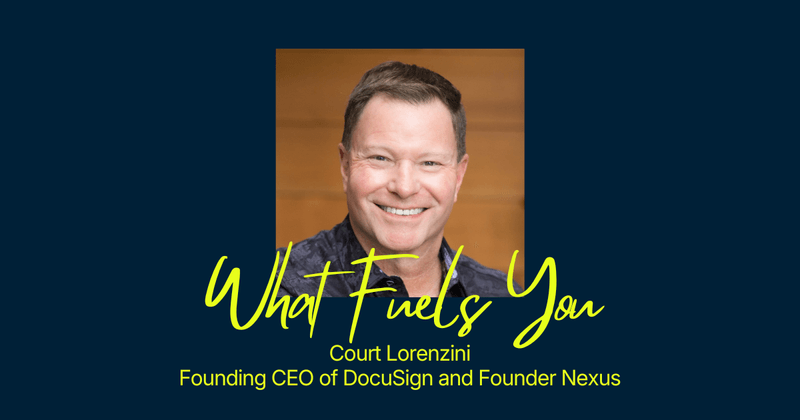
Founding CEO of DocuSign, Founder and CEO of Founder Nexus
Ninety-seven percent of venture-backed startups fail. That is not a talking point Court Lorenzini uses to set a dramatic scene. It is the core problem he has spent the last several years of his life building a solution for. The man who co-founded DocuSign in 2003, raised over $300 million across a career spanning Point.com, Primus BioVision, and MetaBright, and watched his gold-rush-growth company collapse in 90 days when its largest customer walked out the door knows both sides of that number from the inside.
In this episode of What Fuels You, host Shauna Swerland sits down with Court Lorenzini, founding CEO of DocuSign and founder of Founder Nexus, for a conversation that covers growing up at the literal dinner table of Silicon Valley's founding generation, the notebooks he kept from age 14 that predicted the iPhone years before it existed, the counterintuitive move that cracked open DocuSign's legal resistance, why the best advice a founder gets rarely comes from investors or board members, and what a near-death experience taught him about the only scorecard in life that actually matters.
📋 Episode Chapters
| 00:00 | Opening quote: why relationships are the only scorecard in life and how Founder Nexus became Court Lorenzini's highest professional purpose |
| 02:30 | Rapid fire: Gemini and ChatGPT daily, Dots at the movies, morning hot tub with otters and eagles, Paris vs. London, optimization as a hidden talent |
| 09:00 | Growing up in Silicon Valley before it was Silicon Valley: his father, one of the founders of the industry, hosted live VC pitch sessions in the family living room |
| 16:30 | High school in a pre-Silicon Valley cow town: gutting a brand-new Toyota pickup, computerizing an upholstery shop at 14, woodworking, electronics, cooking |
| 22:00 | Choosing Duke over Stanford: walking onto campus, writing the tuition check on the spot, and why it was the best decision he ever made besides his marriage |
| 26:30 | The college-ruled notebook practice: starting at 14, reviewing every entry twice a year, and writing a complete business plan for the iPhone in 2000-2001 |
| 33:00 | Three post-graduate degrees at Stanford, Berkeley, and University of Wisconsin-Madison: each one a stepping stone to a promotion, paid for by his employer |
| 38:00 | Founding Point.com in 1996: inventing comparison shopping on the internet and becoming the first e-commerce site to break carrier exclusivity on cell phone sales |
| 44:30 | Co-founding DocuSign in 2003: hiring a judge, a prosecuting attorney, a defense attorney, and a full jury to retry a fraud case and prove e-signatures were legally binding |
| 51:00 | The three springboard moments for DocuSign: the judge's opinion paper, the National Association of Realtors white-label deal, and an unsolicited call from Brad Smith at Microsoft |
| 56:00 | Why he always exits at product-market fit: being a Phase 1 leader by design and why handing the company to a Phase 2 CEO is a responsibility, not a retreat |
| 61:00 | MetaBright: 50% month-over-month compounding growth, then dead in 90 days when the largest client exited; lessons on client concentration and black swan events |
| 65:00 | Founder Nexus explained: the success equation, micro forum sessions, global membership criteria, and the three-legged stool of VC Lab, remote work, and community |
| 72:00 | What fuels Court Lorenzini: a near-death experience, the relationships scorecard, and why Founder Nexus is the apogee of his professional life |
Raised at the Founding Table of Silicon Valley
Court Lorenzini did not stumble into entrepreneurship. He was born into it. Growing up in the South Bay in the 1960s, before San Jose was anything other than cattle land and honky-tonk bars, his father was one of the eight people credited with founding Silicon Valley. The elder Lorenzini invented the commercial process for growing silicon and was the original supplier of that material to what would become the defining companies of the American technology industry. The founders of Hewlett-Packard, Intel, and Cypress Semiconductor were not distant legends to Court. They were dinner guests.
The education went deeper than those meals. His father was also among the first venture capitalists in the region. His firm had a monthly practice: six partners rotated hosting duties at their homes, and at the end of each dinner, a founder would come into the living room and pitch them. The partners would deliberate after the founder left. Court sat in and watched, twice a year, for years through high school. He was not asked for his opinion. He did not need to give one. He was absorbing, from a front-row seat, how investors examined companies, what a good pitch sounded like, and what happened when it was over.
"I was just sold on being a founder from pretty much the day I figured out what it was. And so I knew that was in my game plan."
-- Court Lorenzini
He also took apart a brand-new Toyota pickup on the day his father bought it for him and rebuilt the engine to multi-hundred horsepower before driving it once. At 14, he walked into a one-man upholstery shop where he had been hired to move furniture, noticed the chaotic wall of fabric swatches, and asked if he could computerize the inventory for the owner. In the late 1970s, when almost no one outside a lab had seen a personal computer, this required some explaining. The owner agreed. Court organized the shop's inventory; the owner spent the rest of the summer teaching him to reupholster furniture from scratch. The Swiss Army knife instinct, as Shauna Swerland puts it in the episode, was already fully assembled.
The Notebooks, the iPhone Business Plan, and the 4 a.m. Post-it Notes
Starting at age 14, Court Lorenzini carried a college-ruled notebook everywhere and wrote things down. Not just ideas, but observations: a manager disciplining an employee, a product he thought could be improved, a decision being made in front of him and his own silent counterargument. Every six months, roughly, he would go back and read every notebook from the beginning. The goal was not organization. It was synthesis. The practice gave him a compounding record of his own evolution as a thinker and a leader.
The notebooks were also where things surfaced that he did not yet know the significance of. Around 2000 and 2001, in the heyday of dedicated digital music players, he wrote a complete business plan for a product that merged a music player with a mobile phone. He concluded that only a large company could pull it off. The capitalization and market risk were too high for a startup. A few years later, the iPhone arrived. He recounts this not to claim credit but to illustrate the point: the practice of writing observations down and returning to them repeatedly is itself a kind of intelligence engine.
"I would have this incredible history of my own, not only evolution of thinking, but all of these little data points of ideas that had come to me over years. And observations about managerial inputs and outputs and outcomes and things. And it was one of my best tutors."
-- Court Lorenzini
A parallel habit runs alongside the notebooks. Court wakes up at roughly 4 a.m. with a fully formed answer to a problem his brain worked on while he was sleeping. For years he kept a pen with a tiny click-activated tip light and a stack of Post-it notes on the nightstand so he could capture the idea without waking his wife. The act of writing it down was what allowed him to fall back asleep. In the morning, some of the notes were legitimately great. Others were, in his words, absolute garbage. The discipline of externalizing the thought regardless of its eventual quality is the point.
DocuSign: The Mock Trial, the Realtors, and Brad Smith's Phone Call
Court Lorenzini co-founded DocuSign in 2003 alongside Tom Gonser and Eric Ranft. The product, electronic signature software, was immediately intuitive to every businessperson who saw it and immediately alarming to every chief legal officer in the country. There was no court precedent establishing that a digital signature was legally binding. CLOs were not being irrational. They were doing their jobs. And their obstruction was stalling the company.
The solution Court arrived at was unconventional enough that he describes it as one of his more out-there founder moments. He went out and hired a judge, a prosecuting attorney, a defense attorney, and a full jury. He sourced a real case of insurance fraud that had turned on a fraudulent signature, and had them retry it as though the document in question had been signed with DocuSign. His intended outcome was a ruling that the signature was legally binding. What he got exceeded that considerably.
"He actually wrote a separate opinion paper which said, not only, as a judge, I preside over these kinds of cases with routine, I've done hundreds of them. This was without a doubt the highest standard of proof and far exceeds anything I've ever seen brought into a courtroom around proof of actuation and signature. And he said, this is better than ink, it's better than fax, it's better than everything else we're doing. This should be the norm."
-- Court Lorenzini
Armed with the judge's opinion paper, Court could walk into any CLO's office and reframe the conversation. Two more springboard moments followed. A white-label deal with the National Association of Realtors embedded DocuSign across their massive platform, with the output document still carrying the DocuSign stamp. Then, in approximately 2005, the company's early adoption of Microsoft's .NET technology was highlighted in an executive briefing. Unprompted, Kevin Herring, who reported to Brad Smith, then Microsoft's chief legal officer, called Court and asked him to come in. Microsoft, at that moment what NVIDIA is today in terms of market dominance, wanted to implement DocuSign. The legal foundation, the distribution through the Realtors, and the Microsoft endorsement together constituted the launch. All three had to come together. They did.
Why He Always Exits at Product-Market Fit, and What MetaBright Taught Him About Black Swans
Court Lorenzini has a framework for his own career that he articulates with the same precision he brings to everything else. He divides a company's lifecycle into three phases: napkin to product-market fit, rapid growth, and profitability. He believes different leaders are suited to different phases and that the worst thing a founder can do is stay in the seat past the phase where they do their best work. He is, by his own clear-eyed analysis, a Phase 1 leader. The existential-stakes environment, the blinders-on building, the moment when every decision could end everything. That is where he operates best. When a company enters Phase 2, the rapid-growth repetition phase, he actively gets bored and hands the company to whoever is born for that stage.
He has done this with intention across every company he has founded. It is not retreat. It is, he argues, the highest-accountability version of the founder role: getting the company to its strongest possible position and then making way for the person who can carry it further. The equity he held in DocuSign was retained through the IPO and beyond. He acknowledges he probably held it too long after the public offering, riding it up and then down. He characterizes this without much distress. It was still life-changing. It was part of the ride.
MetaBright was different. The company had built a licensing technology that was running at multi-million dollar annual recurring revenue, growing at 50 percent month over month compounding. Then the largest client pulled out without warning. The second, third, and fourth largest clients combined did not approach the revenue the first had represented. The operation had been built to scale around that single relationship. The company was dead within 90 days of the client's departure.
"I couldn't look my investors in the face and say, you should put more into this, we should keep trying to move forward. So yeah, that was a tough lesson and hard to swallow, but just a black swan event that you learn as a founder."
-- Court Lorenzini
The gutting part, he says, was not the financial loss. It was telling his employees and investors that there was no path forward and that the company had to shut down. The experience also clarified something he had long sensed but not yet fully named: he had no community of fellow founders to absorb the blow with him. He had a few people in his life who understood what he was going through, and they were invaluable. But not a network. Not at scale. That absence is directly traceable to the founding of Founder Nexus.
Founder Nexus and the Success Equation: Why 97 Percent of Startups Fail and What To Do About It
Court Lorenzini started developing the idea behind Founder Nexus around 2018, after DocuSign had gone public and he no longer needed to work. The genesis came from a clear-eyed review of the guidance he had received across his career. The best of it, consistently, came from other venture-backed founders who had been in similar situations. The worst of it, also consistently, came from investors, advisors, and board members who had not been founders themselves. These were not bad people or bad investors. They genuinely wanted the companies to succeed. They simply had not sat in that particular chair at that particular moment, and the gap in their lived experience produced poor guidance that was difficult to resist given the authority of the people delivering it.
The solution he designed is built around what he calls the success equation. Every decision a founder makes can be rated on a scale of 0 to 1, representing how well it was implemented and executed. All those decisions multiplied together produce the probability of success. A single critical decision rated at 0 collapses the entire equation. Any significant cluster of decisions rated below 0.5 makes recovery extremely difficult. This is why the failure rate is 97 percent. The odds of getting enough decisions above average across an entire company lifecycle are very low. Founder Nexus is designed to raise the individual decision quality of every member, incrementally, by putting them in structured conversation with other founders who have already navigated similar inflection points.
"The best guidance I ever got on any of my journeys to date had been that from other venture-backed founders. And conversely, the worst guidance I ever got routinely came from my investors, advisors, and board members who had not been founders themselves."
-- Court Lorenzini
The membership criteria are specific: founders must have been building a venture-scale company for at least three years, must have raised at least some non-friends-and-family capital, and must be working toward a business that their pitch deck projects will reach $100 million or more in annual revenue. Court calls this indexing for scar tissue. The three years and the professional capital requirement filter for founders who have been around long enough to understand they do not have all the answers, which is the only posture that makes the shared experience model work. Members are organized into tiers based on their ARR stage, from pre-seed to $50 million-plus, and are matched in temporary micro forum sessions of five or six founders, facilitated around a specific topic, with no advice allowed. Participants can only share what they personally experienced. The global scope is intentional: the network includes founders in Tokyo, London, Buenos Aires, and Dayton, Ohio. Getting the geographic distribution right is, for Court, not just a feature of Founder Nexus. It is the thesis of a larger three-legged stool that also includes VC Lab, which he helped co-found in 2018 and which as of last year accounted for more than 50 percent of worldwide growth in the venture capital industry, with close to 90 percent of those new funds located outside the 30 cities where venture capital has historically concentrated.
The Only Scorecard That Matters
Court Lorenzini had a near-death experience a few years ago. He does not elaborate on the details in this episode, but he is specific about what it clarified. When he came out of it, the thing that struck him with force was that money, houses, trips, watches, and cars have no relevance to what a life amounted to. The only measurement that holds up is the quality and mutual impact of the relationships you built. That insight is the organizing principle of everything he does now, and it is why he describes Founder Nexus as the absolute apogee of his professional aspiration.
"The quality of the people that you had a meaningful impact on in a relationship and that impacted you is the only scorecard that matters because that's your legacy. And so to me, that is how I judge my life, is am I building relationships that have mutual impact?"
-- Court Lorenzini
His wife, whom he met at Duke years after graduation, runs the nonprofit side of the Lorenzini Family Foundation while he manages the for-profit investments. The shared lens across both is the same: what creates better societal outcomes? They support female founders, female fund managers, and non-traditional leaders not out of ideology alone but because they believe concentrated investment in underfunded groups produces compounding returns for those communities and, eventually, for the broader economy. He tells his daughters the same thing he and his wife have said to them their whole lives. Leave this world in better shape than you found it. Whether or not any of them become entrepreneurs, that is the assignment.
5 Key Takeaways
Frequently Asked Questions
How did Court Lorenzini prove that DocuSign signatures were legally binding?
Facing persistent resistance from chief legal officers at major companies, Court Lorenzini hired a judge, a prosecuting attorney, a defense attorney, and a full jury and had them retry a real insurance fraud case as if the relevant document had been signed using DocuSign. The judge not only ruled the signature legally binding but wrote a separate opinion paper stating that DocuSign's standard of proof exceeded anything he had encountered in hundreds of similar cases and that it was superior to ink, fax, and all existing alternatives. Lorenzini used that opinion paper to reopen conversations with CLOs who had previously refused to engage.
What is Court Lorenzini's success equation for venture-backed startups?
Lorenzini describes the success equation as a long string of decisions, each rated from 0 to 1 based on the quality of its execution, with all values multiplied together to produce the probability of success. A single critical decision rated at 0 collapses the entire equation. Any significant cluster of decisions rated below 0.5 makes recovery extremely difficult, which is why, in his analysis, 97 percent of venture-backed startups fail. Founder Nexus is built to raise the decision quality of each member incrementally by connecting them with founders who have navigated similar inflection points.
What are the membership criteria for Founder Nexus?
Founder Nexus requires applicants to meet three criteria: they must have been building a venture-scale company for at least three years, they must have raised at least some professional capital beyond friends and family, and they must be pursuing a business that their pitch deck projects will reach $100 million or more in annual revenue. Lorenzini describes these criteria as indexing for scar tissue, meaning he is looking for founders who have been tested enough to understand the value of learning from others' experience rather than always discovering things the hard way.
Why did Court Lorenzini leave DocuSign after co-founding it?
Court Lorenzini describes himself explicitly as a Phase 1 leader, meaning his peak effectiveness and personal fulfillment come in the napkin-to-product-market-fit stage of a company's lifecycle. When a company moves into Phase 2, the rapid-growth repetition phase, he says he actively gets bored and believes he is not the best person in the seat for that work. He left DocuSign in 2008 after getting it to product-market fit, viewing the handoff to a Phase 2 CEO as the most responsible thing a founding CEO can do for the company they built.
What did Court Lorenzini learn from the MetaBright failure?
MetaBright was growing at 50 percent month-over-month compounding revenue when its largest client departed without warning. Because the entire operation had been built to scale around that single relationship, the company was dead within 90 days. Lorenzini says the experience was gutting, particularly the conversations with employees and investors, and that it reinforced the danger of client concentration. He also says the absence of a peer founder community to absorb the blow with him was one of the motivating factors behind building Founder Nexus.
Founding CEO of DocuSign, Founder and CEO of Founder Nexus
Ninety-seven percent of venture-backed startups fail. That is not a talking point Court Lorenzini uses to set a dramatic scene. It is the core problem he has spent the last several years of his life building a solution for. The man who co-founded DocuSign in 2003, raised over $300 million across a career spanning Point.com, Primus BioVision, and MetaBright, and watched his gold-rush-growth company collapse in 90 days when its largest customer walked out the door knows both sides of that number from the inside.
In this episode of What Fuels You, host Shauna Swerland sits down with Court Lorenzini, founding CEO of DocuSign and founder of Founder Nexus, for a conversation that covers growing up at the literal dinner table of Silicon Valley's founding generation, the notebooks he kept from age 14 that predicted the iPhone years before it existed, the counterintuitive move that cracked open DocuSign's legal resistance, why the best advice a founder gets rarely comes from investors or board members, and what a near-death experience taught him about the only scorecard in life that actually matters.
📋 Episode Chapters
| 00:00 | Opening quote: why relationships are the only scorecard in life and how Founder Nexus became Court Lorenzini's highest professional purpose |
| 02:30 | Rapid fire: Gemini and ChatGPT daily, Dots at the movies, morning hot tub with otters and eagles, Paris vs. London, optimization as a hidden talent |
| 09:00 | Growing up in Silicon Valley before it was Silicon Valley: his father, one of the founders of the industry, hosted live VC pitch sessions in the family living room |
| 16:30 | High school in a pre-Silicon Valley cow town: gutting a brand-new Toyota pickup, computerizing an upholstery shop at 14, woodworking, electronics, cooking |
| 22:00 | Choosing Duke over Stanford: walking onto campus, writing the tuition check on the spot, and why it was the best decision he ever made besides his marriage |
| 26:30 | The college-ruled notebook practice: starting at 14, reviewing every entry twice a year, and writing a complete business plan for the iPhone in 2000-2001 |
| 33:00 | Three post-graduate degrees at Stanford, Berkeley, and University of Wisconsin-Madison: each one a stepping stone to a promotion, paid for by his employer |
| 38:00 | Founding Point.com in 1996: inventing comparison shopping on the internet and becoming the first e-commerce site to break carrier exclusivity on cell phone sales |
| 44:30 | Co-founding DocuSign in 2003: hiring a judge, a prosecuting attorney, a defense attorney, and a full jury to retry a fraud case and prove e-signatures were legally binding |
| 51:00 | The three springboard moments for DocuSign: the judge's opinion paper, the National Association of Realtors white-label deal, and an unsolicited call from Brad Smith at Microsoft |
| 56:00 | Why he always exits at product-market fit: being a Phase 1 leader by design and why handing the company to a Phase 2 CEO is a responsibility, not a retreat |
| 61:00 | MetaBright: 50% month-over-month compounding growth, then dead in 90 days when the largest client exited; lessons on client concentration and black swan events |
| 65:00 | Founder Nexus explained: the success equation, micro forum sessions, global membership criteria, and the three-legged stool of VC Lab, remote work, and community |
| 72:00 | What fuels Court Lorenzini: a near-death experience, the relationships scorecard, and why Founder Nexus is the apogee of his professional life |
Raised at the Founding Table of Silicon Valley
Court Lorenzini did not stumble into entrepreneurship. He was born into it. Growing up in the South Bay in the 1960s, before San Jose was anything other than cattle land and honky-tonk bars, his father was one of the eight people credited with founding Silicon Valley. The elder Lorenzini invented the commercial process for growing silicon and was the original supplier of that material to what would become the defining companies of the American technology industry. The founders of Hewlett-Packard, Intel, and Cypress Semiconductor were not distant legends to Court. They were dinner guests.
The education went deeper than those meals. His father was also among the first venture capitalists in the region. His firm had a monthly practice: six partners rotated hosting duties at their homes, and at the end of each dinner, a founder would come into the living room and pitch them. The partners would deliberate after the founder left. Court sat in and watched, twice a year, for years through high school. He was not asked for his opinion. He did not need to give one. He was absorbing, from a front-row seat, how investors examined companies, what a good pitch sounded like, and what happened when it was over.
"I was just sold on being a founder from pretty much the day I figured out what it was. And so I knew that was in my game plan."
-- Court Lorenzini
He also took apart a brand-new Toyota pickup on the day his father bought it for him and rebuilt the engine to multi-hundred horsepower before driving it once. At 14, he walked into a one-man upholstery shop where he had been hired to move furniture, noticed the chaotic wall of fabric swatches, and asked if he could computerize the inventory for the owner. In the late 1970s, when almost no one outside a lab had seen a personal computer, this required some explaining. The owner agreed. Court organized the shop's inventory; the owner spent the rest of the summer teaching him to reupholster furniture from scratch. The Swiss Army knife instinct, as Shauna Swerland puts it in the episode, was already fully assembled.
The Notebooks, the iPhone Business Plan, and the 4 a.m. Post-it Notes
Starting at age 14, Court Lorenzini carried a college-ruled notebook everywhere and wrote things down. Not just ideas, but observations: a manager disciplining an employee, a product he thought could be improved, a decision being made in front of him and his own silent counterargument. Every six months, roughly, he would go back and read every notebook from the beginning. The goal was not organization. It was synthesis. The practice gave him a compounding record of his own evolution as a thinker and a leader.
The notebooks were also where things surfaced that he did not yet know the significance of. Around 2000 and 2001, in the heyday of dedicated digital music players, he wrote a complete business plan for a product that merged a music player with a mobile phone. He concluded that only a large company could pull it off. The capitalization and market risk were too high for a startup. A few years later, the iPhone arrived. He recounts this not to claim credit but to illustrate the point: the practice of writing observations down and returning to them repeatedly is itself a kind of intelligence engine.
"I would have this incredible history of my own, not only evolution of thinking, but all of these little data points of ideas that had come to me over years. And observations about managerial inputs and outputs and outcomes and things. And it was one of my best tutors."
-- Court Lorenzini
A parallel habit runs alongside the notebooks. Court wakes up at roughly 4 a.m. with a fully formed answer to a problem his brain worked on while he was sleeping. For years he kept a pen with a tiny click-activated tip light and a stack of Post-it notes on the nightstand so he could capture the idea without waking his wife. The act of writing it down was what allowed him to fall back asleep. In the morning, some of the notes were legitimately great. Others were, in his words, absolute garbage. The discipline of externalizing the thought regardless of its eventual quality is the point.
DocuSign: The Mock Trial, the Realtors, and Brad Smith's Phone Call
Court Lorenzini co-founded DocuSign in 2003 alongside Tom Gonser and Eric Ranft. The product, electronic signature software, was immediately intuitive to every businessperson who saw it and immediately alarming to every chief legal officer in the country. There was no court precedent establishing that a digital signature was legally binding. CLOs were not being irrational. They were doing their jobs. And their obstruction was stalling the company.
The solution Court arrived at was unconventional enough that he describes it as one of his more out-there founder moments. He went out and hired a judge, a prosecuting attorney, a defense attorney, and a full jury. He sourced a real case of insurance fraud that had turned on a fraudulent signature, and had them retry it as though the document in question had been signed with DocuSign. His intended outcome was a ruling that the signature was legally binding. What he got exceeded that considerably.
"He actually wrote a separate opinion paper which said, not only, as a judge, I preside over these kinds of cases with routine, I've done hundreds of them. This was without a doubt the highest standard of proof and far exceeds anything I've ever seen brought into a courtroom around proof of actuation and signature. And he said, this is better than ink, it's better than fax, it's better than everything else we're doing. This should be the norm."
-- Court Lorenzini
Armed with the judge's opinion paper, Court could walk into any CLO's office and reframe the conversation. Two more springboard moments followed. A white-label deal with the National Association of Realtors embedded DocuSign across their massive platform, with the output document still carrying the DocuSign stamp. Then, in approximately 2005, the company's early adoption of Microsoft's .NET technology was highlighted in an executive briefing. Unprompted, Kevin Herring, who reported to Brad Smith, then Microsoft's chief legal officer, called Court and asked him to come in. Microsoft, at that moment what NVIDIA is today in terms of market dominance, wanted to implement DocuSign. The legal foundation, the distribution through the Realtors, and the Microsoft endorsement together constituted the launch. All three had to come together. They did.
Why He Always Exits at Product-Market Fit, and What MetaBright Taught Him About Black Swans
Court Lorenzini has a framework for his own career that he articulates with the same precision he brings to everything else. He divides a company's lifecycle into three phases: napkin to product-market fit, rapid growth, and profitability. He believes different leaders are suited to different phases and that the worst thing a founder can do is stay in the seat past the phase where they do their best work. He is, by his own clear-eyed analysis, a Phase 1 leader. The existential-stakes environment, the blinders-on building, the moment when every decision could end everything. That is where he operates best. When a company enters Phase 2, the rapid-growth repetition phase, he actively gets bored and hands the company to whoever is born for that stage.
He has done this with intention across every company he has founded. It is not retreat. It is, he argues, the highest-accountability version of the founder role: getting the company to its strongest possible position and then making way for the person who can carry it further. The equity he held in DocuSign was retained through the IPO and beyond. He acknowledges he probably held it too long after the public offering, riding it up and then down. He characterizes this without much distress. It was still life-changing. It was part of the ride.
MetaBright was different. The company had built a licensing technology that was running at multi-million dollar annual recurring revenue, growing at 50 percent month over month compounding. Then the largest client pulled out without warning. The second, third, and fourth largest clients combined did not approach the revenue the first had represented. The operation had been built to scale around that single relationship. The company was dead within 90 days of the client's departure.
"I couldn't look my investors in the face and say, you should put more into this, we should keep trying to move forward. So yeah, that was a tough lesson and hard to swallow, but just a black swan event that you learn as a founder."
-- Court Lorenzini
The gutting part, he says, was not the financial loss. It was telling his employees and investors that there was no path forward and that the company had to shut down. The experience also clarified something he had long sensed but not yet fully named: he had no community of fellow founders to absorb the blow with him. He had a few people in his life who understood what he was going through, and they were invaluable. But not a network. Not at scale. That absence is directly traceable to the founding of Founder Nexus.
Founder Nexus and the Success Equation: Why 97 Percent of Startups Fail and What To Do About It
Court Lorenzini started developing the idea behind Founder Nexus around 2018, after DocuSign had gone public and he no longer needed to work. The genesis came from a clear-eyed review of the guidance he had received across his career. The best of it, consistently, came from other venture-backed founders who had been in similar situations. The worst of it, also consistently, came from investors, advisors, and board members who had not been founders themselves. These were not bad people or bad investors. They genuinely wanted the companies to succeed. They simply had not sat in that particular chair at that particular moment, and the gap in their lived experience produced poor guidance that was difficult to resist given the authority of the people delivering it.
The solution he designed is built around what he calls the success equation. Every decision a founder makes can be rated on a scale of 0 to 1, representing how well it was implemented and executed. All those decisions multiplied together produce the probability of success. A single critical decision rated at 0 collapses the entire equation. Any significant cluster of decisions rated below 0.5 makes recovery extremely difficult. This is why the failure rate is 97 percent. The odds of getting enough decisions above average across an entire company lifecycle are very low. Founder Nexus is designed to raise the individual decision quality of every member, incrementally, by putting them in structured conversation with other founders who have already navigated similar inflection points.
"The best guidance I ever got on any of my journeys to date had been that from other venture-backed founders. And conversely, the worst guidance I ever got routinely came from my investors, advisors, and board members who had not been founders themselves."
-- Court Lorenzini
The membership criteria are specific: founders must have been building a venture-scale company for at least three years, must have raised at least some non-friends-and-family capital, and must be working toward a business that their pitch deck projects will reach $100 million or more in annual revenue. Court calls this indexing for scar tissue. The three years and the professional capital requirement filter for founders who have been around long enough to understand they do not have all the answers, which is the only posture that makes the shared experience model work. Members are organized into tiers based on their ARR stage, from pre-seed to $50 million-plus, and are matched in temporary micro forum sessions of five or six founders, facilitated around a specific topic, with no advice allowed. Participants can only share what they personally experienced. The global scope is intentional: the network includes founders in Tokyo, London, Buenos Aires, and Dayton, Ohio. Getting the geographic distribution right is, for Court, not just a feature of Founder Nexus. It is the thesis of a larger three-legged stool that also includes VC Lab, which he helped co-found in 2018 and which as of last year accounted for more than 50 percent of worldwide growth in the venture capital industry, with close to 90 percent of those new funds located outside the 30 cities where venture capital has historically concentrated.
The Only Scorecard That Matters
Court Lorenzini had a near-death experience a few years ago. He does not elaborate on the details in this episode, but he is specific about what it clarified. When he came out of it, the thing that struck him with force was that money, houses, trips, watches, and cars have no relevance to what a life amounted to. The only measurement that holds up is the quality and mutual impact of the relationships you built. That insight is the organizing principle of everything he does now, and it is why he describes Founder Nexus as the absolute apogee of his professional aspiration.
"The quality of the people that you had a meaningful impact on in a relationship and that impacted you is the only scorecard that matters because that's your legacy. And so to me, that is how I judge my life, is am I building relationships that have mutual impact?"
-- Court Lorenzini
His wife, whom he met at Duke years after graduation, runs the nonprofit side of the Lorenzini Family Foundation while he manages the for-profit investments. The shared lens across both is the same: what creates better societal outcomes? They support female founders, female fund managers, and non-traditional leaders not out of ideology alone but because they believe concentrated investment in underfunded groups produces compounding returns for those communities and, eventually, for the broader economy. He tells his daughters the same thing he and his wife have said to them their whole lives. Leave this world in better shape than you found it. Whether or not any of them become entrepreneurs, that is the assignment.
5 Key Takeaways
Frequently Asked Questions
How did Court Lorenzini prove that DocuSign signatures were legally binding?
Facing persistent resistance from chief legal officers at major companies, Court Lorenzini hired a judge, a prosecuting attorney, a defense attorney, and a full jury and had them retry a real insurance fraud case as if the relevant document had been signed using DocuSign. The judge not only ruled the signature legally binding but wrote a separate opinion paper stating that DocuSign's standard of proof exceeded anything he had encountered in hundreds of similar cases and that it was superior to ink, fax, and all existing alternatives. Lorenzini used that opinion paper to reopen conversations with CLOs who had previously refused to engage.
What is Court Lorenzini's success equation for venture-backed startups?
Lorenzini describes the success equation as a long string of decisions, each rated from 0 to 1 based on the quality of its execution, with all values multiplied together to produce the probability of success. A single critical decision rated at 0 collapses the entire equation. Any significant cluster of decisions rated below 0.5 makes recovery extremely difficult, which is why, in his analysis, 97 percent of venture-backed startups fail. Founder Nexus is built to raise the decision quality of each member incrementally by connecting them with founders who have navigated similar inflection points.
What are the membership criteria for Founder Nexus?
Founder Nexus requires applicants to meet three criteria: they must have been building a venture-scale company for at least three years, they must have raised at least some professional capital beyond friends and family, and they must be pursuing a business that their pitch deck projects will reach $100 million or more in annual revenue. Lorenzini describes these criteria as indexing for scar tissue, meaning he is looking for founders who have been tested enough to understand the value of learning from others' experience rather than always discovering things the hard way.
Why did Court Lorenzini leave DocuSign after co-founding it?
Court Lorenzini describes himself explicitly as a Phase 1 leader, meaning his peak effectiveness and personal fulfillment come in the napkin-to-product-market-fit stage of a company's lifecycle. When a company moves into Phase 2, the rapid-growth repetition phase, he says he actively gets bored and believes he is not the best person in the seat for that work. He left DocuSign in 2008 after getting it to product-market fit, viewing the handoff to a Phase 2 CEO as the most responsible thing a founding CEO can do for the company they built.
What did Court Lorenzini learn from the MetaBright failure?
MetaBright was growing at 50 percent month-over-month compounding revenue when its largest client departed without warning. Because the entire operation had been built to scale around that single relationship, the company was dead within 90 days. Lorenzini says the experience was gutting, particularly the conversations with employees and investors, and that it reinforced the danger of client concentration. He also says the absence of a peer founder community to absorb the blow with him was one of the motivating factors behind building Founder Nexus.