

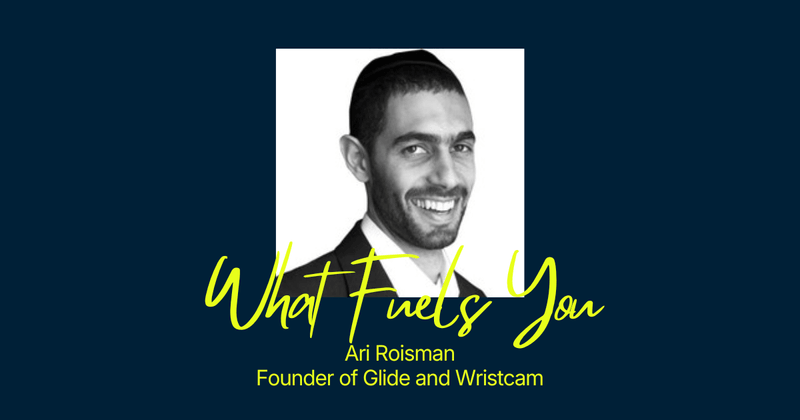
Co-Founder of Glide and Wristcam, Executive Coach to Founders
What does it take to build two category-defining consumer products, raise more than $50 million in venture capital, attract 20 million users, and still end up feeling completely lost? For Ari Roisman, the answer was a decade of building at full speed without stopping to take care of the person doing the building. He co-founded Glide, the push-to-talk video messaging app, in 2012 in Jerusalem. He co-founded Wristcam, the only Apple-certified camera accessory for the Apple Watch, in 2016. By the time he stepped down from both, he had the accolades, the press, and the burnout to prove it.
In this episode of What Fuels You, host Shauna Swerland sits down with Ari Roisman, now an executive coach to founder CEOs, for a conversation that moves through Wilmington, Jerusalem, Palo Alto, and Cincinnati, covering early tinkering with radio-controlled cars, the serendipitous pivot from combustion research to consumer software, what it actually felt like to watch a company he built for eleven years outgrow him, and why a Shabbat-observant entrepreneur who goes offline for 72-plus hours at a stretch might be the most productively present person in the room. The thread connecting all of it: what it means to tap into your source before you run dry.
📋 Episode Chapters
| 00:00 | Introduction and rapid-fire questions: morning ritual, favorite inventions, and daily apps |
| 05:30 | Running three half marathons and how Ari found distance sports later in life |
| 09:00 | Growing up in Wilmington, Delaware: Montessori, Quaker school, and tinkering on the internet via CompuServe at age 9 |
| 15:00 | His father's layoff after 30 years at one company and how it seeded a deep distrust of corporate employment |
| 20:30 | Washington University in St. Louis, a semester at the Technion in Hebrew, and graduating late without realizing it would become his best career pivot |
| 27:00 | Graduate research in oxy-combustion and carbon capture, and how that lab became the largest at WashU |
| 33:00 | Founding Glide in 2012: pioneering push-to-talk video messaging, raising $50M pre-revenue, and becoming one of the hottest companies in Jerusalem |
| 41:00 | Co-founding Wristcam with an Apple Watch program manager who quit Apple on the spot, and building the only official Apple-certified camera for the Apple Watch |
| 48:30 | Burnout, losing his personal sense of self, and finally engaging a coach in the months before he resigned from Glide |
| 54:00 | What to look for in an executive coach as a founder, and why lived startup experience is non-negotiable |
| 59:30 | YPO and EO forum dynamics: why a confidential peer group functions as a pressure release valve for founders in inherently lonely leadership positions |
| 64:30 | Stealth energy company: how his graduate combustion research evolved into a multi-patented pressurized power plant technology aimed at doubling U.S. energy infrastructure |
| 68:00 | Shabbat as a 72-hour digital detox, the national park analogy, and what Ari means when he says tapping into your source fuels everything else |
From Wilmington to Jerusalem: How a Father's Layoff Launched a Career Built on Nobody Else's Terms
Ari Roisman grew up in Wilmington, Delaware, the kind of city that gets a comedic pause in Wayne's World, which he references himself with a laugh. His parents made deliberate investments in his education: a Montessori school, a Quaker Friends school, and a Jewish day school in Philadelphia. His father, a chemical engineer, put a computer in his room early, and by middle school Ari was overclocking it and building radio-controlled cars from kits. He had access to the internet via CompuServe on a DOS prompt and a 14.4 modem before most people knew what email was.
The moment that shaped his career outlook most directly, though, was not a win. It was watching his father get laid off after 30 years at the same publicly traded company, then get rehired, then get pushed out again for challenging the new CEO on the company's internet strategy. His father had given those years in good faith. New management arrived and canceled the agreement. That experience, Roisman says, planted something permanent.
"It just built, it seeded this very deep distrust in putting my fate in the hands of anyone else. And so I think just the moment that happened, it planted something inside of me. It was like, I can't trust any big corporate juggernaut to feed me. I need to be able to carve my own path and do my own thing."
-- Ari Roisman
He enrolled at Washington University in St. Louis as a mechanical engineer, took a semester at the Technion in Israel studying entirely in Hebrew, and graduated slightly behind schedule because of the transfer credits. At the time, he felt like he had failed. In hindsight, the delay dropped him into his graduate advisor's lab at exactly the right moment, leading to his first acquisition and planting the seeds for everything that followed.
Glide, Wristcam, and What It Really Means to Catch Lightning in a Bottle
Roisman did not study computer science. He knew software was eating the world and felt he had missed the boat. So he taught himself the space and in 2012 co-founded Glide in Jerusalem with a childhood friend, raising roughly $40 to $50 million pre-revenue on the strength of a single insight: video messaging should feel like a walkie-talkie. Press a button, and live video begins streaming to the recipient immediately. No waiting to record, no upload delay, no scheduling a call. The moment you press record, the other person can watch live.
Within two and a half years, Glide had attracted 20 million users, acquired another company, grown to nearly 100 people, and become, in Roisman's words, one of the hottest companies in Israel. The mayor of Jerusalem relocated the team to a new office. They were finalists at TechCrunch Disrupt. He describes parallels between that chapter and the first two seasons of Silicon Valley that he finds uncanny in retrospect.
"We caught lightning in a bottle. We focused a lot on having a viral K-factor. We probably were too aggressive in terms of really engineering for that. I had an incredible team, amazing co-founders."
-- Ari Roisman
While still running Glide, Roisman saw the Apple Watch launch and made a bet: wearable computing was the next wave, and the watch was a form factor proven over centuries. He moved to Palo Alto, met an original Apple Watch program manager through a mutual connection, and the two co-founded Wristcam. The program manager quit Apple on the spot after their first meeting. Wristcam became the only official Apple-certified smart accessory for the Apple Watch, a camera system that enabled live tap-to-talk video communication directly from the wrist. The original plan to enter Apple retail distribution was disrupted by the pandemic. Roisman is still proud of the product.
The Burnout Nobody Talks About: Losing Yourself Inside a Company You Built
The clearest and most useful part of this conversation for any founder listening is what Roisman describes happening in the later years at Glide. He was traveling constantly, carrying the entire weight of fundraising, and had stopped investing intentionally in himself. He uses a pointed contrast: one of his co-founders spent a period writing a comic book mashup between Batman and Superman, maintaining a creative life outside the company. Roisman did not have an equivalent. He got swept away.
He tried to find a coach when he first arrived in Silicon Valley. A well-connected startup attorney told him coaches for founders did not really exist. Bill Campbell, the legendary Silicon Valley coach behind executives at Apple and Google, was not taking new clients in the year or two before he passed away. So Roisman went without, relying on informal relationships with former founders turned investors, people in his corner but without any formal structure or accountability.
"I just wasn't taking care of myself. I was traveling incessantly. And it was lonely."
-- Ari Roisman
In the final months before he resigned, he finally engaged a coach. The impact was immediate. It created, in his words, a loving and nurturing space where he could think with real clarity. He determined it was time to move on, resigned on good terms, arranged funding so the company could continue, and passed the baton. Glide has since pivoted into computer vision and AI under the name Endless AI. He describes leaving as a new lease on life.
What Founder Coaching Actually Is, and How to Know If You Need It
Roisman is now an executive coach himself, working with a handful of founder CEOs. He holds an in-progress certification from the International Coaching Federation and is direct about who he is best suited to help: founders who have been at it long enough to have gone through genuine turbulence. He references Ben Horowitz's essay "The Struggle" as a marker. Until a founder has gone through a dark night of the soul, there is not quite enough shared language for the coaching to land at its deepest level.
He makes a distinction worth internalizing between coaching done as pure process and coaching backed by operational experience. A well-trained coach can do important work from pure coaching methodology alone. But for a founder navigating hardware development, international fundraising, co-founder dynamics, and recapitalization simultaneously, someone who has personally done those things adds a layer of instinct that cannot be replicated from training alone.
"It's incredibly gratifying to be able to sit with a founder CEO for like an hour a week and have a massive impact. It's like you see over a long time horizon how the biggest issues are getting resolved and how their company's growing. It's so gratifying. And so it fills me up."
-- Ari Roisman
He also uses AI to enhance his coaching work, recording sessions in Notion with founder permission, generating transcripts, and querying against the accumulated record to surface patterns and track to-dos across time. He is candid that coaching does not scale the way software does, but he is drawn to the high leverage of the work and has carved out space for it alongside his other commitments.
YPO, Peer Forums, and Why Every Ambitious Leader Needs a Confidential Reference Point
Roisman and Shauna Swerland met through YPO, the global network for business leaders, and this conversation makes clear how central peer forums have been in both of their careers. He frames the value of a peer group in terms of Einsteinian special relativity: the true speed or orientation of something is only understood in relation to a reference point. Without that external perspective, he says, it is amazing how lost and confused people become in isolation.
He currently serves as Forum Officer for the YPO Entrepreneurship Network globally, a role focused on standing up and scaling forums specifically for the roughly one-third of YPO members who are founders. He experimented with a bootstrapped company to bring peer groups to a wider audience before a co-founder was recruited to lead an AI infrastructure company seeded with $1 billion from one of the founders of Ripple. That plan did not survive the co-founder's departure, but the energy behind it never went away.
"I feel like the world would be such a better, healthier place if everyone had their confidential space with their peers, where they share, they're on a shared journey, they have a shared ambition."
-- Ari Roisman
Shabbat as Strategy: A 72-Hour Reset and the Energy Company Nobody Knows About Yet
By the time Shauna Swerland asks Roisman how he balances all of it, the picture is genuinely complex: executive coaching with a handful of founders, the YPO Entrepreneurship Network role, advising a family office looking for nutraceutical acquisitions in the $10 to $20 million range, and a stealth hard-tech energy company being built on top of his own graduate research. The combustion lab he helped launch at WashU has grown into the largest lab at the university, winning tens of millions in Department of Energy grants around pressurized oxy-combustion technology. He has been consulting with the university for roughly a year and is now putting together the financial plan and brand strategy.
Alongside all of it, he observes Shabbat fully. Every week, from sundown Friday to sundown Saturday, he is offline. Several times a year, a two-day Jewish holiday lands against Shabbat and he is offline for 72 hours or more. He describes what that time actually looks like: an extraordinary meal, games with his four children, a communal prayer service, deep conversations with close friends, sleep. He compares the experience to arriving at a national park after too long away and immediately wondering why the gap was so long.
"We have to slow down. That's the point. It's a reference point. The spiritual version of going to that national park is available to us at all times if we just allow ourselves to go inward and block out all the noise."
-- Ari Roisman
When Shauna Swerland asks the closing question, what fuels you, Roisman answers without hesitation: connecting to source, to the underlying and unifying life force that is endlessly creative and endlessly growing. He is explicit that this is not only his answer. He believes it is the answer available to everyone, and that the more automated and AI-accelerated the world becomes, the more urgently that muscle needs to be flexed.
5 Key Takeaways
Frequently Asked Questions
What did Ari Roisman build with Glide and how large did it grow?
Ari Roisman co-founded Glide in Jerusalem in 2012 with a childhood friend. Glide pioneered push-to-talk instant video messaging, allowing users to stream live video to recipients the moment they pressed record. Within two and a half years of launch, the app attracted 20 million users, raised more than $50 million in venture capital pre-revenue, and had grown to nearly 100 employees. Roisman led the company as CEO for eleven years before stepping down and passing the baton to new leadership. The company has since pivoted into computer vision and AI and now operates as Endless AI.
What is Wristcam and what was Ari Roisman's role in creating it?
Wristcam is the only official Apple-certified camera accessory for the Apple Watch, enabling live tap-to-talk video communication directly from the wrist. Roisman co-founded Wristcam in 2016 after meeting an original Apple Watch program manager who left Apple immediately after their first conversation. The product was named to Time magazine's 100 Best Inventions list. The original plan to enter Apple retail distribution was disrupted by the pandemic, but the product remains available and is noted for enabling live video capabilities the Apple Watch itself still does not include.
Why did Ari Roisman become an executive coach, and who does he work with?
Roisman became an executive coach after experiencing burnout at the end of his run leading Glide and finally engaging a coach himself in the months before he resigned. He credits that coaching relationship with giving him the clarity to make a clean exit on his own terms. He now works with a small number of founder CEOs who have been building at scale long enough to have gone through genuine turbulence, what he references as Ben Horowitz's concept of "The Struggle." He holds an in-progress certification from the International Coaching Federation and records sessions in Notion to track themes and to-dos over time.
What is Ari Roisman's view on YPO peer forums and why does he consider them essential for founders?
Roisman serves as Forum Officer for the YPO Entrepreneurship Network globally and describes peer forums as one of the highest-leverage tools available to founders in inherently lonely leadership positions. He uses a special relativity analogy: the true speed or orientation of something is only understood in relation to an external reference point. Without that vantage point, he says founders can become deeply lost or confused in isolation. He notes that forums create accountability, a place to bring the top five percent and bottom five percent of what is happening, and a source of wisdom from people who have been through comparable situations.
What is the stealth energy company Ari Roisman is working on?
Roisman is developing a hard-tech energy company based on graduate combustion research he conducted at Washington University in St. Louis under one of the country's leading combustion experts. The technology centers on a pressurized oxy-combustion process that allows power plants to be manufactured in a factory, shipped to site, and operated in a carbon-negative way by combining biofuels with efficient CO2 capture. The lab he helped launch at WashU has grown into the university's largest, winning tens of millions in Department of Energy grants. He began consulting with the university approximately one year before this episode aired and is currently building the financial plan and brand strategy.
Co-Founder of Glide and Wristcam, Executive Coach to Founders
What does it take to build two category-defining consumer products, raise more than $50 million in venture capital, attract 20 million users, and still end up feeling completely lost? For Ari Roisman, the answer was a decade of building at full speed without stopping to take care of the person doing the building. He co-founded Glide, the push-to-talk video messaging app, in 2012 in Jerusalem. He co-founded Wristcam, the only Apple-certified camera accessory for the Apple Watch, in 2016. By the time he stepped down from both, he had the accolades, the press, and the burnout to prove it.
In this episode of What Fuels You, host Shauna Swerland sits down with Ari Roisman, now an executive coach to founder CEOs, for a conversation that moves through Wilmington, Jerusalem, Palo Alto, and Cincinnati, covering early tinkering with radio-controlled cars, the serendipitous pivot from combustion research to consumer software, what it actually felt like to watch a company he built for eleven years outgrow him, and why a Shabbat-observant entrepreneur who goes offline for 72-plus hours at a stretch might be the most productively present person in the room. The thread connecting all of it: what it means to tap into your source before you run dry.
📋 Episode Chapters
| 00:00 | Introduction and rapid-fire questions: morning ritual, favorite inventions, and daily apps |
| 05:30 | Running three half marathons and how Ari found distance sports later in life |
| 09:00 | Growing up in Wilmington, Delaware: Montessori, Quaker school, and tinkering on the internet via CompuServe at age 9 |
| 15:00 | His father's layoff after 30 years at one company and how it seeded a deep distrust of corporate employment |
| 20:30 | Washington University in St. Louis, a semester at the Technion in Hebrew, and graduating late without realizing it would become his best career pivot |
| 27:00 | Graduate research in oxy-combustion and carbon capture, and how that lab became the largest at WashU |
| 33:00 | Founding Glide in 2012: pioneering push-to-talk video messaging, raising $50M pre-revenue, and becoming one of the hottest companies in Jerusalem |
| 41:00 | Co-founding Wristcam with an Apple Watch program manager who quit Apple on the spot, and building the only official Apple-certified camera for the Apple Watch |
| 48:30 | Burnout, losing his personal sense of self, and finally engaging a coach in the months before he resigned from Glide |
| 54:00 | What to look for in an executive coach as a founder, and why lived startup experience is non-negotiable |
| 59:30 | YPO and EO forum dynamics: why a confidential peer group functions as a pressure release valve for founders in inherently lonely leadership positions |
| 64:30 | Stealth energy company: how his graduate combustion research evolved into a multi-patented pressurized power plant technology aimed at doubling U.S. energy infrastructure |
| 68:00 | Shabbat as a 72-hour digital detox, the national park analogy, and what Ari means when he says tapping into your source fuels everything else |
From Wilmington to Jerusalem: How a Father's Layoff Launched a Career Built on Nobody Else's Terms
Ari Roisman grew up in Wilmington, Delaware, the kind of city that gets a comedic pause in Wayne's World, which he references himself with a laugh. His parents made deliberate investments in his education: a Montessori school, a Quaker Friends school, and a Jewish day school in Philadelphia. His father, a chemical engineer, put a computer in his room early, and by middle school Ari was overclocking it and building radio-controlled cars from kits. He had access to the internet via CompuServe on a DOS prompt and a 14.4 modem before most people knew what email was.
The moment that shaped his career outlook most directly, though, was not a win. It was watching his father get laid off after 30 years at the same publicly traded company, then get rehired, then get pushed out again for challenging the new CEO on the company's internet strategy. His father had given those years in good faith. New management arrived and canceled the agreement. That experience, Roisman says, planted something permanent.
"It just built, it seeded this very deep distrust in putting my fate in the hands of anyone else. And so I think just the moment that happened, it planted something inside of me. It was like, I can't trust any big corporate juggernaut to feed me. I need to be able to carve my own path and do my own thing."
-- Ari Roisman
He enrolled at Washington University in St. Louis as a mechanical engineer, took a semester at the Technion in Israel studying entirely in Hebrew, and graduated slightly behind schedule because of the transfer credits. At the time, he felt like he had failed. In hindsight, the delay dropped him into his graduate advisor's lab at exactly the right moment, leading to his first acquisition and planting the seeds for everything that followed.
Glide, Wristcam, and What It Really Means to Catch Lightning in a Bottle
Roisman did not study computer science. He knew software was eating the world and felt he had missed the boat. So he taught himself the space and in 2012 co-founded Glide in Jerusalem with a childhood friend, raising roughly $40 to $50 million pre-revenue on the strength of a single insight: video messaging should feel like a walkie-talkie. Press a button, and live video begins streaming to the recipient immediately. No waiting to record, no upload delay, no scheduling a call. The moment you press record, the other person can watch live.
Within two and a half years, Glide had attracted 20 million users, acquired another company, grown to nearly 100 people, and become, in Roisman's words, one of the hottest companies in Israel. The mayor of Jerusalem relocated the team to a new office. They were finalists at TechCrunch Disrupt. He describes parallels between that chapter and the first two seasons of Silicon Valley that he finds uncanny in retrospect.
"We caught lightning in a bottle. We focused a lot on having a viral K-factor. We probably were too aggressive in terms of really engineering for that. I had an incredible team, amazing co-founders."
-- Ari Roisman
While still running Glide, Roisman saw the Apple Watch launch and made a bet: wearable computing was the next wave, and the watch was a form factor proven over centuries. He moved to Palo Alto, met an original Apple Watch program manager through a mutual connection, and the two co-founded Wristcam. The program manager quit Apple on the spot after their first meeting. Wristcam became the only official Apple-certified smart accessory for the Apple Watch, a camera system that enabled live tap-to-talk video communication directly from the wrist. The original plan to enter Apple retail distribution was disrupted by the pandemic. Roisman is still proud of the product.
The Burnout Nobody Talks About: Losing Yourself Inside a Company You Built
The clearest and most useful part of this conversation for any founder listening is what Roisman describes happening in the later years at Glide. He was traveling constantly, carrying the entire weight of fundraising, and had stopped investing intentionally in himself. He uses a pointed contrast: one of his co-founders spent a period writing a comic book mashup between Batman and Superman, maintaining a creative life outside the company. Roisman did not have an equivalent. He got swept away.
He tried to find a coach when he first arrived in Silicon Valley. A well-connected startup attorney told him coaches for founders did not really exist. Bill Campbell, the legendary Silicon Valley coach behind executives at Apple and Google, was not taking new clients in the year or two before he passed away. So Roisman went without, relying on informal relationships with former founders turned investors, people in his corner but without any formal structure or accountability.
"I just wasn't taking care of myself. I was traveling incessantly. And it was lonely."
-- Ari Roisman
In the final months before he resigned, he finally engaged a coach. The impact was immediate. It created, in his words, a loving and nurturing space where he could think with real clarity. He determined it was time to move on, resigned on good terms, arranged funding so the company could continue, and passed the baton. Glide has since pivoted into computer vision and AI under the name Endless AI. He describes leaving as a new lease on life.
What Founder Coaching Actually Is, and How to Know If You Need It
Roisman is now an executive coach himself, working with a handful of founder CEOs. He holds an in-progress certification from the International Coaching Federation and is direct about who he is best suited to help: founders who have been at it long enough to have gone through genuine turbulence. He references Ben Horowitz's essay "The Struggle" as a marker. Until a founder has gone through a dark night of the soul, there is not quite enough shared language for the coaching to land at its deepest level.
He makes a distinction worth internalizing between coaching done as pure process and coaching backed by operational experience. A well-trained coach can do important work from pure coaching methodology alone. But for a founder navigating hardware development, international fundraising, co-founder dynamics, and recapitalization simultaneously, someone who has personally done those things adds a layer of instinct that cannot be replicated from training alone.
"It's incredibly gratifying to be able to sit with a founder CEO for like an hour a week and have a massive impact. It's like you see over a long time horizon how the biggest issues are getting resolved and how their company's growing. It's so gratifying. And so it fills me up."
-- Ari Roisman
He also uses AI to enhance his coaching work, recording sessions in Notion with founder permission, generating transcripts, and querying against the accumulated record to surface patterns and track to-dos across time. He is candid that coaching does not scale the way software does, but he is drawn to the high leverage of the work and has carved out space for it alongside his other commitments.
YPO, Peer Forums, and Why Every Ambitious Leader Needs a Confidential Reference Point
Roisman and Shauna Swerland met through YPO, the global network for business leaders, and this conversation makes clear how central peer forums have been in both of their careers. He frames the value of a peer group in terms of Einsteinian special relativity: the true speed or orientation of something is only understood in relation to a reference point. Without that external perspective, he says, it is amazing how lost and confused people become in isolation.
He currently serves as Forum Officer for the YPO Entrepreneurship Network globally, a role focused on standing up and scaling forums specifically for the roughly one-third of YPO members who are founders. He experimented with a bootstrapped company to bring peer groups to a wider audience before a co-founder was recruited to lead an AI infrastructure company seeded with $1 billion from one of the founders of Ripple. That plan did not survive the co-founder's departure, but the energy behind it never went away.
"I feel like the world would be such a better, healthier place if everyone had their confidential space with their peers, where they share, they're on a shared journey, they have a shared ambition."
-- Ari Roisman
Shabbat as Strategy: A 72-Hour Reset and the Energy Company Nobody Knows About Yet
By the time Shauna Swerland asks Roisman how he balances all of it, the picture is genuinely complex: executive coaching with a handful of founders, the YPO Entrepreneurship Network role, advising a family office looking for nutraceutical acquisitions in the $10 to $20 million range, and a stealth hard-tech energy company being built on top of his own graduate research. The combustion lab he helped launch at WashU has grown into the largest lab at the university, winning tens of millions in Department of Energy grants around pressurized oxy-combustion technology. He has been consulting with the university for roughly a year and is now putting together the financial plan and brand strategy.
Alongside all of it, he observes Shabbat fully. Every week, from sundown Friday to sundown Saturday, he is offline. Several times a year, a two-day Jewish holiday lands against Shabbat and he is offline for 72 hours or more. He describes what that time actually looks like: an extraordinary meal, games with his four children, a communal prayer service, deep conversations with close friends, sleep. He compares the experience to arriving at a national park after too long away and immediately wondering why the gap was so long.
"We have to slow down. That's the point. It's a reference point. The spiritual version of going to that national park is available to us at all times if we just allow ourselves to go inward and block out all the noise."
-- Ari Roisman
When Shauna Swerland asks the closing question, what fuels you, Roisman answers without hesitation: connecting to source, to the underlying and unifying life force that is endlessly creative and endlessly growing. He is explicit that this is not only his answer. He believes it is the answer available to everyone, and that the more automated and AI-accelerated the world becomes, the more urgently that muscle needs to be flexed.
5 Key Takeaways
Frequently Asked Questions
What did Ari Roisman build with Glide and how large did it grow?
Ari Roisman co-founded Glide in Jerusalem in 2012 with a childhood friend. Glide pioneered push-to-talk instant video messaging, allowing users to stream live video to recipients the moment they pressed record. Within two and a half years of launch, the app attracted 20 million users, raised more than $50 million in venture capital pre-revenue, and had grown to nearly 100 employees. Roisman led the company as CEO for eleven years before stepping down and passing the baton to new leadership. The company has since pivoted into computer vision and AI and now operates as Endless AI.
What is Wristcam and what was Ari Roisman's role in creating it?
Wristcam is the only official Apple-certified camera accessory for the Apple Watch, enabling live tap-to-talk video communication directly from the wrist. Roisman co-founded Wristcam in 2016 after meeting an original Apple Watch program manager who left Apple immediately after their first conversation. The product was named to Time magazine's 100 Best Inventions list. The original plan to enter Apple retail distribution was disrupted by the pandemic, but the product remains available and is noted for enabling live video capabilities the Apple Watch itself still does not include.
Why did Ari Roisman become an executive coach, and who does he work with?
Roisman became an executive coach after experiencing burnout at the end of his run leading Glide and finally engaging a coach himself in the months before he resigned. He credits that coaching relationship with giving him the clarity to make a clean exit on his own terms. He now works with a small number of founder CEOs who have been building at scale long enough to have gone through genuine turbulence, what he references as Ben Horowitz's concept of "The Struggle." He holds an in-progress certification from the International Coaching Federation and records sessions in Notion to track themes and to-dos over time.
What is Ari Roisman's view on YPO peer forums and why does he consider them essential for founders?
Roisman serves as Forum Officer for the YPO Entrepreneurship Network globally and describes peer forums as one of the highest-leverage tools available to founders in inherently lonely leadership positions. He uses a special relativity analogy: the true speed or orientation of something is only understood in relation to an external reference point. Without that vantage point, he says founders can become deeply lost or confused in isolation. He notes that forums create accountability, a place to bring the top five percent and bottom five percent of what is happening, and a source of wisdom from people who have been through comparable situations.
What is the stealth energy company Ari Roisman is working on?
Roisman is developing a hard-tech energy company based on graduate combustion research he conducted at Washington University in St. Louis under one of the country's leading combustion experts. The technology centers on a pressurized oxy-combustion process that allows power plants to be manufactured in a factory, shipped to site, and operated in a carbon-negative way by combining biofuels with efficient CO2 capture. The lab he helped launch at WashU has grown into the university's largest, winning tens of millions in Department of Energy grants. He began consulting with the university approximately one year before this episode aired and is currently building the financial plan and brand strategy.