

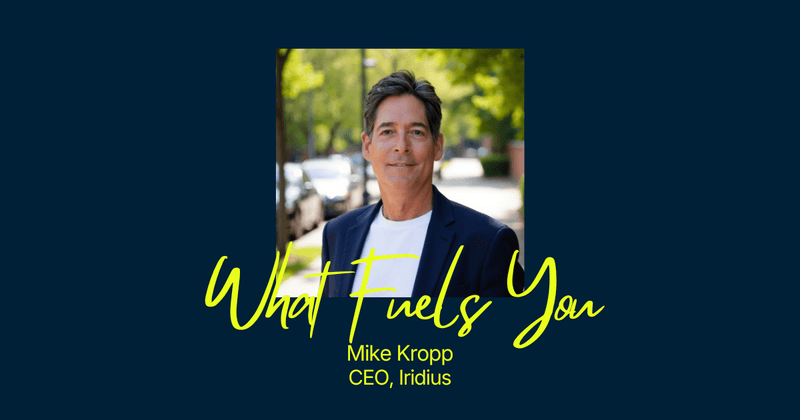
Mike Kropp CEO and Co-Founder of Iridius
A pharma company wants to put AI into a clinical workflow. The technology works. The problem is proving it followed every regulation along the way, before the fact, not after it. That gap between AI that works and AI a regulated company can actually deploy is what led a 25 year veteran of Microsoft and AWS to walk away from both and build something new.
In this episode of What Fuels You, host Shauna Swerland sits down with Mike Kropp, CEO and co-founder of Iridius, a Seattle based startup building compliance by design AI infrastructure for pharma and life sciences. They cover his path from a pre-med track to his first coding class, 32 trips to Japan building a new capability for Nissan, the leadership lessons he carried from Microsoft's culture shift under Satya Nadella to Amazon's bar raiser process, and the thinking behind Iridius's oversubscribed seed round. Kropp's throughline holds from his first job to his latest: earn trust, then build something that lasts.
📋 Episode Chapters
| 00:00 | Cold open: why customer success is the best feeling in the world for Mike Kropp |
| 00:53 | Introducing Mike Kropp, CEO and co-founder of Iridius |
| 02:05 | Hidden talents, early mornings, and growing up playing soccer in Seattle |
| 03:20 | The walk in Indianola that redirected him from pre-med to his first coding class |
| 05:00 | From junior college to the University of Washington and Microsoft's Wharton Leadership Program |
| 07:10 | Landing his first Microsoft job cold and reporting into Steve Ballmer's org |
| 10:15 | 32 trips to Japan building a new capability for Nissan |
| 12:30 | Why earning trust became his defining leadership principle |
| 14:20 | Leaving Microsoft after two decades and joining AWS to build a database migration service |
| 16:40 | Comparing Microsoft's "learn it all" culture to AWS's leadership principles and bar raiser process |
| 22:10 | The idea for Iridius, studying AI at MIT, and choosing between ChatGPT and Claude |
| 25:45 | Bootstrapping Iridius and closing an oversubscribed seed round |
| 29:50 | Why Iridius bet its go to market on pharma and life sciences compliance |
| 34:15 | Hiring philosophy: "A's hire A's" and building the Iridius team |
| 37:30 | Mentors, what fuels him, and the worldwide impact he's chasing next |
A Walk in Indianola: From Pre-Med to His First Line of Code
Mike Kropp grew up in Seattle, out most mornings before 6 a.m. knocking on neighbors' windows to get a pickup baseball or soccer game going. He eventually zeroed in on soccer and played it his entire life. His path, though, was supposed to run through medicine. His father was chief of plastic surgery at Children's Hospital, and his father's best friend was chief of neurosurgery. Two years into pre-med coursework, the pair took him on a walk in Indianola, outside Seattle, and asked him a question that changed the direction of his career: what do you love to do?
Kropp told them he had just taken his first coding class and loved it. Their answer reframed everything, that computers were going to be the future, and that following what he loved meant he would never really be working.
"If you follow your passion, you're never going to work a day in your life. And I'm still doing computing and I still love it and I'm challenged by it every day."
-- Mike Kropp
That advice sent him from a junior college through transfers to the University of Washington and Seattle Pacific University, working full time to pay his way, before he landed his first job out of school at Microsoft, applying cold with no internal connections.
32 Trips to Japan: Learning to Operate Inside Global Giants
Kropp's first Microsoft role put him in charge of sales and marketing applications worldwide, inside an organization led by Steve Ballmer, who at the time reported to Bill Gates. Within four months of being hired, he was working directly with executives including Jeff Raikes and Orlando Ayala. Operating at that level meant learning that every subsidiary had its own regional priorities and cultural expectations, and that no single playbook worked everywhere.
That skill carried into relationships with companies like BMW, where Kropp got direct access to senior leaders trying to implement new technology. The hardest stretch came when Nissan's CIO, impressed by capabilities Kropp's team had built at Microsoft, asked Microsoft's president to send Kropp to Japan to help build a new capability for the automaker.
"I wouldn't move there, but I ended up doing 32 trips back and forth to Japan from Seattle."
-- Mike Kropp
Two Cultures, One Lesson on Earning Trust
Kropp spent more than 20 years at Microsoft before joining AWS in 2020 to help build a new database migration and application modernization service. Both companies run on leadership principles, but he describes the cultures as fundamentally different. Microsoft, when he started, ran on what he calls a know it all culture, one that rewarded people for what they already knew. He credits Satya Nadella with turning that into a learn it all, customer obsessed culture instead.
AWS's version, in his experience, is more codified. Its 12 (now closer to 14 or 15) leadership principles get broken apart and assigned to individual interviewers during hiring, and get invoked constantly inside meetings, where a colleague might flag that a plan does not really reflect thinking big. AWS also distinguishes between one way doors, decisions serious enough to require real inspection, and two way doors, decisions reversible enough to just try. Where Microsoft used a role called an as appropriate, or AA, to make the final hiring call, Amazon uses bar raisers, interviewers whose job is to ask whether a candidate would rank in the top half of people already at that level. Kropp built Iridius's own leadership principles from what he took away from both companies.
"You make a commitment, you pay it off, and you try to exceed expectations when you deliver."
-- Mike Kropp
Betting on AI Before Iridius Had a Name
Kropp says he did not plan to leave AWS when he did. Watching AI accelerate roughly two and a half years ago convinced him it was a wave he wanted to be part of, so he went back to school at MIT to study it formally. Day to day, he splits his AI use between ChatGPT and Claude, though he estimates 80 percent of his time now runs through Claude.
The idea for Iridius came together quickly once Kropp connected with two former colleagues: Mark Turley, previously a controller at KPMG who later ran finance and compliance for major Amazon acquisitions including PillPack, and Alistair Lowe-Norris, a 23 year Microsoft veteran who built products including SharePoint and Active Directory and later led safe and responsible AI work reporting directly to Satya Nadella. The three settled on a specific gap in the market.
"If it isn't safe and responsible and isn't compliant, a lot of the big businesses in the world will not adopt it."
-- Mike Kropp
Iridius is a licensed product company, not a services firm. Kropp says the team is still fine tuning pricing while the product remains generally available.
Betting the Business on Pharma Compliance
Iridius bootstrapped through its early stage before closing an $8.6 million seed round that came in oversubscribed, led by Chalfen Ventures and joined by Accenture Ventures and Osage Venture Partners. The company has ten team members, with engineering as its first and ongoing hiring priority.
Choosing pharma as the starting vertical was not the original plan. Kropp says the team initially thought horizontally, the way Microsoft and AWS do, before narrowing focus after Microsoft began introducing Iridius to pharmaceutical customers whose AI pilots were getting blocked by compliance right at the edge of production. Iridius built a Growth Advisory Board of former CIOs from companies including Merck, Pfizer, Johnson & Johnson, Novartis, Allergan and Bayer to pressure test its go to market strategy, and later added Clark Golestani, a former CIO and 23 year president at Merck and founder of the venture firm K2 Access Fund, to its board of directors.
"The first thing we look for is how hungry is this person to learn."
-- Mike Kropp
Kropp traces that mindset to a mentor at Microsoft, a vice president named Mike Nash, who told him plainly: A's hire A's, B's hire C's and D's. Kropp carried that instruction into how he built his first big team at Microsoft, and how he is staffing Iridius now.
Mentors, Trust, and What Fuels Mike Kropp
Kropp traces his approach to leadership back to two mentors. The first was a childhood soccer coach, Al Kovacs, who taught a controlled, possession first style of play, pulling players who forced the ball and asking them why. The second was John Connors, Microsoft's CIO when Kropp joined the company in 1997. At his first all hands meeting in Bellevue, a stranger in the elevator greeted him by name before Kropp had any idea who he was, saying, "hello, Mr. Kropp." Minutes later, the lights dimmed and that same man walked onstage as Connors, the CIO himself. Kropp stayed close to him for years afterward, through Connors's later role at Ignition Partners.
"The most amazing thing for me is when customers will be using our product and see the value in it, and it helps them just be incredibly successful. I don't think there's a better feeling in the world than that."
-- Mike Kropp
Kropp connects that feeling to something bigger: the scale of impact he experienced years earlier leading Microsoft's Patterns and Practices team, whose frameworks reached 29 percent of developers and 37 percent of architects worldwide within four years. That is the outcome he is chasing again at Iridius, on a bigger scale.
"Once you've tasted fruit off the worldwide impact tree, there's kind of nothing like it."
-- Mike Kropp
5 Key Takeaways
Frequently Asked Questions
Who is Mike Kropp?
Mike Kropp is the CEO and co-founder of Iridius, a Seattle based startup building compliance by design AI infrastructure for regulated industries such as pharma and life sciences. He spent over 25 years leading engineering teams at Microsoft and Amazon Web Services before co-founding Iridius in June 2024 with Mark Turley and Alistair Lowe-Norris.
What does Iridius do?
Iridius builds AI infrastructure that embeds regulatory compliance directly into how AI systems run, rather than auditing them after the fact. The company's initial focus is pharma and life sciences, where Kropp says regulated companies cannot move AI into production until compliance is designed in from the start.
What did Mike Kropp say about hiring at Iridius?
Kropp said the first thing Iridius looks for in a hire is how hungry that person is to learn and how fast they can adapt, since he expects the skills the company needs today to change quickly. He credits his hiring philosophy, summarized as "A's hire A's," to advice from his former Microsoft boss, Mike Nash.
Why did Iridius choose pharma and life sciences as its go to market focus?
Kropp said Iridius originally considered a horizontal strategy like Microsoft and AWS before narrowing to pharma and life sciences, after Microsoft began introducing the startup to pharmaceutical customers whose AI pilots were stalling on compliance. Iridius also built a Growth Advisory Board of former CIOs from companies including Merck, Pfizer, Johnson & Johnson, Novartis, Allergan and Bayer to guide its approach.
Mike Kropp CEO and Co-Founder of Iridius
A pharma company wants to put AI into a clinical workflow. The technology works. The problem is proving it followed every regulation along the way, before the fact, not after it. That gap between AI that works and AI a regulated company can actually deploy is what led a 25 year veteran of Microsoft and AWS to walk away from both and build something new.
In this episode of What Fuels You, host Shauna Swerland sits down with Mike Kropp, CEO and co-founder of Iridius, a Seattle based startup building compliance by design AI infrastructure for pharma and life sciences. They cover his path from a pre-med track to his first coding class, 32 trips to Japan building a new capability for Nissan, the leadership lessons he carried from Microsoft's culture shift under Satya Nadella to Amazon's bar raiser process, and the thinking behind Iridius's oversubscribed seed round. Kropp's throughline holds from his first job to his latest: earn trust, then build something that lasts.
📋 Episode Chapters
| 00:00 | Cold open: why customer success is the best feeling in the world for Mike Kropp |
| 00:53 | Introducing Mike Kropp, CEO and co-founder of Iridius |
| 02:05 | Hidden talents, early mornings, and growing up playing soccer in Seattle |
| 03:20 | The walk in Indianola that redirected him from pre-med to his first coding class |
| 05:00 | From junior college to the University of Washington and Microsoft's Wharton Leadership Program |
| 07:10 | Landing his first Microsoft job cold and reporting into Steve Ballmer's org |
| 10:15 | 32 trips to Japan building a new capability for Nissan |
| 12:30 | Why earning trust became his defining leadership principle |
| 14:20 | Leaving Microsoft after two decades and joining AWS to build a database migration service |
| 16:40 | Comparing Microsoft's "learn it all" culture to AWS's leadership principles and bar raiser process |
| 22:10 | The idea for Iridius, studying AI at MIT, and choosing between ChatGPT and Claude |
| 25:45 | Bootstrapping Iridius and closing an oversubscribed seed round |
| 29:50 | Why Iridius bet its go to market on pharma and life sciences compliance |
| 34:15 | Hiring philosophy: "A's hire A's" and building the Iridius team |
| 37:30 | Mentors, what fuels him, and the worldwide impact he's chasing next |
A Walk in Indianola: From Pre-Med to His First Line of Code
Mike Kropp grew up in Seattle, out most mornings before 6 a.m. knocking on neighbors' windows to get a pickup baseball or soccer game going. He eventually zeroed in on soccer and played it his entire life. His path, though, was supposed to run through medicine. His father was chief of plastic surgery at Children's Hospital, and his father's best friend was chief of neurosurgery. Two years into pre-med coursework, the pair took him on a walk in Indianola, outside Seattle, and asked him a question that changed the direction of his career: what do you love to do?
Kropp told them he had just taken his first coding class and loved it. Their answer reframed everything, that computers were going to be the future, and that following what he loved meant he would never really be working.
"If you follow your passion, you're never going to work a day in your life. And I'm still doing computing and I still love it and I'm challenged by it every day."
-- Mike Kropp
That advice sent him from a junior college through transfers to the University of Washington and Seattle Pacific University, working full time to pay his way, before he landed his first job out of school at Microsoft, applying cold with no internal connections.
32 Trips to Japan: Learning to Operate Inside Global Giants
Kropp's first Microsoft role put him in charge of sales and marketing applications worldwide, inside an organization led by Steve Ballmer, who at the time reported to Bill Gates. Within four months of being hired, he was working directly with executives including Jeff Raikes and Orlando Ayala. Operating at that level meant learning that every subsidiary had its own regional priorities and cultural expectations, and that no single playbook worked everywhere.
That skill carried into relationships with companies like BMW, where Kropp got direct access to senior leaders trying to implement new technology. The hardest stretch came when Nissan's CIO, impressed by capabilities Kropp's team had built at Microsoft, asked Microsoft's president to send Kropp to Japan to help build a new capability for the automaker.
"I wouldn't move there, but I ended up doing 32 trips back and forth to Japan from Seattle."
-- Mike Kropp
Two Cultures, One Lesson on Earning Trust
Kropp spent more than 20 years at Microsoft before joining AWS in 2020 to help build a new database migration and application modernization service. Both companies run on leadership principles, but he describes the cultures as fundamentally different. Microsoft, when he started, ran on what he calls a know it all culture, one that rewarded people for what they already knew. He credits Satya Nadella with turning that into a learn it all, customer obsessed culture instead.
AWS's version, in his experience, is more codified. Its 12 (now closer to 14 or 15) leadership principles get broken apart and assigned to individual interviewers during hiring, and get invoked constantly inside meetings, where a colleague might flag that a plan does not really reflect thinking big. AWS also distinguishes between one way doors, decisions serious enough to require real inspection, and two way doors, decisions reversible enough to just try. Where Microsoft used a role called an as appropriate, or AA, to make the final hiring call, Amazon uses bar raisers, interviewers whose job is to ask whether a candidate would rank in the top half of people already at that level. Kropp built Iridius's own leadership principles from what he took away from both companies.
"You make a commitment, you pay it off, and you try to exceed expectations when you deliver."
-- Mike Kropp
Betting on AI Before Iridius Had a Name
Kropp says he did not plan to leave AWS when he did. Watching AI accelerate roughly two and a half years ago convinced him it was a wave he wanted to be part of, so he went back to school at MIT to study it formally. Day to day, he splits his AI use between ChatGPT and Claude, though he estimates 80 percent of his time now runs through Claude.
The idea for Iridius came together quickly once Kropp connected with two former colleagues: Mark Turley, previously a controller at KPMG who later ran finance and compliance for major Amazon acquisitions including PillPack, and Alistair Lowe-Norris, a 23 year Microsoft veteran who built products including SharePoint and Active Directory and later led safe and responsible AI work reporting directly to Satya Nadella. The three settled on a specific gap in the market.
"If it isn't safe and responsible and isn't compliant, a lot of the big businesses in the world will not adopt it."
-- Mike Kropp
Iridius is a licensed product company, not a services firm. Kropp says the team is still fine tuning pricing while the product remains generally available.
Betting the Business on Pharma Compliance
Iridius bootstrapped through its early stage before closing an $8.6 million seed round that came in oversubscribed, led by Chalfen Ventures and joined by Accenture Ventures and Osage Venture Partners. The company has ten team members, with engineering as its first and ongoing hiring priority.
Choosing pharma as the starting vertical was not the original plan. Kropp says the team initially thought horizontally, the way Microsoft and AWS do, before narrowing focus after Microsoft began introducing Iridius to pharmaceutical customers whose AI pilots were getting blocked by compliance right at the edge of production. Iridius built a Growth Advisory Board of former CIOs from companies including Merck, Pfizer, Johnson & Johnson, Novartis, Allergan and Bayer to pressure test its go to market strategy, and later added Clark Golestani, a former CIO and 23 year president at Merck and founder of the venture firm K2 Access Fund, to its board of directors.
"The first thing we look for is how hungry is this person to learn."
-- Mike Kropp
Kropp traces that mindset to a mentor at Microsoft, a vice president named Mike Nash, who told him plainly: A's hire A's, B's hire C's and D's. Kropp carried that instruction into how he built his first big team at Microsoft, and how he is staffing Iridius now.
Mentors, Trust, and What Fuels Mike Kropp
Kropp traces his approach to leadership back to two mentors. The first was a childhood soccer coach, Al Kovacs, who taught a controlled, possession first style of play, pulling players who forced the ball and asking them why. The second was John Connors, Microsoft's CIO when Kropp joined the company in 1997. At his first all hands meeting in Bellevue, a stranger in the elevator greeted him by name before Kropp had any idea who he was, saying, "hello, Mr. Kropp." Minutes later, the lights dimmed and that same man walked onstage as Connors, the CIO himself. Kropp stayed close to him for years afterward, through Connors's later role at Ignition Partners.
"The most amazing thing for me is when customers will be using our product and see the value in it, and it helps them just be incredibly successful. I don't think there's a better feeling in the world than that."
-- Mike Kropp
Kropp connects that feeling to something bigger: the scale of impact he experienced years earlier leading Microsoft's Patterns and Practices team, whose frameworks reached 29 percent of developers and 37 percent of architects worldwide within four years. That is the outcome he is chasing again at Iridius, on a bigger scale.
"Once you've tasted fruit off the worldwide impact tree, there's kind of nothing like it."
-- Mike Kropp
5 Key Takeaways
Frequently Asked Questions
Who is Mike Kropp?
Mike Kropp is the CEO and co-founder of Iridius, a Seattle based startup building compliance by design AI infrastructure for regulated industries such as pharma and life sciences. He spent over 25 years leading engineering teams at Microsoft and Amazon Web Services before co-founding Iridius in June 2024 with Mark Turley and Alistair Lowe-Norris.
What does Iridius do?
Iridius builds AI infrastructure that embeds regulatory compliance directly into how AI systems run, rather than auditing them after the fact. The company's initial focus is pharma and life sciences, where Kropp says regulated companies cannot move AI into production until compliance is designed in from the start.
What did Mike Kropp say about hiring at Iridius?
Kropp said the first thing Iridius looks for in a hire is how hungry that person is to learn and how fast they can adapt, since he expects the skills the company needs today to change quickly. He credits his hiring philosophy, summarized as "A's hire A's," to advice from his former Microsoft boss, Mike Nash.
Why did Iridius choose pharma and life sciences as its go to market focus?
Kropp said Iridius originally considered a horizontal strategy like Microsoft and AWS before narrowing to pharma and life sciences, after Microsoft began introducing the startup to pharmaceutical customers whose AI pilots were stalling on compliance. Iridius also built a Growth Advisory Board of former CIOs from companies including Merck, Pfizer, Johnson & Johnson, Novartis, Allergan and Bayer to guide its approach.