

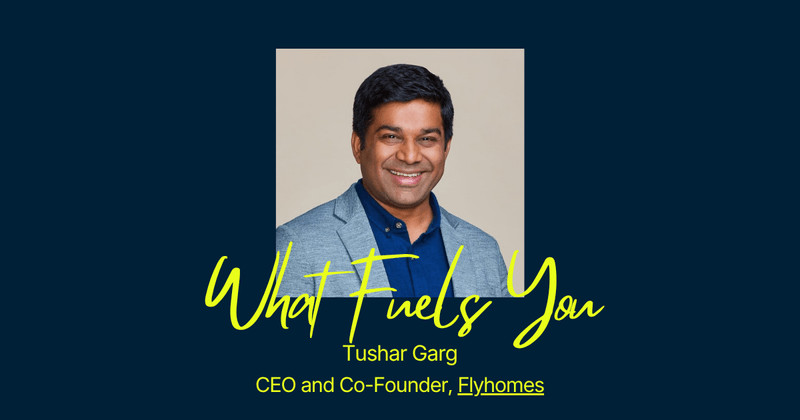
In 2015, a Kellogg MBA student with a machine learning background and a McKinsey offer in hand started standing outside Seattle open houses, asking strangers if he could help them buy a home. By the time he graduated, Flyhomes had raised no outside capital and he ranked among the top 100 realtors in Washington. A decade later, the company has been rebuilt from the studs into a fintech that lets families buy their next home before they sell the one they're in.
In this episode of What Fuels You, host Shauna Swerland sits down with Tushar Garg, co-founder and CEO of Flyhomes, for a conversation that covers growing up across four high schools in Uttar Pradesh, the experimentation culture of Microsoft's Bing team, the deal that inspired Flyhomes' Cash Offer, and the decision to rebuild the company as a B2B Buy Before You Sell platform when interest rates spiked. The throughline is a founder who keeps questioning his own assumptions, and who learned that the hardest moments are when you have to "radically reimagine who you are, what you built, what you need to go do."
📋 Episode Chapters
| 00:00 | Tushar Garg on radically reimagining a company when things get difficult |
| 01:21 | Rapid fire: Indian milk chai, a golden doodle named Melon, Annie Duke's book Quit, and resetting in Washington's outdoors |
| 07:34 | Growing up in Uttar Pradesh, four high schools, and fundraising for SPIC MACAY at IIT |
| 17:01 | A family of engineers, Tom Mitchell's Machine Learning, and a University of Minnesota PhD track |
| 20:20 | How a sabbatical from Professor Vipin Kumar's lab led to a Microsoft job offer in Seattle |
| 22:39 | Microsoft Office rigor versus the Bing core ranking team's move fast, fail fast culture |
| 26:07 | Why he left Microsoft for a Kellogg MBA and the decisions that weren't in any playbook |
| 32:50 | Meeting co-founder Steve Lane, the home energy idea that failed, and getting a brokerage license |
| 37:58 | Pitching buyers outside open houses and winning a Seattle home against 9 offers |
| 42:22 | Mark Vadon's $2 million seed round, Guaranteed Offers, and the house Flyhomes bought on December 23rd |
| 45:44 | Raising a Series A from Andreessen Horowitz and why it came together a little too easily |
| 49:34 | COVID, the interest rate hike, and rebuilding Flyhomes down to the studs as a B2B fintech |
| 56:05 | Listening in Monday sales meetings, making big decisions, and the role of the board in a Series D |
| 58:40 | Helping 30,000 families by 2030, becoming profitable, and what fuels Tushar Garg |
Four High Schools, 220 Million People, and an Early Education in Humans
Tushar Garg grew up in Uttar Pradesh, which he describes as India's most populous state, with about 220 million people in an area roughly the size of Washington. His father served in the Indian Administrative Service, a transferable post that moved the family from city to city. By the end of high school Tushar had attended four schools: St. Francis College, run by Christian missionaries; a boarding school in the mountains where his father and uncle had studied decades earlier; Army Public School; and an academic school built around the idea of world peace.
"So, you learn a thing or two about humans when you're there."
-- Tushar Garg
Each school had its own subculture and its own ideas about right and wrong. Looking back, Tushar sees that constant transition as training for building a company in the US with people from every background. At the boarding school, teachers who had once taught his father let him learn the periodic table two years early on weekend visits to their homes. At IIT Guwahati, where admission came down to physics, chemistry, math, and one national exam, he signed up for every club he could and raised money from small shop owners for SPIC MACAY, a classical music and culture festival that was hard to fund. His team also grew the budget of the school's technical festival tenfold, to the point that the director had to put caps on how much they could raise.
From a Free Machine Learning Sample to Bing's Core Ranking Team
Tushar comes from four generations of engineers. His great-grandfather, grandfather, and father all studied at the University of Roorkee, India's oldest engineering college. In 2004, when most computer science students were choosing networking or operating systems, he picked up a free sample of Tom Mitchell's Machine Learning from a professor's desk and couldn't put it down. He sent 100 to 200 emails to professors around the world asking for a research internship, landed five scholarship offers, and spent a paid summer internship in Italy. That professor pointed him to her twin sister's lab at the University of Minnesota, which brought him to the US.
In Minnesota he applied machine learning to protein function prediction and brain research with Mayo Clinic under Professor Vipin Kumar. Unsure whether academia was his path, he told Kumar he had doubts before a trip to India. When he came back, Kumar introduced him to a former student at Microsoft and suggested a one-year sabbatical. Microsoft was the only company Tushar interviewed with. He arrived on a sunny spring day, took the offer, and has been in Seattle for 18 years.
He started on the Microsoft Office analytics group, building analytics for SharePoint, where shipping meant a year of no new features before a release. He then moved to Bing's core ranking team, the group behind the "10 blue links," which he calls an underdog team chasing Google with fewer resources. Many of its alumni went on to found companies.
"What you have to do is you just sort of set up the infrastructure so that you can test your hypothesis as fast as possible."
-- Tushar Garg
Tushar carried both modes into Flyhomes: the Office and PhD habit of detailed, careful work, and Bing's habit of shipping models and measuring how fast the team was iterating. He says founders need a time and place for each.
Leaving McKinsey to Become a Seattle Realtor
Tushar left Microsoft for Kellogg with a plan to become a business and civic leader with a deep background in data. He had been admitted to a joint MBA and public policy program with Harvard's Kennedy School, but the partnership ended, and with his first child born and his wife's family in Wisconsin, Kellogg first and McKinsey after made sense. Then he made a different call.
"But I left my job at McKinsey to become a realtor in Seattle."
-- Tushar Garg
He traces that kind of decision to marrying his wife, who grew up in a small town in Wisconsin, a choice he says "wasn't in any other playbook." At Kellogg he met Steve Lane, a fellow Microsoft alum in the JD/MBA program from a small town in Texas who had walked onto the Longhorn football team and arrived saying he would have a company by graduation. Their class project aimed to help homeowners save energy. Within a quarter, a top Chicago realtor showed them why it wouldn't work: upgrades don't pay back in time, and the housing market doesn't price them. The team pivoted to a more nuanced pricing model, which Tushar calls "Zillow++," and Steve used his law degree to get a real estate brokerage license so they could access the data.
The first client was Tushar's former Microsoft boss, who mentioned over a weekend that he was looking for a house. Tushar admitted he had no idea what he was doing. The boss trusted him anyway. Tushar planned to help 10 families buy homes during a quarter off, earning commissions to bootstrap the startup and learning what data buyers cared about.
"There's no better way to learn, you know, product discovery than from just doing it."
-- Tushar Garg
Microsoft friends became many of the earliest Flyhomes customers. The rest came from Tushar waiting outside open houses and introducing himself to buyers as they walked out. He's still surprised it worked. By the time he graduated from Kellogg, without any outside capital, he had hired a community college student who showed homes in Seattle while Tushar worked deals from Chicago, and was among the top 100 realtors in the state.
The Seller Shouldn't Have to Guess: From Guaranteed Offers to Cash Offer
Coming from outside the industry, Tushar and his team saw problems everyone else accepted. The biggest in 2015 and 2016 was buyers losing to cash offers. His first family, a Microsoft couple putting 10% down, had been losing houses for two years. Tushar called the listing agent and asked what mattered to her sellers. She told him 10% wasn't enough when competitors had all cash or 50% down. He asked who her favorite lender in town was and got his buyers qualified there. They were the fifth-highest of 9 offers, matched the top price, and won.
The lesson was that the agent wasn't chasing the highest number. She wanted confidence the deal would close. Tushar found it backwards that sellers had to judge a buyer's ability to close on one of the largest transactions of their lives.
"So, for example, if I go to Walmart and buying something, I can just swipe my card, I can get the goods I need. The teller is not trying to figure out if I can pay for this or not pay for this, you know?"
-- Tushar Garg
Flyhomes launched Guaranteed Offers: if a buyer failed to close, Flyhomes would buy the house on the same terms. Seattle founder Mark Vadon, who founded Zulily and Blue Nile and served on Chewy's board, put in the $2 million seed round that backed the guarantee. The first buyer backed out almost immediately, and Flyhomes bought a roughly half-million-dollar home on December 23rd while Tushar was walking into his in-laws' house in Wisconsin. They sold it at a profit and hired a key employee out of the experience.
Agents still didn't trust a guarantee from a company they'd never heard of, and a guarantee only gets tested when a deal fails. So Flyhomes flipped the model: turn every buyer into a cash buyer who can close in 10 days. That required fronting cash through what Tushar calls a new class of financial asset, a short-term liquidity product secured by the home and refinanced as soon as 30 days later. Mark Vadon made introductions on a three-day trip to the Bay Area, and the Series A came together with Andreessen Horowitz.
"And honestly, Series A came together a little too easily."
-- Tushar Garg
The day the Andreessen Horowitz money arrived, Tushar was in the office until 11 p.m. as the team helped 9 families buy homes, a single-day record at the time. In hindsight, he says, nobody stopped to think much about it. They assumed capital would always be there.
Rebuilding Flyhomes Down to the Studs
Flyhomes grew its consumer model quickly and raised a $150 million Series C from investors including Norwest Venture Partners and Battery Ventures. Then the Fed began raising interest rates, and the housing market shifted fast.
"It's like being an airline company in COVID, you know, a travel company."
-- Tushar Garg
Flyhomes kept what Tushar considers the best of what it had built: its financial products, especially the idea that people should be able to buy their next home before they sell. The company stepped back from brokerage, long-term mortgage, and title, and became a fintech that plugs in as a short-term liquidity layer behind real estate companies, loan officers, and agents nationwide.
Tushar credits his team for some of the biggest calls. The leader who came in to run mortgage pushed to drop long-term lending entirely.
"The person who came to run mortgage was like, hey, instead of running long-term mortgage, we should do short-term mortgage. And that was a very courageous decision."
-- Tushar Garg
The new model reaches customers the old brand never did. Flyhomes now operates in all 50 states, and in the month before recording, people in about 37 states used its products to move. Downsizers with equity locked in their current homes have become a major use case.
"So our model does not have like big customer acquisition. Our loan officers across the country are now our sales force."
-- Tushar Garg
Listening First, Board Relationships, and a Humble Confidence
Tushar sits in on the Flyhomes sales team meeting every Monday with one rule for himself: listen, don't participate.
"And I actually try to be just walking around and listening, not to even participate, just because if you try to participate, you sometimes don't end up listening properly."
-- Tushar Garg
He splits decisions into two kinds. Most of the work is executing on the current path with constant small experiments. Every so often, a company has to rethink everything, and for those moments he says he has no playbook beyond being vulnerable and talking to a lot of people, inside the team and on the board. The Flyhomes board was unanimously supportive as the company prepared its Series D. His lesson: board members each have individual interests, but they also share a larger interest in the company, and the leader's job is to connect those dots. Outside work, he leans on his father, who lives with the family, and his wife, whom he calls a great listener.
Today Flyhomes works with about 40,000 loan officers and hundreds of thousands of agents who bring its products to their communities. The north star is helping 30,000 families buy before they sell by 2030. The team set two shared goals this year, profitability and an origination volume target. It became profitable, then meaningfully profitable by summer, and hit the volume number in July in what Tushar calls one of the hardest, slowest housing markets.
"But the fact that we've been able to come out of it on the other end of it, I think just gives the level of, I would call it a humble confidence, you know, which is something that's very endearing as well."
-- Tushar Garg
Asked what fuels him, Tushar points to the mission, the hard and creative problems, and being present for his kids, his family, and the Washington outdoors.
"I've always been very mission-driven, but I also love solving really creative and hard problems and reimagining."
-- Tushar Garg
5 Key Takeaways
Frequently Asked Questions
What does Flyhomes do?
Flyhomes is a residential real estate fintech that lets homebuyers buy their next home before they sell their current one and make cash offers. Co-founder and CEO Tushar Garg explains that Flyhomes plugs in as a short-term liquidity layer behind loan officers, agents, and real estate companies through wholesale lending, and it now operates in all 50 states. Downsizers with equity tied up in their homes have become one of its largest use cases.
How did Tushar Garg start Flyhomes?
Tushar Garg co-founded Flyhomes with Steve Lane while both were students at Northwestern's Kellogg School of Management. After a class project on home energy efficiency stalled, they got a real estate brokerage license to access housing data, and Tushar left McKinsey to work as a realtor in Seattle. He helped his former Microsoft boss buy the company's first home and found many early clients by pitching buyers outside open houses.
Why did Flyhomes change its business model?
According to Tushar Garg, rising interest rates made the consumer model much harder to grow. The company stepped back from its end-to-end brokerage, long-term mortgage, and title businesses and kept its financial products, Cash Offer and Buy Before You Sell, distributing them through loan officers and agents nationwide. As Tushar put it, "our loan officers across the country are now our sales force."
What did Tushar Garg say about raising a Series A from Andreessen Horowitz?
Tushar Garg said Flyhomes' Series A with Andreessen Horowitz "came together a little too easily," helped by introductions from seed investor Mark Vadon, founder of Zulily and Blue Nile. On the day the money arrived, the team helped 9 families buy homes, a company record at the time. Looking back, he says the team assumed capital would always be available, an assumption the rate hikes later broke.
How does Tushar Garg make big decisions as a CEO?
Tushar Garg separates steady execution with small experiments from the rare moments that require radically reimagining the business. In those moments, he says he relies on being vulnerable and talking to many people, including his leadership team and board. He also attends the Flyhomes sales meeting every Monday purely to listen, because trying to participate can get in the way of listening properly.
In 2015, a Kellogg MBA student with a machine learning background and a McKinsey offer in hand started standing outside Seattle open houses, asking strangers if he could help them buy a home. By the time he graduated, Flyhomes had raised no outside capital and he ranked among the top 100 realtors in Washington. A decade later, the company has been rebuilt from the studs into a fintech that lets families buy their next home before they sell the one they're in.
In this episode of What Fuels You, host Shauna Swerland sits down with Tushar Garg, co-founder and CEO of Flyhomes, for a conversation that covers growing up across four high schools in Uttar Pradesh, the experimentation culture of Microsoft's Bing team, the deal that inspired Flyhomes' Cash Offer, and the decision to rebuild the company as a B2B Buy Before You Sell platform when interest rates spiked. The throughline is a founder who keeps questioning his own assumptions, and who learned that the hardest moments are when you have to "radically reimagine who you are, what you built, what you need to go do."
📋 Episode Chapters
| 00:00 | Tushar Garg on radically reimagining a company when things get difficult |
| 01:21 | Rapid fire: Indian milk chai, a golden doodle named Melon, Annie Duke's book Quit, and resetting in Washington's outdoors |
| 07:34 | Growing up in Uttar Pradesh, four high schools, and fundraising for SPIC MACAY at IIT |
| 17:01 | A family of engineers, Tom Mitchell's Machine Learning, and a University of Minnesota PhD track |
| 20:20 | How a sabbatical from Professor Vipin Kumar's lab led to a Microsoft job offer in Seattle |
| 22:39 | Microsoft Office rigor versus the Bing core ranking team's move fast, fail fast culture |
| 26:07 | Why he left Microsoft for a Kellogg MBA and the decisions that weren't in any playbook |
| 32:50 | Meeting co-founder Steve Lane, the home energy idea that failed, and getting a brokerage license |
| 37:58 | Pitching buyers outside open houses and winning a Seattle home against 9 offers |
| 42:22 | Mark Vadon's $2 million seed round, Guaranteed Offers, and the house Flyhomes bought on December 23rd |
| 45:44 | Raising a Series A from Andreessen Horowitz and why it came together a little too easily |
| 49:34 | COVID, the interest rate hike, and rebuilding Flyhomes down to the studs as a B2B fintech |
| 56:05 | Listening in Monday sales meetings, making big decisions, and the role of the board in a Series D |
| 58:40 | Helping 30,000 families by 2030, becoming profitable, and what fuels Tushar Garg |
Four High Schools, 220 Million People, and an Early Education in Humans
Tushar Garg grew up in Uttar Pradesh, which he describes as India's most populous state, with about 220 million people in an area roughly the size of Washington. His father served in the Indian Administrative Service, a transferable post that moved the family from city to city. By the end of high school Tushar had attended four schools: St. Francis College, run by Christian missionaries; a boarding school in the mountains where his father and uncle had studied decades earlier; Army Public School; and an academic school built around the idea of world peace.
"So, you learn a thing or two about humans when you're there."
-- Tushar Garg
Each school had its own subculture and its own ideas about right and wrong. Looking back, Tushar sees that constant transition as training for building a company in the US with people from every background. At the boarding school, teachers who had once taught his father let him learn the periodic table two years early on weekend visits to their homes. At IIT Guwahati, where admission came down to physics, chemistry, math, and one national exam, he signed up for every club he could and raised money from small shop owners for SPIC MACAY, a classical music and culture festival that was hard to fund. His team also grew the budget of the school's technical festival tenfold, to the point that the director had to put caps on how much they could raise.
From a Free Machine Learning Sample to Bing's Core Ranking Team
Tushar comes from four generations of engineers. His great-grandfather, grandfather, and father all studied at the University of Roorkee, India's oldest engineering college. In 2004, when most computer science students were choosing networking or operating systems, he picked up a free sample of Tom Mitchell's Machine Learning from a professor's desk and couldn't put it down. He sent 100 to 200 emails to professors around the world asking for a research internship, landed five scholarship offers, and spent a paid summer internship in Italy. That professor pointed him to her twin sister's lab at the University of Minnesota, which brought him to the US.
In Minnesota he applied machine learning to protein function prediction and brain research with Mayo Clinic under Professor Vipin Kumar. Unsure whether academia was his path, he told Kumar he had doubts before a trip to India. When he came back, Kumar introduced him to a former student at Microsoft and suggested a one-year sabbatical. Microsoft was the only company Tushar interviewed with. He arrived on a sunny spring day, took the offer, and has been in Seattle for 18 years.
He started on the Microsoft Office analytics group, building analytics for SharePoint, where shipping meant a year of no new features before a release. He then moved to Bing's core ranking team, the group behind the "10 blue links," which he calls an underdog team chasing Google with fewer resources. Many of its alumni went on to found companies.
"What you have to do is you just sort of set up the infrastructure so that you can test your hypothesis as fast as possible."
-- Tushar Garg
Tushar carried both modes into Flyhomes: the Office and PhD habit of detailed, careful work, and Bing's habit of shipping models and measuring how fast the team was iterating. He says founders need a time and place for each.
Leaving McKinsey to Become a Seattle Realtor
Tushar left Microsoft for Kellogg with a plan to become a business and civic leader with a deep background in data. He had been admitted to a joint MBA and public policy program with Harvard's Kennedy School, but the partnership ended, and with his first child born and his wife's family in Wisconsin, Kellogg first and McKinsey after made sense. Then he made a different call.
"But I left my job at McKinsey to become a realtor in Seattle."
-- Tushar Garg
He traces that kind of decision to marrying his wife, who grew up in a small town in Wisconsin, a choice he says "wasn't in any other playbook." At Kellogg he met Steve Lane, a fellow Microsoft alum in the JD/MBA program from a small town in Texas who had walked onto the Longhorn football team and arrived saying he would have a company by graduation. Their class project aimed to help homeowners save energy. Within a quarter, a top Chicago realtor showed them why it wouldn't work: upgrades don't pay back in time, and the housing market doesn't price them. The team pivoted to a more nuanced pricing model, which Tushar calls "Zillow++," and Steve used his law degree to get a real estate brokerage license so they could access the data.
The first client was Tushar's former Microsoft boss, who mentioned over a weekend that he was looking for a house. Tushar admitted he had no idea what he was doing. The boss trusted him anyway. Tushar planned to help 10 families buy homes during a quarter off, earning commissions to bootstrap the startup and learning what data buyers cared about.
"There's no better way to learn, you know, product discovery than from just doing it."
-- Tushar Garg
Microsoft friends became many of the earliest Flyhomes customers. The rest came from Tushar waiting outside open houses and introducing himself to buyers as they walked out. He's still surprised it worked. By the time he graduated from Kellogg, without any outside capital, he had hired a community college student who showed homes in Seattle while Tushar worked deals from Chicago, and was among the top 100 realtors in the state.
The Seller Shouldn't Have to Guess: From Guaranteed Offers to Cash Offer
Coming from outside the industry, Tushar and his team saw problems everyone else accepted. The biggest in 2015 and 2016 was buyers losing to cash offers. His first family, a Microsoft couple putting 10% down, had been losing houses for two years. Tushar called the listing agent and asked what mattered to her sellers. She told him 10% wasn't enough when competitors had all cash or 50% down. He asked who her favorite lender in town was and got his buyers qualified there. They were the fifth-highest of 9 offers, matched the top price, and won.
The lesson was that the agent wasn't chasing the highest number. She wanted confidence the deal would close. Tushar found it backwards that sellers had to judge a buyer's ability to close on one of the largest transactions of their lives.
"So, for example, if I go to Walmart and buying something, I can just swipe my card, I can get the goods I need. The teller is not trying to figure out if I can pay for this or not pay for this, you know?"
-- Tushar Garg
Flyhomes launched Guaranteed Offers: if a buyer failed to close, Flyhomes would buy the house on the same terms. Seattle founder Mark Vadon, who founded Zulily and Blue Nile and served on Chewy's board, put in the $2 million seed round that backed the guarantee. The first buyer backed out almost immediately, and Flyhomes bought a roughly half-million-dollar home on December 23rd while Tushar was walking into his in-laws' house in Wisconsin. They sold it at a profit and hired a key employee out of the experience.
Agents still didn't trust a guarantee from a company they'd never heard of, and a guarantee only gets tested when a deal fails. So Flyhomes flipped the model: turn every buyer into a cash buyer who can close in 10 days. That required fronting cash through what Tushar calls a new class of financial asset, a short-term liquidity product secured by the home and refinanced as soon as 30 days later. Mark Vadon made introductions on a three-day trip to the Bay Area, and the Series A came together with Andreessen Horowitz.
"And honestly, Series A came together a little too easily."
-- Tushar Garg
The day the Andreessen Horowitz money arrived, Tushar was in the office until 11 p.m. as the team helped 9 families buy homes, a single-day record at the time. In hindsight, he says, nobody stopped to think much about it. They assumed capital would always be there.
Rebuilding Flyhomes Down to the Studs
Flyhomes grew its consumer model quickly and raised a $150 million Series C from investors including Norwest Venture Partners and Battery Ventures. Then the Fed began raising interest rates, and the housing market shifted fast.
"It's like being an airline company in COVID, you know, a travel company."
-- Tushar Garg
Flyhomes kept what Tushar considers the best of what it had built: its financial products, especially the idea that people should be able to buy their next home before they sell. The company stepped back from brokerage, long-term mortgage, and title, and became a fintech that plugs in as a short-term liquidity layer behind real estate companies, loan officers, and agents nationwide.
Tushar credits his team for some of the biggest calls. The leader who came in to run mortgage pushed to drop long-term lending entirely.
"The person who came to run mortgage was like, hey, instead of running long-term mortgage, we should do short-term mortgage. And that was a very courageous decision."
-- Tushar Garg
The new model reaches customers the old brand never did. Flyhomes now operates in all 50 states, and in the month before recording, people in about 37 states used its products to move. Downsizers with equity locked in their current homes have become a major use case.
"So our model does not have like big customer acquisition. Our loan officers across the country are now our sales force."
-- Tushar Garg
Listening First, Board Relationships, and a Humble Confidence
Tushar sits in on the Flyhomes sales team meeting every Monday with one rule for himself: listen, don't participate.
"And I actually try to be just walking around and listening, not to even participate, just because if you try to participate, you sometimes don't end up listening properly."
-- Tushar Garg
He splits decisions into two kinds. Most of the work is executing on the current path with constant small experiments. Every so often, a company has to rethink everything, and for those moments he says he has no playbook beyond being vulnerable and talking to a lot of people, inside the team and on the board. The Flyhomes board was unanimously supportive as the company prepared its Series D. His lesson: board members each have individual interests, but they also share a larger interest in the company, and the leader's job is to connect those dots. Outside work, he leans on his father, who lives with the family, and his wife, whom he calls a great listener.
Today Flyhomes works with about 40,000 loan officers and hundreds of thousands of agents who bring its products to their communities. The north star is helping 30,000 families buy before they sell by 2030. The team set two shared goals this year, profitability and an origination volume target. It became profitable, then meaningfully profitable by summer, and hit the volume number in July in what Tushar calls one of the hardest, slowest housing markets.
"But the fact that we've been able to come out of it on the other end of it, I think just gives the level of, I would call it a humble confidence, you know, which is something that's very endearing as well."
-- Tushar Garg
Asked what fuels him, Tushar points to the mission, the hard and creative problems, and being present for his kids, his family, and the Washington outdoors.
"I've always been very mission-driven, but I also love solving really creative and hard problems and reimagining."
-- Tushar Garg
5 Key Takeaways
Frequently Asked Questions
What does Flyhomes do?
Flyhomes is a residential real estate fintech that lets homebuyers buy their next home before they sell their current one and make cash offers. Co-founder and CEO Tushar Garg explains that Flyhomes plugs in as a short-term liquidity layer behind loan officers, agents, and real estate companies through wholesale lending, and it now operates in all 50 states. Downsizers with equity tied up in their homes have become one of its largest use cases.
How did Tushar Garg start Flyhomes?
Tushar Garg co-founded Flyhomes with Steve Lane while both were students at Northwestern's Kellogg School of Management. After a class project on home energy efficiency stalled, they got a real estate brokerage license to access housing data, and Tushar left McKinsey to work as a realtor in Seattle. He helped his former Microsoft boss buy the company's first home and found many early clients by pitching buyers outside open houses.
Why did Flyhomes change its business model?
According to Tushar Garg, rising interest rates made the consumer model much harder to grow. The company stepped back from its end-to-end brokerage, long-term mortgage, and title businesses and kept its financial products, Cash Offer and Buy Before You Sell, distributing them through loan officers and agents nationwide. As Tushar put it, "our loan officers across the country are now our sales force."
What did Tushar Garg say about raising a Series A from Andreessen Horowitz?
Tushar Garg said Flyhomes' Series A with Andreessen Horowitz "came together a little too easily," helped by introductions from seed investor Mark Vadon, founder of Zulily and Blue Nile. On the day the money arrived, the team helped 9 families buy homes, a company record at the time. Looking back, he says the team assumed capital would always be available, an assumption the rate hikes later broke.
How does Tushar Garg make big decisions as a CEO?
Tushar Garg separates steady execution with small experiments from the rare moments that require radically reimagining the business. In those moments, he says he relies on being vulnerable and talking to many people, including his leadership team and board. He also attends the Flyhomes sales meeting every Monday purely to listen, because trying to participate can get in the way of listening properly.