
"The Seattle Way Is Incredibly Ambitious" -- Jacob Colker, Co-Founder and Managing Director of AI House
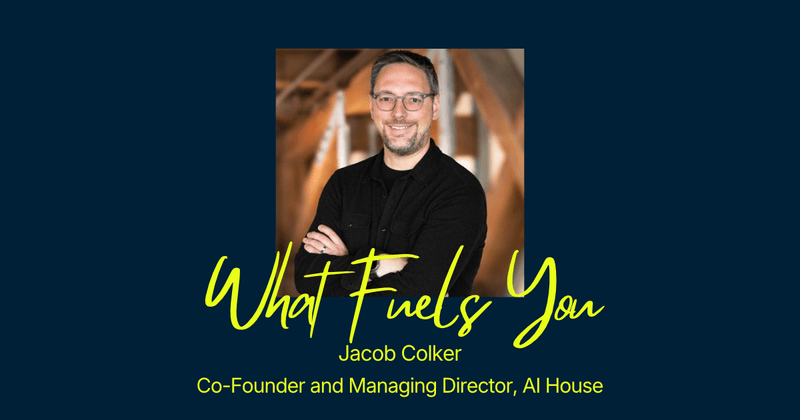
Jacob Colker, Co-Founder and Managing Director of AI House
Jacob Colker
Co-Founder and Managing Director, AI House
Jacob Colker is co-founder and managing director of AI House at Pier 70 in Seattle. Formerly the AI2 Incubator, it grew out of the commercialization arm he helped build inside the Allen Institute for AI (AI2) and rebranded as AI House in June 2026. He has personally raised or helped his teams raise more than $500 million in capital and helped create over $2 billion in startup valuation. Before AI2, he founded the crowdsourcing platform Sparked, helped lead a prop tech company through its acquisition by Buildium, led go-to-market at Lighter Capital, and taught in the University of Washington MBA program. He is an Echoing Green Fellow and a Rolex Awards for Enterprise Young Laureate, and studied media management at Columbia College Chicago before attending Johns Hopkins University.
The email went to a University of Washington professor, and its sender didn't know the Allen Institute for AI existed. He was hunting for bleeding edge research he could turn into products, and he was ready for his next swing. The professor was Oren Etzioni, who a few days earlier had been told by Paul Allen to go find someone to double down on the institute's commercialization arm. Allen and Etzioni gave the newcomer 3 months to prove himself. Ten years later, that effort is AI House, the former AI2 Incubator, which took its new name in June 2026 and is based at Pier 70 on Seattle's waterfront.
In this episode of What Fuels You, host Shauna Swerland sits down with Jacob Colker, co-founder and managing director of AI House, for a conversation that runs from Chicago blues clubs and campaign phone banks to Sparked, Buildium, Lighter Capital, and the incubator that produced Xnor.ai and Lexion. Colker explains why technical talent is becoming something you can rent for a few tokens, why AI House treats community as a core company building asset, and what founders are up against now that anyone can vibe code anything.
Running through all of it is the answer he gives to Shauna's final question: whether it's a photograph, a song, a drum line, or a company, he's drawn to finding ways to inspire people.
$500M+
Capital raised by Colker and his teams
$2B+
Startup valuation he helped create
$80M
Size of the incubator's third fund
600%
Jump in campaign voter contact rate
| Time | Topic |
|---|---|
| 00:00 | The Seattle way: Jacob Colker on ambition, humility, and Patagonia flannel |
| 01:00 | Rapid fire: Chicago blues, New Orleans, street photography, and staying up until 4:00am |
| 06:30 | A drummer at 12: growing up in Chicago and playing along to '90s rock radio |
| 10:15 | Why school fails so many kids: the case for AI-powered personalized education |
| 14:40 | A laptop at 10: hand-me-down computers, Columbia College Chicago, and Johns Hopkins |
| 19:15 | Campaign tech: bringing predictive dialing to Democratic Party phone banks |
| 22:10 | Sparked: building one of the first mobile crowdsourcing platforms after the 2007 iPhone launch |
| 26:20 | The wrong metrics: what a national NPR story did and didn't do for a startup |
| 28:45 | Buildium and Lighter Capital: learning what real exits look like, and which kind of venture he prefers |
| 35:20 | The cold email to Oren Etzioni: Paul Allen, AI2, and 3 months to prove himself |
| 39:40 | Early incubator companies: Xnor.ai, Lexion, and the team that built the AI2 incubator |
| 45:30 | Community as a company building asset: why AI House moved to Pier 70 |
| 52:00 | Betting on the Pacific Northwest: the $80 million fund, Seattle politics, and founders leaving |
| 58:10 | Founding in the vibe code era: domain expertise, go-to-market noise, and VC incentives |
| 60:40 | Silver medalist syndrome: Colker's 5-year vision for Seattle and what fuels him |
From Chicago Drum Kits to Campaign Phone Banks
Colker grew up in Chicago, a first-generation American and an only child. The drums came first. In 7th and 8th grade, a friend's older brother had a beaten-up drum set that Colker thought was the coolest thing he'd ever seen, and at 12 or 13 his parents let him buy his own and pound on it in the house. He spent hours in his bedroom playing along to the radio, mostly bands out of Chicago like the Smashing Pumpkins and Local H, then spent more than a decade of his teenage and college years in recording studios late at night and did sound for blues clubs in college. Drums are still what he reaches for first when he needs to decompress.
Computers came early too. His father had some of the first laptops and handed the old ones down, so Colker had his own machine at about 10 years old, when that was unheard of. "I don't think I would be in the career that I am today if my dad hadn't handed me down his old laptop," he says. He studied media management at Columbia College Chicago, where he first thought he'd go to film school and tell stories, and finished college quickly. Visits to the Johns Hopkins campus convinced him he wanted to study there next. He got in, then dropped out a year later to start his first company.
He's blunt about the school system that didn't fit him. He describes a cartoon of a professor telling a monkey, a fish, an elephant, and a giraffe that they'll be judged on their ability to climb a tree, and says he'd love to work someday on an AI product that brings hyper-personalization to education. "You can't jam 30 kids into a room simply because they're 8 years old or 10 years old and expect them to all perform well," he tells Shauna Swerland.
Before startups, there was politics. Colker traveled the US running political campaigns, and to him it was the same job as touring with a band.
"To me, politics was the same thing, except you traded in your black t-shirts and your tattoos for a suit. But it was still about trying to inspire people and make them feel something and compel them to have some kind of action."
Watching hundreds of volunteers dial numbers by hand, he went looking for a fix. Predictive dialing software, which dials 3 numbers at once and hot-transfers whoever picks up first, was common in sales but hadn't reached political campaigns. Colker brought it into the campaigns he ran. "Our voter contact rate went up like 600%," he says, and the approach spread across the Democratic Party from there. Even then, he wasn't writing the software. He has always partnered with strong technical people, and calls himself "the guy that did everything but the code," a role he says is as true today as it was 30 years ago.
What Sparked Taught Him About Chasing the Wrong Metrics
Sparked grew out of the same question: how do you organize large groups of people more efficiently? When the iPhone came out in 2007, Colker's team built one of the world's first crowdsourcing platforms, breaking work into chunks people could finish in 2, 3, or 4 minutes from their phones while waiting on a bus or standing in line at the bank. Before Google Translate, Ronald McDonald House could upload a 20-page document, volunteers who spoke Arabic would translate it one sentence at a time, and the system would reassemble the full translation. Cities used it to have residents photograph potholes and graffiti with a GPS marker attached.
The social impact work earned Colker an Echoing Green Fellowship and a Rolex Award. Then top San Francisco venture capitalists started calling him in Washington, DC, asking him to move west so they could write him a check. He moved, raised from what he calls some of the best VCs there, and pivoted Sparked toward brands, like a car company collecting feedback on new designs from its most passionate fans.
The lesson he draws is about metrics. When NPR wanted to do a national story on Sparked, the team spent 3 weeks preparing for the interview.
"In practice, that translated to just about 500 unique additional visitors to our website and basically $0 in extra incremental revenue."
"I was optimizing for the things that seem like they're important, but ultimately had zero impact on the business," he says. A great business, in his view, has product-market fit, a plan for growth, and a clear path to margin, and if it's deliberately skipping margin, that's for growth reasons. Those were things he didn't know at 22 without a business background, and his investors didn't fill the gap. He describes them as kind, thoughtful, and very hands-off, with board meetings every 6 to 8 weeks.
"It has always been about helping entrepreneurs not make a lot of the same mistakes that I did and to be a way better mentor to folks than I had."
A Cold Email to Oren Etzioni and 3 Months to Prove It
After moving to Seattle, Colker worked with close friends on a real estate prop tech company that Buildium, based in Boston, acquired. For a couple of years he flew to Boston one week a month, helped Buildium add tens of millions of dollars in revenue, and watched Buildium itself get acquired by a private equity fund at a significant markup. He calls it his education in "what real exits and real dollars look like," including how important lawyers are throughout.
When his earnout ended, a coffee with Chris DeVore and an ikigai exercise pointed him toward venture capital. DeVore laughed and told him, "Jacob, nobody's just going to give you money to invest." Colker credits Eric Benson at Voyager and BJ Lackland, then CEO of Lighter Capital, with giving him his first seat on the investor side. He led Lighter's go-to-market team for a year and a half and doubled revenue, but the work clarified what he didn't want: later-stage investing underwritten to churn rates and spreadsheets.
"It also helped me realize that I much prefer the early 2 years messy stage of getting a company off the ground."
While teaching in the UW MBA program, he emailed every professor in the Allen School asking for coffee, looking for bleeding edge technology to commercialize. He didn't know the Allen Institute for AI existed, and he says he didn't really know what AI was, even though his companies had used it under the names big data and machine learning. Oren Etzioni wrote back. Colker did his homework, walked in, and proposed turning many of the institute's technologies into startups instead of one. Etzioni started laughing: Paul Allen had told him days earlier to find someone to double down on commercialization. "Paul and Oren gave me an opportunity to prove myself. They gave me 3 months."
The thesis was impact through AI, which could mean a heavily cited paper, open source code with a lot of GitHub stars, or a product that raises capital and grows. Colker says Allen saw as early as 2014 that AI would have a massive impact, and that Etzioni was the first person to major in AI at Harvard. Nobody knew how to commercialize it yet, and one early assumption broke fast.
"One premise we had was that a bunch of the researchers would want to start companies, and it turns out researchers wanted to do research."
Xnor.ai, Lexion, and the people behind the incubator
The fix was bringing in external entrepreneurs who could handle the market side. Xnor.ai, one of the first true computer vision companies, was led by Ali Farhadi, who later became CEO of the research institute, with Mohammad Rastegari, Jon Gelsey, and Sophie Lebrecht, and was acquired by Apple. Lexion started when Gaurav Oberoi walked in as an external entrepreneur wanting to be close to a couple dozen AI PhDs. The incubator covered some living expenses with a stipend for roughly 8 entrepreneurs in residence, and Oberoi, Emad Elwany, and James Baird hit it off and built Lexion.
Colker is quick to say he's "one spoke in a wheel." He credits Vu Ha, the incubator's CTO and "the sage, wise voice of reason," and Bryan Hale, who helped raise 2 funds over 4 years before leaving to become a managing director at Anthos. He recruited Yifan Zhang, who had just sold her company Loftium to Flyhomes, after she spoke to one of his UW classes, and Sri Chandrasekar joined as a managing director in May from Point72 Ventures.
Why AI House Treats Community as a Core Company Building Asset
The incubator was born inside a research institute full of what Colker calls "the Michael Jordans of their respective field," including an AI2 colleague who solved a Rubik's Cube blindfolded in about 60 seconds at a talent show. After 10 years, though, he says 2 shifts forced the organization to adapt. The first is about what expertise is worth now.
"Look, technical talent is remarkable. It's also something that increasingly you can rent for a few tokens."
AI House still backs net new technologies that, in his words, no LLM is "just gonna start doing one day." The second shift came from inside the community. As founders worked through a highly ambiguous market, they started solving problems together, and the group knowledge proved more valuable than any book or paper.
"We started to see this incredible phenomenon where one team would like learn something on a Tuesday, and then that became all the other folks in our community's unfair advantage by Thursday."
That convinced him the future was community "not as like dinners that you sprinkle on something, but like community as a core company building asset," and it needed a physical home with an iconic event space. When Colker read that Washington State was selling 2 ferries at a relatively low price, he pictured coworking upstairs and events downstairs. He called Dru Agarwal, a friend of a friend whose company, Landmark Event Co., already ran a ferry as an event venue on Lake Union. Agarwal asked where they'd park it. Colker suggested mooring it next to Pier 70, which was sitting empty. Two weeks later Agarwal called back. He hadn't bought a ferry. "He goes, I bought Pier 70 instead."
Today the pier, more than 100,000 square feet on the waterfront, holds several businesses: Agarwal's event business, which hosts corporate events and the occasional wedding, a separately run coworking space where AI House companies can move downstairs after they raise capital, and AI House itself.
The June 2026 rebrand from AI2 Incubator to AI House put that thinking into the name. AI House is now organized around community, its incubator, which co-founds companies with entrepreneurs from the earliest stages, and capital from its fund, with community listed first.
Building a Startup When Anyone Can Vibe Code Anything
Asked what founders are struggling with right now, Colker starts with how cheap building has become.
"We now live in a world where it is remarkably easy to vibe code just about anything. And in that environment, knowing what to vibe code is more important than ever."
That makes domain expertise critical, and it makes go-to-market harder for everyone. The sheer volume of new products means customers are overwhelmed every week by people hitting them up, don't trust half of what shows up on their doorstep, and are asking whether they should vibe code what they need internally. Even AI House's founders, whom he calls "real deal entrepreneurs with technologies that are real deal technologies," have to break through that noise.
He also points to funding incentives. In the current hype cycle, he says, a lot of VCs and LPs are pouring money into things optimized for what's best for VCs and LPs, not customers, which leaves founders deciding whether to build a story for investors or a story for customers. He doesn't treat that as a reason to wait. Technology transitions are when the next chapter's iconic companies get built: "So this is the moment."
Silver Medalist Syndrome and the Seattle Way
The incubator's third fund is $80 million, and community is the first of the 3 pillars Colker says hold AI House up. He's relentless about the Pacific Northwest on social media and backs it with numbers: by his count there are 200,000 tech, science, space, health, and bio startup builders in the region and billions of dollars of good ideas. He points to what the region has already produced, from the cloud and online retail to home computing and airplanes, and argues innovation isn't a monopoly any one city holds.
"Starting a company is one of the hardest things that anybody can ever do."
His pitch to founders weighing Seattle is practical. The region is still a remarkably capital-efficient place to build, cheaper to operate and hire in than many alternatives, and more than 100 engineering outposts have set up here for the talent. World-class mountains and water are 30 to 45 minutes away. "We are number 2. And number 2 is pretty great because of all the unfair advantages that come with that," he says. Asked where Seattle will be in 5 years, he rejects the usual comparison to other cities, which he calls silver medalist syndrome, and describes something closer to home.
"The Seattle way is incredibly ambitious. It also has a good degree of humility, and I don't think we should move away from that. It doesn't change our ambition, but we can hold the door open for people and say thank you and acknowledge how hard things are sometimes and have that empathy."
His answer to the show's closing question ties the drummer, the street photographer, the campaign organizer, and the incubator builder together: "Whether I'm making a photograph or writing a song or playing drums live or building a company or creating community, I'm drawn to finding ways to inspire people."
5 Key Takeaways
📉
Press is not a growth metric
Three weeks of prep for a national NPR story brought Sparked about 500 extra website visitors and basically $0 in revenue, so judge every effort by its effect on product-market fit, growth, and margin.
🧪
Pair researchers with operators
AI2's incubator learned early that researchers wanted to do research, and companies like Xnor.ai and Lexion came from bringing in external entrepreneurs to work alongside the PhDs.
🤝
Treat community as infrastructure
At AI House, one team's Tuesday lesson becomes every other team's advantage by Thursday, which is why Colker invested in a physical space built for daily collisions instead of occasional dinners.
📣
Knowing what to build beats building fast
When anyone can vibe code anything, domain expertise and a credible go-to-market path separate real companies from the noise customers are already tuning out.
🏔️
Stop measuring Seattle against other cities
Colker calls the habit silver medalist syndrome and argues Seattle's capital efficiency, 100+ engineering outposts, and quality of life are advantages worth building on in their own right.
Jacob Colker AI House What Fuels You Shauna Swerland Fuel Talent Allen Institute for AI AI2 Incubator Pier 70 Seattle Startups Pacific Northwest Startup Incubator Venture Capital AI Commercialization Artificial Intelligence Startup Community Vibe Coding Go-to-Market Founder Advice Sparked Buildium Lighter Capital Oren Etzioni Johns Hopkins University Columbia College Chicago Managing Director
Frequently Asked Questions
Who is Jacob Colker?
Jacob Colker is co-founder and managing director of AI House at Pier 70 in Seattle, which grew out of the startup incubator he helped build inside the Allen Institute for AI starting 10 years ago. He has personally raised or helped his teams raise more than $500 million and helped create over $2 billion in startup valuation. He previously founded the crowdsourcing platform Sparked, worked with Buildium after it acquired his team's prop tech company, and led go-to-market at Lighter Capital.
What is AI House in Seattle?
AI House is a Seattle startup hub and incubator at Pier 70 focused on turning cutting-edge AI research into real-world companies, with a specialty in the 0-to-1 phase. It began as the commercialization arm of the Allen Institute for AI, which Paul Allen and Oren Etzioni asked Jacob Colker to build, and operated as the AI2 Incubator until it rebranded as AI House in June 2026. It is organized around community, incubation, and capital. The incubator has raised an $80 million third fund, and its early companies include Xnor.ai, which Apple acquired, and Lexion.
How did AI House end up at Pier 70?
Jacob Colker wanted a space built around community and an iconic event venue, and he considered buying one of 2 ferries Washington State was selling and mooring it next to the empty Pier 70. He brought the idea to Dru Agarwal of Landmark Event Co., who called back 2 weeks later and said he'd bought Pier 70 instead. AI House now rents space at the pier alongside an event business and a coworking space where its companies can move after they raise capital.
What did Jacob Colker say about vibe coding and startups?
Colker said it is now remarkably easy to vibe code just about anything, so "knowing what to vibe code is more important than ever." He named domain expertise and go-to-market as founders' biggest challenges, because customers are overwhelmed by new products and are weighing whether to vibe code tools internally. He also said technical talent is increasingly something "you can rent for a few tokens."
Why does Jacob Colker think Seattle is a good place to start a company?
Colker said Seattle is still a remarkably capital-efficient place to build a company, significantly cheaper to operate and hire in than many other places, with a talent pool that has drawn more than 100 engineering outposts. He counts 200,000 tech, science, space, health, and bio startup builders in the Pacific Northwest. He rejects comparing Seattle to other cities, which he calls silver medalist syndrome, and argues for "the Seattle way," which he describes as ambitious with a good degree of humility.
Jacob Colker, Co-Founder and Managing Director of AI House
Jacob Colker
Co-Founder and Managing Director, AI House
Jacob Colker is co-founder and managing director of AI House at Pier 70 in Seattle. Formerly the AI2 Incubator, it grew out of the commercialization arm he helped build inside the Allen Institute for AI (AI2) and rebranded as AI House in June 2026. He has personally raised or helped his teams raise more than $500 million in capital and helped create over $2 billion in startup valuation. Before AI2, he founded the crowdsourcing platform Sparked, helped lead a prop tech company through its acquisition by Buildium, led go-to-market at Lighter Capital, and taught in the University of Washington MBA program. He is an Echoing Green Fellow and a Rolex Awards for Enterprise Young Laureate, and studied media management at Columbia College Chicago before attending Johns Hopkins University.
The email went to a University of Washington professor, and its sender didn't know the Allen Institute for AI existed. He was hunting for bleeding edge research he could turn into products, and he was ready for his next swing. The professor was Oren Etzioni, who a few days earlier had been told by Paul Allen to go find someone to double down on the institute's commercialization arm. Allen and Etzioni gave the newcomer 3 months to prove himself. Ten years later, that effort is AI House, the former AI2 Incubator, which took its new name in June 2026 and is based at Pier 70 on Seattle's waterfront.
In this episode of What Fuels You, host Shauna Swerland sits down with Jacob Colker, co-founder and managing director of AI House, for a conversation that runs from Chicago blues clubs and campaign phone banks to Sparked, Buildium, Lighter Capital, and the incubator that produced Xnor.ai and Lexion. Colker explains why technical talent is becoming something you can rent for a few tokens, why AI House treats community as a core company building asset, and what founders are up against now that anyone can vibe code anything.
Running through all of it is the answer he gives to Shauna's final question: whether it's a photograph, a song, a drum line, or a company, he's drawn to finding ways to inspire people.
$500M+
Capital raised by Colker and his teams
$2B+
Startup valuation he helped create
$80M
Size of the incubator's third fund
600%
Jump in campaign voter contact rate
| Time | Topic |
|---|---|
| 00:00 | The Seattle way: Jacob Colker on ambition, humility, and Patagonia flannel |
| 01:00 | Rapid fire: Chicago blues, New Orleans, street photography, and staying up until 4:00am |
| 06:30 | A drummer at 12: growing up in Chicago and playing along to '90s rock radio |
| 10:15 | Why school fails so many kids: the case for AI-powered personalized education |
| 14:40 | A laptop at 10: hand-me-down computers, Columbia College Chicago, and Johns Hopkins |
| 19:15 | Campaign tech: bringing predictive dialing to Democratic Party phone banks |
| 22:10 | Sparked: building one of the first mobile crowdsourcing platforms after the 2007 iPhone launch |
| 26:20 | The wrong metrics: what a national NPR story did and didn't do for a startup |
| 28:45 | Buildium and Lighter Capital: learning what real exits look like, and which kind of venture he prefers |
| 35:20 | The cold email to Oren Etzioni: Paul Allen, AI2, and 3 months to prove himself |
| 39:40 | Early incubator companies: Xnor.ai, Lexion, and the team that built the AI2 incubator |
| 45:30 | Community as a company building asset: why AI House moved to Pier 70 |
| 52:00 | Betting on the Pacific Northwest: the $80 million fund, Seattle politics, and founders leaving |
| 58:10 | Founding in the vibe code era: domain expertise, go-to-market noise, and VC incentives |
| 60:40 | Silver medalist syndrome: Colker's 5-year vision for Seattle and what fuels him |
From Chicago Drum Kits to Campaign Phone Banks
Colker grew up in Chicago, a first-generation American and an only child. The drums came first. In 7th and 8th grade, a friend's older brother had a beaten-up drum set that Colker thought was the coolest thing he'd ever seen, and at 12 or 13 his parents let him buy his own and pound on it in the house. He spent hours in his bedroom playing along to the radio, mostly bands out of Chicago like the Smashing Pumpkins and Local H, then spent more than a decade of his teenage and college years in recording studios late at night and did sound for blues clubs in college. Drums are still what he reaches for first when he needs to decompress.
Computers came early too. His father had some of the first laptops and handed the old ones down, so Colker had his own machine at about 10 years old, when that was unheard of. "I don't think I would be in the career that I am today if my dad hadn't handed me down his old laptop," he says. He studied media management at Columbia College Chicago, where he first thought he'd go to film school and tell stories, and finished college quickly. Visits to the Johns Hopkins campus convinced him he wanted to study there next. He got in, then dropped out a year later to start his first company.
He's blunt about the school system that didn't fit him. He describes a cartoon of a professor telling a monkey, a fish, an elephant, and a giraffe that they'll be judged on their ability to climb a tree, and says he'd love to work someday on an AI product that brings hyper-personalization to education. "You can't jam 30 kids into a room simply because they're 8 years old or 10 years old and expect them to all perform well," he tells Shauna Swerland.
Before startups, there was politics. Colker traveled the US running political campaigns, and to him it was the same job as touring with a band.
"To me, politics was the same thing, except you traded in your black t-shirts and your tattoos for a suit. But it was still about trying to inspire people and make them feel something and compel them to have some kind of action."
Watching hundreds of volunteers dial numbers by hand, he went looking for a fix. Predictive dialing software, which dials 3 numbers at once and hot-transfers whoever picks up first, was common in sales but hadn't reached political campaigns. Colker brought it into the campaigns he ran. "Our voter contact rate went up like 600%," he says, and the approach spread across the Democratic Party from there. Even then, he wasn't writing the software. He has always partnered with strong technical people, and calls himself "the guy that did everything but the code," a role he says is as true today as it was 30 years ago.
What Sparked Taught Him About Chasing the Wrong Metrics
Sparked grew out of the same question: how do you organize large groups of people more efficiently? When the iPhone came out in 2007, Colker's team built one of the world's first crowdsourcing platforms, breaking work into chunks people could finish in 2, 3, or 4 minutes from their phones while waiting on a bus or standing in line at the bank. Before Google Translate, Ronald McDonald House could upload a 20-page document, volunteers who spoke Arabic would translate it one sentence at a time, and the system would reassemble the full translation. Cities used it to have residents photograph potholes and graffiti with a GPS marker attached.
The social impact work earned Colker an Echoing Green Fellowship and a Rolex Award. Then top San Francisco venture capitalists started calling him in Washington, DC, asking him to move west so they could write him a check. He moved, raised from what he calls some of the best VCs there, and pivoted Sparked toward brands, like a car company collecting feedback on new designs from its most passionate fans.
The lesson he draws is about metrics. When NPR wanted to do a national story on Sparked, the team spent 3 weeks preparing for the interview.
"In practice, that translated to just about 500 unique additional visitors to our website and basically $0 in extra incremental revenue."
"I was optimizing for the things that seem like they're important, but ultimately had zero impact on the business," he says. A great business, in his view, has product-market fit, a plan for growth, and a clear path to margin, and if it's deliberately skipping margin, that's for growth reasons. Those were things he didn't know at 22 without a business background, and his investors didn't fill the gap. He describes them as kind, thoughtful, and very hands-off, with board meetings every 6 to 8 weeks.
"It has always been about helping entrepreneurs not make a lot of the same mistakes that I did and to be a way better mentor to folks than I had."
A Cold Email to Oren Etzioni and 3 Months to Prove It
After moving to Seattle, Colker worked with close friends on a real estate prop tech company that Buildium, based in Boston, acquired. For a couple of years he flew to Boston one week a month, helped Buildium add tens of millions of dollars in revenue, and watched Buildium itself get acquired by a private equity fund at a significant markup. He calls it his education in "what real exits and real dollars look like," including how important lawyers are throughout.
When his earnout ended, a coffee with Chris DeVore and an ikigai exercise pointed him toward venture capital. DeVore laughed and told him, "Jacob, nobody's just going to give you money to invest." Colker credits Eric Benson at Voyager and BJ Lackland, then CEO of Lighter Capital, with giving him his first seat on the investor side. He led Lighter's go-to-market team for a year and a half and doubled revenue, but the work clarified what he didn't want: later-stage investing underwritten to churn rates and spreadsheets.
"It also helped me realize that I much prefer the early 2 years messy stage of getting a company off the ground."
While teaching in the UW MBA program, he emailed every professor in the Allen School asking for coffee, looking for bleeding edge technology to commercialize. He didn't know the Allen Institute for AI existed, and he says he didn't really know what AI was, even though his companies had used it under the names big data and machine learning. Oren Etzioni wrote back. Colker did his homework, walked in, and proposed turning many of the institute's technologies into startups instead of one. Etzioni started laughing: Paul Allen had told him days earlier to find someone to double down on commercialization. "Paul and Oren gave me an opportunity to prove myself. They gave me 3 months."
The thesis was impact through AI, which could mean a heavily cited paper, open source code with a lot of GitHub stars, or a product that raises capital and grows. Colker says Allen saw as early as 2014 that AI would have a massive impact, and that Etzioni was the first person to major in AI at Harvard. Nobody knew how to commercialize it yet, and one early assumption broke fast.
"One premise we had was that a bunch of the researchers would want to start companies, and it turns out researchers wanted to do research."
Xnor.ai, Lexion, and the people behind the incubator
The fix was bringing in external entrepreneurs who could handle the market side. Xnor.ai, one of the first true computer vision companies, was led by Ali Farhadi, who later became CEO of the research institute, with Mohammad Rastegari, Jon Gelsey, and Sophie Lebrecht, and was acquired by Apple. Lexion started when Gaurav Oberoi walked in as an external entrepreneur wanting to be close to a couple dozen AI PhDs. The incubator covered some living expenses with a stipend for roughly 8 entrepreneurs in residence, and Oberoi, Emad Elwany, and James Baird hit it off and built Lexion.
Colker is quick to say he's "one spoke in a wheel." He credits Vu Ha, the incubator's CTO and "the sage, wise voice of reason," and Bryan Hale, who helped raise 2 funds over 4 years before leaving to become a managing director at Anthos. He recruited Yifan Zhang, who had just sold her company Loftium to Flyhomes, after she spoke to one of his UW classes, and Sri Chandrasekar joined as a managing director in May from Point72 Ventures.
Why AI House Treats Community as a Core Company Building Asset
The incubator was born inside a research institute full of what Colker calls "the Michael Jordans of their respective field," including an AI2 colleague who solved a Rubik's Cube blindfolded in about 60 seconds at a talent show. After 10 years, though, he says 2 shifts forced the organization to adapt. The first is about what expertise is worth now.
"Look, technical talent is remarkable. It's also something that increasingly you can rent for a few tokens."
AI House still backs net new technologies that, in his words, no LLM is "just gonna start doing one day." The second shift came from inside the community. As founders worked through a highly ambiguous market, they started solving problems together, and the group knowledge proved more valuable than any book or paper.
"We started to see this incredible phenomenon where one team would like learn something on a Tuesday, and then that became all the other folks in our community's unfair advantage by Thursday."
That convinced him the future was community "not as like dinners that you sprinkle on something, but like community as a core company building asset," and it needed a physical home with an iconic event space. When Colker read that Washington State was selling 2 ferries at a relatively low price, he pictured coworking upstairs and events downstairs. He called Dru Agarwal, a friend of a friend whose company, Landmark Event Co., already ran a ferry as an event venue on Lake Union. Agarwal asked where they'd park it. Colker suggested mooring it next to Pier 70, which was sitting empty. Two weeks later Agarwal called back. He hadn't bought a ferry. "He goes, I bought Pier 70 instead."
Today the pier, more than 100,000 square feet on the waterfront, holds several businesses: Agarwal's event business, which hosts corporate events and the occasional wedding, a separately run coworking space where AI House companies can move downstairs after they raise capital, and AI House itself.
The June 2026 rebrand from AI2 Incubator to AI House put that thinking into the name. AI House is now organized around community, its incubator, which co-founds companies with entrepreneurs from the earliest stages, and capital from its fund, with community listed first.
Building a Startup When Anyone Can Vibe Code Anything
Asked what founders are struggling with right now, Colker starts with how cheap building has become.
"We now live in a world where it is remarkably easy to vibe code just about anything. And in that environment, knowing what to vibe code is more important than ever."
That makes domain expertise critical, and it makes go-to-market harder for everyone. The sheer volume of new products means customers are overwhelmed every week by people hitting them up, don't trust half of what shows up on their doorstep, and are asking whether they should vibe code what they need internally. Even AI House's founders, whom he calls "real deal entrepreneurs with technologies that are real deal technologies," have to break through that noise.
He also points to funding incentives. In the current hype cycle, he says, a lot of VCs and LPs are pouring money into things optimized for what's best for VCs and LPs, not customers, which leaves founders deciding whether to build a story for investors or a story for customers. He doesn't treat that as a reason to wait. Technology transitions are when the next chapter's iconic companies get built: "So this is the moment."
Silver Medalist Syndrome and the Seattle Way
The incubator's third fund is $80 million, and community is the first of the 3 pillars Colker says hold AI House up. He's relentless about the Pacific Northwest on social media and backs it with numbers: by his count there are 200,000 tech, science, space, health, and bio startup builders in the region and billions of dollars of good ideas. He points to what the region has already produced, from the cloud and online retail to home computing and airplanes, and argues innovation isn't a monopoly any one city holds.
"Starting a company is one of the hardest things that anybody can ever do."
His pitch to founders weighing Seattle is practical. The region is still a remarkably capital-efficient place to build, cheaper to operate and hire in than many alternatives, and more than 100 engineering outposts have set up here for the talent. World-class mountains and water are 30 to 45 minutes away. "We are number 2. And number 2 is pretty great because of all the unfair advantages that come with that," he says. Asked where Seattle will be in 5 years, he rejects the usual comparison to other cities, which he calls silver medalist syndrome, and describes something closer to home.
"The Seattle way is incredibly ambitious. It also has a good degree of humility, and I don't think we should move away from that. It doesn't change our ambition, but we can hold the door open for people and say thank you and acknowledge how hard things are sometimes and have that empathy."
His answer to the show's closing question ties the drummer, the street photographer, the campaign organizer, and the incubator builder together: "Whether I'm making a photograph or writing a song or playing drums live or building a company or creating community, I'm drawn to finding ways to inspire people."
5 Key Takeaways
📉
Press is not a growth metric
Three weeks of prep for a national NPR story brought Sparked about 500 extra website visitors and basically $0 in revenue, so judge every effort by its effect on product-market fit, growth, and margin.
🧪
Pair researchers with operators
AI2's incubator learned early that researchers wanted to do research, and companies like Xnor.ai and Lexion came from bringing in external entrepreneurs to work alongside the PhDs.
🤝
Treat community as infrastructure
At AI House, one team's Tuesday lesson becomes every other team's advantage by Thursday, which is why Colker invested in a physical space built for daily collisions instead of occasional dinners.
📣
Knowing what to build beats building fast
When anyone can vibe code anything, domain expertise and a credible go-to-market path separate real companies from the noise customers are already tuning out.
🏔️
Stop measuring Seattle against other cities
Colker calls the habit silver medalist syndrome and argues Seattle's capital efficiency, 100+ engineering outposts, and quality of life are advantages worth building on in their own right.
Jacob Colker AI House What Fuels You Shauna Swerland Fuel Talent Allen Institute for AI AI2 Incubator Pier 70 Seattle Startups Pacific Northwest Startup Incubator Venture Capital AI Commercialization Artificial Intelligence Startup Community Vibe Coding Go-to-Market Founder Advice Sparked Buildium Lighter Capital Oren Etzioni Johns Hopkins University Columbia College Chicago Managing Director
Frequently Asked Questions
Who is Jacob Colker?
Jacob Colker is co-founder and managing director of AI House at Pier 70 in Seattle, which grew out of the startup incubator he helped build inside the Allen Institute for AI starting 10 years ago. He has personally raised or helped his teams raise more than $500 million and helped create over $2 billion in startup valuation. He previously founded the crowdsourcing platform Sparked, worked with Buildium after it acquired his team's prop tech company, and led go-to-market at Lighter Capital.
What is AI House in Seattle?
AI House is a Seattle startup hub and incubator at Pier 70 focused on turning cutting-edge AI research into real-world companies, with a specialty in the 0-to-1 phase. It began as the commercialization arm of the Allen Institute for AI, which Paul Allen and Oren Etzioni asked Jacob Colker to build, and operated as the AI2 Incubator until it rebranded as AI House in June 2026. It is organized around community, incubation, and capital. The incubator has raised an $80 million third fund, and its early companies include Xnor.ai, which Apple acquired, and Lexion.
How did AI House end up at Pier 70?
Jacob Colker wanted a space built around community and an iconic event venue, and he considered buying one of 2 ferries Washington State was selling and mooring it next to the empty Pier 70. He brought the idea to Dru Agarwal of Landmark Event Co., who called back 2 weeks later and said he'd bought Pier 70 instead. AI House now rents space at the pier alongside an event business and a coworking space where its companies can move after they raise capital.
What did Jacob Colker say about vibe coding and startups?
Colker said it is now remarkably easy to vibe code just about anything, so "knowing what to vibe code is more important than ever." He named domain expertise and go-to-market as founders' biggest challenges, because customers are overwhelmed by new products and are weighing whether to vibe code tools internally. He also said technical talent is increasingly something "you can rent for a few tokens."
Why does Jacob Colker think Seattle is a good place to start a company?
Colker said Seattle is still a remarkably capital-efficient place to build a company, significantly cheaper to operate and hire in than many other places, with a talent pool that has drawn more than 100 engineering outposts. He counts 200,000 tech, science, space, health, and bio startup builders in the Pacific Northwest. He rejects comparing Seattle to other cities, which he calls silver medalist syndrome, and argues for "the Seattle way," which he describes as ambitious with a good degree of humility.