

"If You Want to Be Interesting, You Have to Be Interested" -- Doug Glant, Chairman and Owner of Pacific Iron and Metal
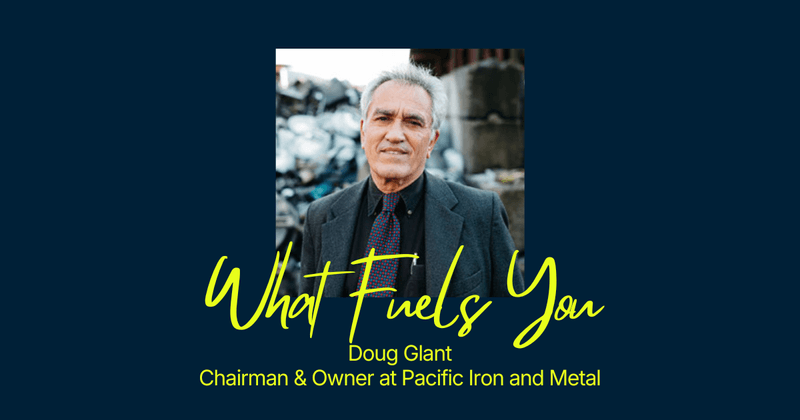
Chairman and Owner of Pacific Iron and Metal
He turned down the U.S. ambassadorship to Argentina, a top-three post at the CIA, and a seat at UW Law School. For 18 years he ran covert intelligence operations in Vietnam, China, and the Middle East while telling his family he was in Asia buying scrap metal. He gave the team speech the night before the Washington Huskies won the 1991 national championship, coached six Seattle city-championship youth football teams, and recently walked a Nigerian bride down the aisle because he had been like a second father to her since her playing days at UW. Doug Glant has lived, by any measure, more than one lifetime.
In this episode of What Fuels You, host Shauna Swerland sits down with Doug Glant, Chairman and Owner of Pacific Iron and Metal, a Seattle scrap-metal and precious-metals company his grandfather founded in 1917 and now in its fourth generation of family ownership. The conversation covers photographic memory, the ethics of family business succession, what a Mossad deputy director taught him about secrets, the sliding-door moments he still thinks about, and why, at 83, he believes the most underutilized asset in any organization is an experienced elder who is not running it.
📋 Episode Chapters
| 00:00 | Opening: photographic memory, recalling Passover 1948 and walking to John Muir Elementary in 1951 |
| 02:15 | Rapid fire: most inspiring teachers, Robert Spock at Lakeside and Wallace Stegner at Stanford |
| 06:30 | Growing up Jewish in Seattle's Mount Baker District in the 1940s and 1950s: gratitude, ambition, and reading at age 3 |
| 12:00 | Photographic memory: first memories at age 2, VE Day 1945, and a German gardener his Jewish grandparents refused to fire |
| 18:30 | Choosing Stanford over Harvard and Yale, paying his own tuition by bussing tables and winning at Tahoe, and getting expelled for punching a cop |
| 23:45 | Taking over Pacific Iron and Metal at 23: grandfather's call, the sliding-door moments he turned down, including ambassador to Argentina and number 3 at the CIA |
| 29:00 | 18 years as a DIA and CIA intelligence officer: Vietnam in 1969, China in 1976, the Mossad's David Kimke and the rule about secrets |
| 34:15 | Family business succession: why he told his son Ryan not to join, why his advisory board told him he was wrong, and how to hand over the keys |
| 38:30 | The state of the scrap metal industry in Western Washington, gold at an all-time high, and what it signals about the U.S. dollar |
| 41:00 | Scouting for the Huskies: recruiting Warren Moon's era, giving the Churchill speech the night before the 1991 national championship |
| 44:30 | Mentoring Black youth in the Central District and Rainier Valley starting in 1965: six city championships and giving away a bride in Phoenix in 2026 |
| 47:00 | Advice for young people: be ethical, find things you love that cost nothing, and why "if you want to be interesting you have to be interested" |
| 48:45 | What fuels Doug Glant: interesting people, contentment over happiness, and still being able to read, think, teach, and engage at 83 |
A Life Built on Curiosity: Seattle, Lakeside, and the Making of a Renaissance Man
Doug Glant was born in 1942 and grew up in Seattle's Mount Baker neighborhood at a time when, as he puts it, "you could ride your bike to the movies on Saturday with your buddies" and there was no television in the house until he was 10. He started reading at age 3 using the Sunday comic strips and a KVI radio show called Putt the Comic Weekly Man. By 8th grade, an English literature teacher at Lakeside School named Robert Spock had given him a "lifelong love of great books." At Stanford, a creative writing course taught by the celebrated novelist Wallace Stegner deepened that foundation further. These early influences are not incidental. They explain almost everything that followed: the intelligence work, the history lecturing, the blog writing, the five or six books on his nightstand right now.
What set Doug apart even within his own family was a curiosity that had no obvious origin. He listened to the 1948 presidential election returns, the night Harry Truman upset Tom Dewey, alone in his bedroom at the age of 6 because nobody else in the house cared. He recalls it in precise detail because he has a photographic memory, which he assumed was universal until classmates at Lakeside started asking how he got such good grades without studying. The memory, he says, is a two-way tool: he uses it to recall history, but he also uses it therapeutically, deliberately summoning happy scenes from 1948 and 1951 when he is in a low mood.
"At this age, to have a photographic memory that still works. I love it because when I'm in a low mood, sometimes I'll have myself remember happy things that happened in 1948. Passover dinner at my grandparents'. Walking to John Muir Elementary with my friends in 1951. I'm smiling now because I'm thinking about it."
-- Doug Glant
His first confirmed memory is his second birthday, November 8th, 1944, when he was allowed out of a sick room to greet a few friends before being sent back. There were twin Raggedy Ann cakes, pink and blue. The next confirmed memory is VE Day, May 8th, 1945, when his Jewish grandparents sent the small boy outside to hug their German gardener, a man others in the neighborhood had fired for having an accent. The gardener picked him up and wept. It is the kind of detail that tells you something specific about the values Doug Glant absorbed before he ever started school.
Stanford, a Police Car, and a Grandfather's Phone Call
Doug got into Harvard, Yale, and Stanford. He chose Stanford because it was closer, because he was only 17 and had never been on an airplane, and because he had wealthy great-aunts in San Francisco he could visit for a decent meal. He paid his own tuition by bussing tables at a rival fraternity house, working every summer and Christmas break in the family scrapyard, and one year winning enough at a Tahoe card table on the drive down to cover a semester's fees. His grandmother covered the gas. That was the full extent of parental support.
His time at Stanford was interrupted when he hit a police car in the middle of the night, then punched the officer who arrested him. He explains the context without using it as an excuse: that morning he had learned by telephone that his father had undergone emergency cancer surgery the night before, and no one had told him. He was sent home, enrolled at the University of Washington for a year, changed his major from Political Science to History, and returned to Stanford to finish his degree. The year at the UW would later prove useful in ways nobody expected.
In 1965, with a Stanford history degree and plans to move to Maui, buy real estate, and teach high school history, he got a phone call from his grandfather. The oldest grandchild was needed. His father could not run Pacific Iron and Metal. The grandfather was too old. Doug came back to Seattle and took over the company at 23.
"I didn't want that. I went to Maui in 1965 after being turned down for the Marine Corps because I was 4F. I realized I wanted to go to real estate in Maui and become very wealthy and also teach high school or college history."
-- Doug Glant
He is candid that this decision, made at 23 under family pressure, foreclosed a string of paths he still thinks about. He was accepted to UW Law School at 31 and did not go. He turned down the U.S. ambassadorship to Costa Rica, then to Argentina (where his first wife was born and where her grandfather had been vice president). He was offered a senior post at the CIA. He said no to all of it. His current wife, Kristen, has told him directly: do not blame your parents for forcing you into the business. You made that decision. He agrees. He also says he is happy with his life, and that the trade was real.
18 Years in the Shadows: DIA, CIA, Vietnam, and What a Mossad Deputy Director Told Him
Roughly three years after he took over Pacific Iron and Metal, Doug received a call from an office connected to Senator Henry "Scoop" Jackson asking whether he was still willing to go to Vietnam. Not in the Marine Corps, which had rejected him for a physical disqualification, but for the Defense Intelligence Agency. He agreed, on the condition that he could keep it secret from his father. The cover story was simple: he was traveling to Asia to buy and sell metal, and he could not be reached by phone for a week or two. He notes, without irony, that this story would be impossible to sustain today.
In February of 1969, one year after the Tet Offensive, he went to Saigon. Over the next 18 years he also worked operations in China in 1976, while Mao Zedong was still alive, and throughout the Middle East. He ended his intelligence work in 1987 when, with his father dying and a divorce underway, the agency asked him to go to Afghanistan to assess whether the mujahideen were keeping the U.S. Stinger missiles they had been given. He said no. That refusal cost him his eyes-only clearance and effectively closed the chapter.
During those years he worked alongside some extraordinary people, including David Kimke, a former undercover operative who later became deputy director of Mossad. Kimke offered him a rule he still uses in business and in life.
"He said, if more than one person knows something, it's not a secret. And I said, no, you mean more than two people? He said, no, more than one. I said, you're saying that there are no secrets? He said, that's what I'm telling you. Assume that nothing is secret when you go about your business."
-- Doug Glant
He kept his own secret for 18 years. Only one person was ever told: his co-coach Jimmy Greenfield, whom he took out to Spuds Fish and Chips in West Seattle and warned, over a view of the water, that he might not be coming back from his next "metal-buying" trip to Vietnam. Greenfield died of a heart attack a year later, at 44, in Doug's parents' bedroom, on the first night after Doug sold the family home.
108 Years of Family Business: The Rules, the Regrets, and the Handoff to Ryan
Pacific Iron and Metal was founded in 1917 by Doug's grandfather Jules Glant in what is now Seattle's SODO neighborhood, not far from where the company's current facility has stood since 1932. The business started as a heavy industrial scrap operation serving the manufacturing economy of western Washington. Over the decades, Doug shifted its center of gravity toward non-ferrous metals and, increasingly, precious metals. Today the customers are jewelers, dentists, industrial accounts, and government and military buyers. Gold, at the time of this recording, is at an all-time high, and Doug's view is direct: elevated gold prices signal a lack of confidence in the U.S. dollar and the global economy. His advice to anyone sitting on gold is equally direct. Sit on it. It will reach $5,000 an ounce or more.
When Doug taught family business at the UW and CLU business schools, he opened with a rule: "The first do is don't." He cites Hamlet and King Lear as case studies. If a family still insists on going in, he points to the Nordstroms, the Pigotts at PACCAR, and the Rosens at Alaska Copper as models. The nonnegotiable principles, in his telling: run it like a business, do not promote family members past their competence, and when it is time to step down, step down completely.
"When my son Ryan was about to take over the company, running the company 10 years ago, I stepped completely away from him other than give him, if he came to me for advice, fine. But I left him alone to run the company to this day."
-- Doug Glant
The transition itself had a complicated start. Ryan was a rising junior partner at the law firm Perkins Coie, doing M&A work, and Doug told him not to come into the family business. His own advisory board, including Doug Rosen, Lisa Kiddlesby, and Chuck Barber, pushed back hard. They told him he was 68 years old and was turning away a bright young man who wanted in. He relented. The succession was managed with help from a Chinese non-family CFO who had been at the company for 25 years and served as the professional bridge between generations. Doug calls bringing Ryan in one of the things he is most grateful for.
The Huskies, the Central District, and What It Means to Actually Show Up
Doug Glant's relationship with the University of Washington football program began in 1947, when he was the mascot at a road game in Minneapolis, and has never really ended. His first remembered game was in 1950, when he watched Hugh McElhenny play. As a Stanford freshman, he tipped off his father, who played poker with head coach Jim Owens, about an unrecruited prospect at Sequoia High School in Menlo Park named Mike Otis. Owens signed the kid. Otis played in the Rose Bowl. That was how a 17-year-old became a Husky scout.
When Don James arrived in 1975, Doug and his father hosted the welcoming party, with Trader Vic's catering and a guest list that included elder Nordstroms and Sam Spencers. From 1977 onward, starting with Warren Moon's senior year, he was on the sidelines with a camera. The night before the 1991 Rose Bowl, in which Washington played Michigan for the national championship, he stood up in front of the team and quoted Winston Churchill: "Never, never, never, never quit." That phrase ran on the pads the players wore the next day when they won.
His work with youth in Seattle's Central District and Rainier Valley began the same year he took over Pacific Iron and Metal. Jimmy Greenfield, then 10 to 12 years older than Doug, called and asked if he knew football and wanted to co-coach in Rainier Valley. He did. That was 1965. Over the following decades he coached mostly Black kids in a city crackling with the tensions of the civil rights movement, served as a community liaison between the FBI, the Seattle Police, and the Black Panthers, and hosted players in his home at a time when, as his former players still tell him, he was the first white person who had ever done that. The teams won six city championships. Last Thursday, he was in Phoenix for the wedding of Chantelle Osahor, the center on the Huskies' Final Four women's basketball team, where the bride's father asked Doug to join him in giving her away.
"It changed my life because as the kids tell me, Doug, you were the first white person that ever had us into their homes. You have to understand, this is the 1960s. Martin Luther King's assassination, Malcolm X, Jack Kennedy. But it was a tumultuous time."
-- Doug Glant
Shauna Swerland draws a distinction in the episode that is worth sitting with. There is a version of community involvement that involves rubber-chicken dinners and a check. Doug's version involves six decades of showing up in person, knowing names, coaching practices, and attending funerals. The morning after this episode was recorded, he was delivering a eulogy for one of his best players, Teddy Jackson, whose brother Ricky had played in the Orange Bowl.
What Doug Glant Would Tell Anyone Starting Out, and What He Wishes Someone Had Told Him
Doug's advice for young people does not come from a stage or a keynote. It comes from a man who has done the math on his own life and knows what the opportunity costs were. He wanted to teach history. He ended up running a scrapyard. He does not frame it as a tragedy, but he does not pretend the regret is not real either. His advice is earned.
The throughline is ethics. If the people above you are not ethical, get out as fast as you can. "When you lie down with dogs, you get fleas." Find work you love, because if you do something you do not love you will be miserable, and misery is not a wealth strategy. Find pleasures that do not cost money, because you cannot know whether the money is coming, and the pleasures should not be contingent on it: hiking, music, books, fishing, canasta with your grandmother. Keep your curiosity alive. Ask people what they are reading. Look at their bookshelves when you walk into their homes. And understand the connection between interesting and interested.
"If a person wants to be interesting they have to be interested."
-- Doug Glant
His definition of success at 83 centers on his four sons, all of whom he describes as good human beings. Two of the older ones are married to women he considers wonderful. He wishes he had been slightly more focused on accumulating money, specifically so he could now endow a history chair at the University of Washington or fund cancer research, because cancer has taken more of his family than heart disease. He is direct about the fact that the philanthropic ambition currently exceeds the resources available for it. But he is also clear that he is contented, which he distinguishes carefully from happy. Happy is what you feel when the Huskies win. Contented is more lasting. And contented, with the family and the reading and the hiking and the music, is what he has.
5 Key Takeaways
Chairman and Owner of Pacific Iron and Metal
He turned down the U.S. ambassadorship to Argentina, a top-three post at the CIA, and a seat at UW Law School. For 18 years he ran covert intelligence operations in Vietnam, China, and the Middle East while telling his family he was in Asia buying scrap metal. He gave the team speech the night before the Washington Huskies won the 1991 national championship, coached six Seattle city-championship youth football teams, and recently walked a Nigerian bride down the aisle because he had been like a second father to her since her playing days at UW. Doug Glant has lived, by any measure, more than one lifetime.
In this episode of What Fuels You, host Shauna Swerland sits down with Doug Glant, Chairman and Owner of Pacific Iron and Metal, a Seattle scrap-metal and precious-metals company his grandfather founded in 1917 and now in its fourth generation of family ownership. The conversation covers photographic memory, the ethics of family business succession, what a Mossad deputy director taught him about secrets, the sliding-door moments he still thinks about, and why, at 83, he believes the most underutilized asset in any organization is an experienced elder who is not running it.
📋 Episode Chapters
| 00:00 | Opening: photographic memory, recalling Passover 1948 and walking to John Muir Elementary in 1951 |
| 02:15 | Rapid fire: most inspiring teachers, Robert Spock at Lakeside and Wallace Stegner at Stanford |
| 06:30 | Growing up Jewish in Seattle's Mount Baker District in the 1940s and 1950s: gratitude, ambition, and reading at age 3 |
| 12:00 | Photographic memory: first memories at age 2, VE Day 1945, and a German gardener his Jewish grandparents refused to fire |
| 18:30 | Choosing Stanford over Harvard and Yale, paying his own tuition by bussing tables and winning at Tahoe, and getting expelled for punching a cop |
| 23:45 | Taking over Pacific Iron and Metal at 23: grandfather's call, the sliding-door moments he turned down, including ambassador to Argentina and number 3 at the CIA |
| 29:00 | 18 years as a DIA and CIA intelligence officer: Vietnam in 1969, China in 1976, the Mossad's David Kimke and the rule about secrets |
| 34:15 | Family business succession: why he told his son Ryan not to join, why his advisory board told him he was wrong, and how to hand over the keys |
| 38:30 | The state of the scrap metal industry in Western Washington, gold at an all-time high, and what it signals about the U.S. dollar |
| 41:00 | Scouting for the Huskies: recruiting Warren Moon's era, giving the Churchill speech the night before the 1991 national championship |
| 44:30 | Mentoring Black youth in the Central District and Rainier Valley starting in 1965: six city championships and giving away a bride in Phoenix in 2026 |
| 47:00 | Advice for young people: be ethical, find things you love that cost nothing, and why "if you want to be interesting you have to be interested" |
| 48:45 | What fuels Doug Glant: interesting people, contentment over happiness, and still being able to read, think, teach, and engage at 83 |
A Life Built on Curiosity: Seattle, Lakeside, and the Making of a Renaissance Man
Doug Glant was born in 1942 and grew up in Seattle's Mount Baker neighborhood at a time when, as he puts it, "you could ride your bike to the movies on Saturday with your buddies" and there was no television in the house until he was 10. He started reading at age 3 using the Sunday comic strips and a KVI radio show called Putt the Comic Weekly Man. By 8th grade, an English literature teacher at Lakeside School named Robert Spock had given him a "lifelong love of great books." At Stanford, a creative writing course taught by the celebrated novelist Wallace Stegner deepened that foundation further. These early influences are not incidental. They explain almost everything that followed: the intelligence work, the history lecturing, the blog writing, the five or six books on his nightstand right now.
What set Doug apart even within his own family was a curiosity that had no obvious origin. He listened to the 1948 presidential election returns, the night Harry Truman upset Tom Dewey, alone in his bedroom at the age of 6 because nobody else in the house cared. He recalls it in precise detail because he has a photographic memory, which he assumed was universal until classmates at Lakeside started asking how he got such good grades without studying. The memory, he says, is a two-way tool: he uses it to recall history, but he also uses it therapeutically, deliberately summoning happy scenes from 1948 and 1951 when he is in a low mood.
"At this age, to have a photographic memory that still works. I love it because when I'm in a low mood, sometimes I'll have myself remember happy things that happened in 1948. Passover dinner at my grandparents'. Walking to John Muir Elementary with my friends in 1951. I'm smiling now because I'm thinking about it."
-- Doug Glant
His first confirmed memory is his second birthday, November 8th, 1944, when he was allowed out of a sick room to greet a few friends before being sent back. There were twin Raggedy Ann cakes, pink and blue. The next confirmed memory is VE Day, May 8th, 1945, when his Jewish grandparents sent the small boy outside to hug their German gardener, a man others in the neighborhood had fired for having an accent. The gardener picked him up and wept. It is the kind of detail that tells you something specific about the values Doug Glant absorbed before he ever started school.
Stanford, a Police Car, and a Grandfather's Phone Call
Doug got into Harvard, Yale, and Stanford. He chose Stanford because it was closer, because he was only 17 and had never been on an airplane, and because he had wealthy great-aunts in San Francisco he could visit for a decent meal. He paid his own tuition by bussing tables at a rival fraternity house, working every summer and Christmas break in the family scrapyard, and one year winning enough at a Tahoe card table on the drive down to cover a semester's fees. His grandmother covered the gas. That was the full extent of parental support.
His time at Stanford was interrupted when he hit a police car in the middle of the night, then punched the officer who arrested him. He explains the context without using it as an excuse: that morning he had learned by telephone that his father had undergone emergency cancer surgery the night before, and no one had told him. He was sent home, enrolled at the University of Washington for a year, changed his major from Political Science to History, and returned to Stanford to finish his degree. The year at the UW would later prove useful in ways nobody expected.
In 1965, with a Stanford history degree and plans to move to Maui, buy real estate, and teach high school history, he got a phone call from his grandfather. The oldest grandchild was needed. His father could not run Pacific Iron and Metal. The grandfather was too old. Doug came back to Seattle and took over the company at 23.
"I didn't want that. I went to Maui in 1965 after being turned down for the Marine Corps because I was 4F. I realized I wanted to go to real estate in Maui and become very wealthy and also teach high school or college history."
-- Doug Glant
He is candid that this decision, made at 23 under family pressure, foreclosed a string of paths he still thinks about. He was accepted to UW Law School at 31 and did not go. He turned down the U.S. ambassadorship to Costa Rica, then to Argentina (where his first wife was born and where her grandfather had been vice president). He was offered a senior post at the CIA. He said no to all of it. His current wife, Kristen, has told him directly: do not blame your parents for forcing you into the business. You made that decision. He agrees. He also says he is happy with his life, and that the trade was real.
18 Years in the Shadows: DIA, CIA, Vietnam, and What a Mossad Deputy Director Told Him
Roughly three years after he took over Pacific Iron and Metal, Doug received a call from an office connected to Senator Henry "Scoop" Jackson asking whether he was still willing to go to Vietnam. Not in the Marine Corps, which had rejected him for a physical disqualification, but for the Defense Intelligence Agency. He agreed, on the condition that he could keep it secret from his father. The cover story was simple: he was traveling to Asia to buy and sell metal, and he could not be reached by phone for a week or two. He notes, without irony, that this story would be impossible to sustain today.
In February of 1969, one year after the Tet Offensive, he went to Saigon. Over the next 18 years he also worked operations in China in 1976, while Mao Zedong was still alive, and throughout the Middle East. He ended his intelligence work in 1987 when, with his father dying and a divorce underway, the agency asked him to go to Afghanistan to assess whether the mujahideen were keeping the U.S. Stinger missiles they had been given. He said no. That refusal cost him his eyes-only clearance and effectively closed the chapter.
During those years he worked alongside some extraordinary people, including David Kimke, a former undercover operative who later became deputy director of Mossad. Kimke offered him a rule he still uses in business and in life.
"He said, if more than one person knows something, it's not a secret. And I said, no, you mean more than two people? He said, no, more than one. I said, you're saying that there are no secrets? He said, that's what I'm telling you. Assume that nothing is secret when you go about your business."
-- Doug Glant
He kept his own secret for 18 years. Only one person was ever told: his co-coach Jimmy Greenfield, whom he took out to Spuds Fish and Chips in West Seattle and warned, over a view of the water, that he might not be coming back from his next "metal-buying" trip to Vietnam. Greenfield died of a heart attack a year later, at 44, in Doug's parents' bedroom, on the first night after Doug sold the family home.
108 Years of Family Business: The Rules, the Regrets, and the Handoff to Ryan
Pacific Iron and Metal was founded in 1917 by Doug's grandfather Jules Glant in what is now Seattle's SODO neighborhood, not far from where the company's current facility has stood since 1932. The business started as a heavy industrial scrap operation serving the manufacturing economy of western Washington. Over the decades, Doug shifted its center of gravity toward non-ferrous metals and, increasingly, precious metals. Today the customers are jewelers, dentists, industrial accounts, and government and military buyers. Gold, at the time of this recording, is at an all-time high, and Doug's view is direct: elevated gold prices signal a lack of confidence in the U.S. dollar and the global economy. His advice to anyone sitting on gold is equally direct. Sit on it. It will reach $5,000 an ounce or more.
When Doug taught family business at the UW and CLU business schools, he opened with a rule: "The first do is don't." He cites Hamlet and King Lear as case studies. If a family still insists on going in, he points to the Nordstroms, the Pigotts at PACCAR, and the Rosens at Alaska Copper as models. The nonnegotiable principles, in his telling: run it like a business, do not promote family members past their competence, and when it is time to step down, step down completely.
"When my son Ryan was about to take over the company, running the company 10 years ago, I stepped completely away from him other than give him, if he came to me for advice, fine. But I left him alone to run the company to this day."
-- Doug Glant
The transition itself had a complicated start. Ryan was a rising junior partner at the law firm Perkins Coie, doing M&A work, and Doug told him not to come into the family business. His own advisory board, including Doug Rosen, Lisa Kiddlesby, and Chuck Barber, pushed back hard. They told him he was 68 years old and was turning away a bright young man who wanted in. He relented. The succession was managed with help from a Chinese non-family CFO who had been at the company for 25 years and served as the professional bridge between generations. Doug calls bringing Ryan in one of the things he is most grateful for.
The Huskies, the Central District, and What It Means to Actually Show Up
Doug Glant's relationship with the University of Washington football program began in 1947, when he was the mascot at a road game in Minneapolis, and has never really ended. His first remembered game was in 1950, when he watched Hugh McElhenny play. As a Stanford freshman, he tipped off his father, who played poker with head coach Jim Owens, about an unrecruited prospect at Sequoia High School in Menlo Park named Mike Otis. Owens signed the kid. Otis played in the Rose Bowl. That was how a 17-year-old became a Husky scout.
When Don James arrived in 1975, Doug and his father hosted the welcoming party, with Trader Vic's catering and a guest list that included elder Nordstroms and Sam Spencers. From 1977 onward, starting with Warren Moon's senior year, he was on the sidelines with a camera. The night before the 1991 Rose Bowl, in which Washington played Michigan for the national championship, he stood up in front of the team and quoted Winston Churchill: "Never, never, never, never quit." That phrase ran on the pads the players wore the next day when they won.
His work with youth in Seattle's Central District and Rainier Valley began the same year he took over Pacific Iron and Metal. Jimmy Greenfield, then 10 to 12 years older than Doug, called and asked if he knew football and wanted to co-coach in Rainier Valley. He did. That was 1965. Over the following decades he coached mostly Black kids in a city crackling with the tensions of the civil rights movement, served as a community liaison between the FBI, the Seattle Police, and the Black Panthers, and hosted players in his home at a time when, as his former players still tell him, he was the first white person who had ever done that. The teams won six city championships. Last Thursday, he was in Phoenix for the wedding of Chantelle Osahor, the center on the Huskies' Final Four women's basketball team, where the bride's father asked Doug to join him in giving her away.
"It changed my life because as the kids tell me, Doug, you were the first white person that ever had us into their homes. You have to understand, this is the 1960s. Martin Luther King's assassination, Malcolm X, Jack Kennedy. But it was a tumultuous time."
-- Doug Glant
Shauna Swerland draws a distinction in the episode that is worth sitting with. There is a version of community involvement that involves rubber-chicken dinners and a check. Doug's version involves six decades of showing up in person, knowing names, coaching practices, and attending funerals. The morning after this episode was recorded, he was delivering a eulogy for one of his best players, Teddy Jackson, whose brother Ricky had played in the Orange Bowl.
What Doug Glant Would Tell Anyone Starting Out, and What He Wishes Someone Had Told Him
Doug's advice for young people does not come from a stage or a keynote. It comes from a man who has done the math on his own life and knows what the opportunity costs were. He wanted to teach history. He ended up running a scrapyard. He does not frame it as a tragedy, but he does not pretend the regret is not real either. His advice is earned.
The throughline is ethics. If the people above you are not ethical, get out as fast as you can. "When you lie down with dogs, you get fleas." Find work you love, because if you do something you do not love you will be miserable, and misery is not a wealth strategy. Find pleasures that do not cost money, because you cannot know whether the money is coming, and the pleasures should not be contingent on it: hiking, music, books, fishing, canasta with your grandmother. Keep your curiosity alive. Ask people what they are reading. Look at their bookshelves when you walk into their homes. And understand the connection between interesting and interested.
"If a person wants to be interesting they have to be interested."
-- Doug Glant
His definition of success at 83 centers on his four sons, all of whom he describes as good human beings. Two of the older ones are married to women he considers wonderful. He wishes he had been slightly more focused on accumulating money, specifically so he could now endow a history chair at the University of Washington or fund cancer research, because cancer has taken more of his family than heart disease. He is direct about the fact that the philanthropic ambition currently exceeds the resources available for it. But he is also clear that he is contented, which he distinguishes carefully from happy. Happy is what you feel when the Huskies win. Contented is more lasting. And contented, with the family and the reading and the hiking and the music, is what he has.