"I Wanted to Be a CEO Since I Was 11 Years Old" -- Chad Robins, CEO and Co-Founder of Adaptive Biotechnologies
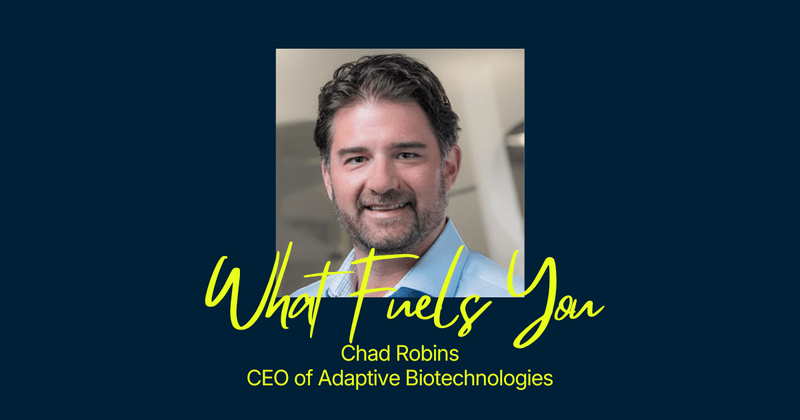
Chad Robins CEO and Co-Founder, Adaptive Biotechnologies
Chad Robins
CEO and Co-Founder, Adaptive Biotechnologies
Chad Robins co-founded Adaptive Biotechnologies (Nasdaq: ADPT) in 2009 with his brother Harlan Robins, Chief Scientific Officer, after Harlan called him from academia saying he had sequenced T-cell receptors at high throughput and needed someone who knew business. Under Chad's leadership, Adaptive raised over $400 million in funding, launched clonoSEQ, the first and only FDA-authorized next-generation sequencing test for minimal residual disease in blood cancers, and forged a landmark partnership with Microsoft. Chad holds a BS in Managerial Economics from Cornell University and an MBA from The Wharton School at the University of Pennsylvania, and was named a Goldman Sachs Most Intriguing Entrepreneur every year from 2015 onward and the Ernst and Young Entrepreneur of the Year for the Pacific Northwest in 2016.
2009
Year Adaptive Biotechnologies founded
$400M+
Funding raised to date
100
Days in wilderness with NOLS shaping Chad's leadership style
$80K
Raised by Adaptive team in annual charity bike ride
| Time | Topic |
|---|---|
| 00:00 | Rapid fire -- Grateful Dead, French cuisine, Steve Jobs as the CEO he most admires, and what actually fuels Chad Robins |
| 03:00 | Growing up in Wilmette, Illinois -- A father who left at 5 AM so he could be home for dinner every night, and what that model of presence taught Chad about leadership |
| 08:00 | The Robins brothers dynamic -- 13 months apart, very different personalities, and how Chad learned to preface every external meeting by disclosing they are brothers |
| 13:00 | Knowing at age 11 he wanted to be a CEO -- Reading Forbes and Fortune as a kid, why he calls himself a mutt, and the winding path through real estate, investment banking, and hedge funds |
| 19:00 | Cornell, Jackson Hole, and American Beauty -- The post-college business Chad tried to launch in Wyoming, why they were a decade early, and what that credit-based adventure travel idea looks like today |
| 25:00 | 100 days in the wilderness with NOLS -- How expedition behavior in the desert became Chad's entire leadership philosophy, and what happens when someone does not do their job in a camp group of three |
| 31:00 | Investment banking as a foundation -- Why hard skills from Wasserstein Perella doing high-tech M&A matter, and why soft skills are what differentiate over time |
| 37:00 | The phone call that started Adaptive -- Harlan calling in 2009 to say he had a big discovery, and Chad going to Wikipedia to understand what immunosequencing actually meant |
| 43:00 | How immunosequencing works -- Explaining immune receptors as barcode scanners, clonal expansion, and why the immune system touches every disease state from cancer to autoimmune disorders |
| 47:00 | clonoSEQ and the FDA clearance -- The first diagnostic product for measuring minimal residual disease in blood cancer, what it means for patients, and the Medicare reimbursement challenge |
| 50:00 | Culture, money, people, strategy -- How Chad simplifies the CEO job into three categories, why he loves fundraising, and what the emerging leaders program at Suncadia is designed to surface |
| 53:00 | Legacy and what fuels him -- Great husband, father, and friend first; changing how drugs are discovered and patients are managed second |
The Kid Who Read Forbes at 11 and Called Himself a Mutt
Chad Robins grew up in Wilmette, Illinois, a suburb north of Chicago that he compares directly to Mercer Island: relatively affluent, relatively homogeneous, and the kind of place where kids could ride bikes in the street after school. His father was a corporate lawyer who made an unusual trade-off, leaving for the office at 5 AM every day so he could reliably be home for dinner, to throw a ball around, to coach teams. Chad says this was one of the formative patterns of his childhood, a demonstration that presence is a choice you engineer around, not something that just happens.
By age 11, Chad was reading Forbes and Fortune and telling people he wanted to be a CEO. He was president of his freshman class at a large public high school, organized the social calendar, and played sports alongside a brother who was, in Chad's telling, the more accomplished athlete, the debate team captain, the math team standout, and the starting running back all at the same time. Chad describes their personalities as very different then and very different now. He was always the social one. Harlan was the overachiever. What they share is a complementary set of skills that their father summarized in a single sentence their mother still quotes.
"I call myself a mutt. I mean, I backed into or lucked into where I am now as CEO of a biotech company. But that was not clearly the design path for sure. I've been in real estate, investment banking, hedge funds, healthcare."
After Cornell, where he studied entrepreneurship and managerial economics and won a school-wide business plan competition his senior year, Chad moved to Jackson Hole, Wyoming to try to launch a credit-based outdoor adventure travel company called American Beauty, named after a Grateful Dead song. They had a piece of land picked out on the Snake River, were looking at buying a rafting company, and needed tens of millions of dollars to execute. He says they were ahead of their time and probably on different pages with the partners. That company did not become a company. But the instinct behind it, combining adventure, relationships, and an unconventional business model, describes everything that came next.
100 Days in the Desert, and the Leadership Philosophy That Came Out of It
While at Cornell, Chad spent 100 days in the wilderness as part of the National Outdoor Leadership School program. He says this plainly and then says something that stops the conversation: his entire leadership style, to this day, is built on what he learned there. Shauna Swerland asks him to explain, and the answer is worth slowing down for.
The concept is called expedition behavior. Chad describes it as a long explanation that ultimately reduces to: do your job and be a good person. In the field the accountability is total and immediate. In the desert, hiking 8 to 15 miles a day in groups of three, you get to camp and one person sets up the shelter, one person finds water, one person cooks the meal. If any one of those three people does not do their job, the group either does not sleep, does not drink, or does not eat. There is nowhere to hide. Chad admits he was someone who, when engaged, would go all out, and when not, would mail it in. The wilderness made him see clearly that when he mailed it in, someone else picked it up. That is not fair. He has carried that standard into how he expects people to show up at Adaptive.
"My whole leadership style, to this day, is based on those 100 days in the wilderness."
The investment banking years at Wasserstein Perella in San Francisco, doing high-tech M&A during the early internet build-out in the mid-1990s, gave him the technical vocabulary that still matters in his role today. He describes two reasons the experience was formative: the pure rigor of building financial models and constructing presentations under pressure, and the mentors he found in a satellite office where New York's rules did not fully apply. He is specific about what separates the people who advance: the hard skills get you in the room. The soft skills, the ability to connect, negotiate, manage, and set culture, are what differentiate over time. He points to the Goldman Sachs Builders and Innovators Conference as evidence. The people in that room know their numbers. What makes them exceptional is that they are also unbelievably charismatic.
The Phone Call from Harlan, and a Crash Course in Immunosequencing via Wikipedia
In 2009, Chad was sitting in his home office in Chicago when his brother Harlan called. Harlan had spent years at Fred Hutch as a computational biologist, having switched from theoretical physics and string theory when he concluded there were no practical applications of the work he was doing. The call to Chad was brief and direct: he had figured out how to sequence T-cell receptors at high throughput, he had been presenting it in academic circles and been mobbed with interest, and he had concluded that for it to help patients it would need to become a business. He had no idea how to do that. Chad was the only person he knew in business.
"He called me and said, 'Hey, Chad, I had a pretty big discovery. I think it could change the world. I've been talking about it in academic circles and I've been kind of mobbed with interest. I think in order for it to impact patients, it has to become a business. I have no idea how to do it. I'm calling you 'cause you're the only person I know in business.'"
Chad said yes immediately. Then he went to Wikipedia. He describes following every link in the immune system entry, absorbing as much as he could as fast as he could. The signal that the discovery was real was the call itself: Harlan had spent 20 years with no interest in business whatsoever. Chad had called him repeatedly over the years asking if he had discovered anything worth commercializing. Harlan had always said no. The fact that he finally called meant something had actually happened. What Harlan had discovered was the foundation for immunosequencing: using advances in next-generation sequencing hardware to develop chemistry and informatics that profile the immune system. Chad explains it simply: your immune system scans anything foreign, reacts to it, kills it, and remembers it. Adaptive's technology can identify and quantify each receptor type from a sample, at scale and in real time, with applications across cancer, infectious disease, autoimmune disorders, and the measurement of patient response to specific therapeutics.
Money, People, Strategy: How Chad Thinks About the CEO Job
Chad tells Shauna Swerland that he has simplified the CEO role into three categories: money, people, and strategy, in that order. Without capital you cannot hire. Without the right people the strategy does not matter, because you need people to execute it. He has arrived at this clarity over time, not from a textbook. The fundraising process, which many CEOs describe as a burden, is something Chad says he genuinely loves. He gets to tell the story of the company, meet new people, and understand what investors are building toward. His lead investor, Brian Kaufman of Viking Global, came in during a Series C close and told the team that if Adaptive was what they thought it was, they would need significantly more capital. He went in larger and has been what Chad describes as a true thought partner ever since, rigorous rather than unconditional, someone who helps think through problems.
"I try to simplify a CEO's job into really 3 categories: money, people, strategy, right? If you don't have money, you can't get the right people. And if you don't have the right people, it doesn't matter what strategy you set, you need the people to effectuate the strategy."
On culture, Chad is equally deliberate. He says culture is top-down and bottom-up simultaneously: the CEO sets the tone and the mission, but the best things often emerge from the organization itself. Adaptive has a branded gym called Adaptafit with trainers, showers, and locker rooms. They have an arcade game room, nerdy board game nights, and lunchtime research paper lectures that Chad says he never would have thought to create himself. He runs an emerging leaders program that takes cross-functional teams offsite to Suncadia, where he can watch how people collaborate outside their normal reporting lines and identify who is ready to grow. His biggest admitted failure is also the most common one for founders who are wired toward people: not spending enough time vetting before bringing someone on, and then not acting fast enough once it is clear the fit is wrong. He says you get better at it over time. He also says it is easier said than done.
Relationships as Fuel, and the Legacy He Is Building Outside the Science
When Shauna Swerland asks what fuels Chad Robins, he says relationships without hesitating. He says it in the rapid fire at the top of the episode and then spends the next 50 minutes demonstrating it. The thread from his father's genuine interest in the people in the mailroom and the shoeshine guy at his law firm, to Chad's curiosity about investors, board members, fellow executives, and the businesses they run, is unbroken throughout. He makes the distinction explicitly: he does not like the word networking because he does not experience what he does as networking. He is genuinely interested in people. That is not a strategy. It is just who he is.
On raising children in the context of significant financial success, he is candid about the difficulty. He grew up with the principle that with privilege comes responsibility, and he wants that to transfer. He mowed lawns. He waited tables at a pizza place and was not, by his own admission, very good at it. He wants his daughters to work. He also says honestly that some of the drive he carries is probably innate, not instilled. You can nurture it. He does not think you can manufacture it. What you can control is how your children watch you treat people. If his kids ever used a position of privilege to treat anyone differently, he says, he would go absolutely ballistic.
"First and foremost, I hope people can say I was a great husband, father, and friend. And then secondly, that we truly had an impact on the world from what was created from, you know, a few people that we grew into something that had such a profound impact on how patients are managed and how drugs are discovered."
His wife Kristi, whom he credits as an unconditional believer through the roller coaster of building Adaptive, is running what he calls the most important operation in his life. He is currently reading a book called What School Should Be and recently moved his youngest daughter to a school aligned with its philosophy, which emphasizes experiential learning and teaching kids how to think rather than what to think. The same principle, he notes, was what his own best teachers gave him. He has taken 25 years to circle back to it.
5 Key Takeaways
🏕️
Build your leadership philosophy somewhere you cannot hide
Chad traces his entire leadership style to 100 days in the wilderness with NOLS, where expedition behavior meant no one could mail it in without everyone else paying for it. That standard of transparent accountability is how he expects people to show up at Adaptive.
💼
Hard skills get you in the room; soft skills determine how far you go
Chad's investment banking foundation at Wasserstein Perella gave him technical fluency that still matters when talking to bankers and investors. But he is emphatic that the differentiator at every level, including among the most senior people at Goldman Sachs, is the ability to connect, negotiate, and build culture.
🧬
Hold platform conviction even when investors push for narrow focus
Adaptive faced sustained pressure to concentrate on a single application of the immune sequencing platform. Chad held the line, arguing that true platforms are rare and worth protecting across multiple bets. The FDA clearance of clonoSEQ and the Microsoft partnership are downstream of that decision.
👥
Simplify the CEO job to three things: money, people, strategy
Chad's operating framework is sequential and clear: capital first, because without it you cannot hire; people second, because without them strategy is irrelevant; strategy third, because execution requires the first two. He describes arriving at this clarity over time, not from a curriculum.
🤝
Genuine curiosity about people is a business strategy, not a personality quirk
Chad rejects the word networking because it does not describe what he actually does. He is interested in people across every context, from investor summits to the Adaptive gym, and credits this directly to watching his father develop real relationships with the mailroom staff and the shoeshine guy at his law firm.
Chad Robins Adaptive Biotechnologies Harlan Robins What Fuels You Shauna Swerland Fuel Talent Biotech CEO Immunosequencing clonoSEQ Immune Medicine Fred Hutch Microsoft Partnership Seattle Biotech Startup Founder NOLS Leadership Investment Banking Cornell University Wharton MBA Cancer Diagnostics Executive Leadership Company Culture Pacific Northwest Life Science Washington Goldman Sachs Most Intriguing Entrepreneur
Frequently Asked Questions
Who is Chad Robins and what is Adaptive Biotechnologies?
Chad Robins is the CEO and co-founder of Adaptive Biotechnologies (Nasdaq: ADPT), a Seattle-based commercial-stage biotech company he founded with his brother Harlan Robins in 2009. The company has developed a proprietary immune medicine platform that profiles the immune system using immunosequencing, with applications in clinical diagnostics, drug discovery, and the measurement of patient response to cancer therapies. Under Chad's leadership, Adaptive raised over $400 million in funding, launched the FDA-cleared diagnostic clonoSEQ for blood cancers, and forged a landmark research partnership with Microsoft.
What is clonoSEQ and what does it do for cancer patients?
clonoSEQ is Adaptive Biotechnologies' first commercial diagnostic product and the first and only FDA-authorized next-generation sequencing test for detecting and monitoring minimal residual disease in blood cancers. It allows clinicians to determine at a molecular level whether a cancer clone is responding to treatment or beginning to return, before the patient presents with clinical symptoms. Chad Robins described it on What Fuels You as giving doctors the ability to see cancer behavior in a patient's molecular information before it shows up in the exam room.
How did Chad Robins develop his leadership style?
Chad Robins told Shauna Swerland on What Fuels You that his entire leadership philosophy comes from 100 days in the wilderness with the National Outdoor Leadership School while he was at Cornell. The program introduced him to expedition behavior, which in the field means each person in a small camp group must do their assigned job or the whole group suffers. He describes realizing that when he was disengaged, someone else was picking up his slack, and that this was not fair. He has applied that standard of transparent accountability to how he leads at Adaptive ever since.
How does Chad Robins think about the role of the CEO?
Chad Robins simplifies the CEO job into three categories in priority order: money, people, and strategy. He argues that without capital you cannot hire the right people, and without the right people the strategy is irrelevant because you need people to execute it. He applies this framework to how he spends his time, with fundraising as a first-order responsibility he describes as something he genuinely loves rather than a burden, because it gives him the opportunity to meet people and tell the company's story.
What did Chad Robins say about hard skills versus soft skills in executive careers?
On What Fuels You, Chad Robins argued that technical hard skills from his investment banking years at Wasserstein Perella are essential foundations that give you credibility and language in the room. But he was equally clear that hard skills are not what differentiate people over time. The differentiator at every level, including among the most senior bankers at Goldman Sachs, is the soft skills: the ability to connect with people, negotiate, manage teams, and build culture. He described this as a pattern he has observed consistently across every industry and career stage.
Chad Robins CEO and Co-Founder, Adaptive Biotechnologies
Chad Robins
CEO and Co-Founder, Adaptive Biotechnologies
Chad Robins co-founded Adaptive Biotechnologies (Nasdaq: ADPT) in 2009 with his brother Harlan Robins, Chief Scientific Officer, after Harlan called him from academia saying he had sequenced T-cell receptors at high throughput and needed someone who knew business. Under Chad's leadership, Adaptive raised over $400 million in funding, launched clonoSEQ, the first and only FDA-authorized next-generation sequencing test for minimal residual disease in blood cancers, and forged a landmark partnership with Microsoft. Chad holds a BS in Managerial Economics from Cornell University and an MBA from The Wharton School at the University of Pennsylvania, and was named a Goldman Sachs Most Intriguing Entrepreneur every year from 2015 onward and the Ernst and Young Entrepreneur of the Year for the Pacific Northwest in 2016.
2009
Year Adaptive Biotechnologies founded
$400M+
Funding raised to date
100
Days in wilderness with NOLS shaping Chad's leadership style
$80K
Raised by Adaptive team in annual charity bike ride
| Time | Topic |
|---|---|
| 00:00 | Rapid fire -- Grateful Dead, French cuisine, Steve Jobs as the CEO he most admires, and what actually fuels Chad Robins |
| 03:00 | Growing up in Wilmette, Illinois -- A father who left at 5 AM so he could be home for dinner every night, and what that model of presence taught Chad about leadership |
| 08:00 | The Robins brothers dynamic -- 13 months apart, very different personalities, and how Chad learned to preface every external meeting by disclosing they are brothers |
| 13:00 | Knowing at age 11 he wanted to be a CEO -- Reading Forbes and Fortune as a kid, why he calls himself a mutt, and the winding path through real estate, investment banking, and hedge funds |
| 19:00 | Cornell, Jackson Hole, and American Beauty -- The post-college business Chad tried to launch in Wyoming, why they were a decade early, and what that credit-based adventure travel idea looks like today |
| 25:00 | 100 days in the wilderness with NOLS -- How expedition behavior in the desert became Chad's entire leadership philosophy, and what happens when someone does not do their job in a camp group of three |
| 31:00 | Investment banking as a foundation -- Why hard skills from Wasserstein Perella doing high-tech M&A matter, and why soft skills are what differentiate over time |
| 37:00 | The phone call that started Adaptive -- Harlan calling in 2009 to say he had a big discovery, and Chad going to Wikipedia to understand what immunosequencing actually meant |
| 43:00 | How immunosequencing works -- Explaining immune receptors as barcode scanners, clonal expansion, and why the immune system touches every disease state from cancer to autoimmune disorders |
| 47:00 | clonoSEQ and the FDA clearance -- The first diagnostic product for measuring minimal residual disease in blood cancer, what it means for patients, and the Medicare reimbursement challenge |
| 50:00 | Culture, money, people, strategy -- How Chad simplifies the CEO job into three categories, why he loves fundraising, and what the emerging leaders program at Suncadia is designed to surface |
| 53:00 | Legacy and what fuels him -- Great husband, father, and friend first; changing how drugs are discovered and patients are managed second |
The Kid Who Read Forbes at 11 and Called Himself a Mutt
Chad Robins grew up in Wilmette, Illinois, a suburb north of Chicago that he compares directly to Mercer Island: relatively affluent, relatively homogeneous, and the kind of place where kids could ride bikes in the street after school. His father was a corporate lawyer who made an unusual trade-off, leaving for the office at 5 AM every day so he could reliably be home for dinner, to throw a ball around, to coach teams. Chad says this was one of the formative patterns of his childhood, a demonstration that presence is a choice you engineer around, not something that just happens.
By age 11, Chad was reading Forbes and Fortune and telling people he wanted to be a CEO. He was president of his freshman class at a large public high school, organized the social calendar, and played sports alongside a brother who was, in Chad's telling, the more accomplished athlete, the debate team captain, the math team standout, and the starting running back all at the same time. Chad describes their personalities as very different then and very different now. He was always the social one. Harlan was the overachiever. What they share is a complementary set of skills that their father summarized in a single sentence their mother still quotes.
"I call myself a mutt. I mean, I backed into or lucked into where I am now as CEO of a biotech company. But that was not clearly the design path for sure. I've been in real estate, investment banking, hedge funds, healthcare."
After Cornell, where he studied entrepreneurship and managerial economics and won a school-wide business plan competition his senior year, Chad moved to Jackson Hole, Wyoming to try to launch a credit-based outdoor adventure travel company called American Beauty, named after a Grateful Dead song. They had a piece of land picked out on the Snake River, were looking at buying a rafting company, and needed tens of millions of dollars to execute. He says they were ahead of their time and probably on different pages with the partners. That company did not become a company. But the instinct behind it, combining adventure, relationships, and an unconventional business model, describes everything that came next.
100 Days in the Desert, and the Leadership Philosophy That Came Out of It
While at Cornell, Chad spent 100 days in the wilderness as part of the National Outdoor Leadership School program. He says this plainly and then says something that stops the conversation: his entire leadership style, to this day, is built on what he learned there. Shauna Swerland asks him to explain, and the answer is worth slowing down for.
The concept is called expedition behavior. Chad describes it as a long explanation that ultimately reduces to: do your job and be a good person. In the field the accountability is total and immediate. In the desert, hiking 8 to 15 miles a day in groups of three, you get to camp and one person sets up the shelter, one person finds water, one person cooks the meal. If any one of those three people does not do their job, the group either does not sleep, does not drink, or does not eat. There is nowhere to hide. Chad admits he was someone who, when engaged, would go all out, and when not, would mail it in. The wilderness made him see clearly that when he mailed it in, someone else picked it up. That is not fair. He has carried that standard into how he expects people to show up at Adaptive.
"My whole leadership style, to this day, is based on those 100 days in the wilderness."
The investment banking years at Wasserstein Perella in San Francisco, doing high-tech M&A during the early internet build-out in the mid-1990s, gave him the technical vocabulary that still matters in his role today. He describes two reasons the experience was formative: the pure rigor of building financial models and constructing presentations under pressure, and the mentors he found in a satellite office where New York's rules did not fully apply. He is specific about what separates the people who advance: the hard skills get you in the room. The soft skills, the ability to connect, negotiate, manage, and set culture, are what differentiate over time. He points to the Goldman Sachs Builders and Innovators Conference as evidence. The people in that room know their numbers. What makes them exceptional is that they are also unbelievably charismatic.
The Phone Call from Harlan, and a Crash Course in Immunosequencing via Wikipedia
In 2009, Chad was sitting in his home office in Chicago when his brother Harlan called. Harlan had spent years at Fred Hutch as a computational biologist, having switched from theoretical physics and string theory when he concluded there were no practical applications of the work he was doing. The call to Chad was brief and direct: he had figured out how to sequence T-cell receptors at high throughput, he had been presenting it in academic circles and been mobbed with interest, and he had concluded that for it to help patients it would need to become a business. He had no idea how to do that. Chad was the only person he knew in business.
"He called me and said, 'Hey, Chad, I had a pretty big discovery. I think it could change the world. I've been talking about it in academic circles and I've been kind of mobbed with interest. I think in order for it to impact patients, it has to become a business. I have no idea how to do it. I'm calling you 'cause you're the only person I know in business.'"
Chad said yes immediately. Then he went to Wikipedia. He describes following every link in the immune system entry, absorbing as much as he could as fast as he could. The signal that the discovery was real was the call itself: Harlan had spent 20 years with no interest in business whatsoever. Chad had called him repeatedly over the years asking if he had discovered anything worth commercializing. Harlan had always said no. The fact that he finally called meant something had actually happened. What Harlan had discovered was the foundation for immunosequencing: using advances in next-generation sequencing hardware to develop chemistry and informatics that profile the immune system. Chad explains it simply: your immune system scans anything foreign, reacts to it, kills it, and remembers it. Adaptive's technology can identify and quantify each receptor type from a sample, at scale and in real time, with applications across cancer, infectious disease, autoimmune disorders, and the measurement of patient response to specific therapeutics.
Money, People, Strategy: How Chad Thinks About the CEO Job
Chad tells Shauna Swerland that he has simplified the CEO role into three categories: money, people, and strategy, in that order. Without capital you cannot hire. Without the right people the strategy does not matter, because you need people to execute it. He has arrived at this clarity over time, not from a textbook. The fundraising process, which many CEOs describe as a burden, is something Chad says he genuinely loves. He gets to tell the story of the company, meet new people, and understand what investors are building toward. His lead investor, Brian Kaufman of Viking Global, came in during a Series C close and told the team that if Adaptive was what they thought it was, they would need significantly more capital. He went in larger and has been what Chad describes as a true thought partner ever since, rigorous rather than unconditional, someone who helps think through problems.
"I try to simplify a CEO's job into really 3 categories: money, people, strategy, right? If you don't have money, you can't get the right people. And if you don't have the right people, it doesn't matter what strategy you set, you need the people to effectuate the strategy."
On culture, Chad is equally deliberate. He says culture is top-down and bottom-up simultaneously: the CEO sets the tone and the mission, but the best things often emerge from the organization itself. Adaptive has a branded gym called Adaptafit with trainers, showers, and locker rooms. They have an arcade game room, nerdy board game nights, and lunchtime research paper lectures that Chad says he never would have thought to create himself. He runs an emerging leaders program that takes cross-functional teams offsite to Suncadia, where he can watch how people collaborate outside their normal reporting lines and identify who is ready to grow. His biggest admitted failure is also the most common one for founders who are wired toward people: not spending enough time vetting before bringing someone on, and then not acting fast enough once it is clear the fit is wrong. He says you get better at it over time. He also says it is easier said than done.
Relationships as Fuel, and the Legacy He Is Building Outside the Science
When Shauna Swerland asks what fuels Chad Robins, he says relationships without hesitating. He says it in the rapid fire at the top of the episode and then spends the next 50 minutes demonstrating it. The thread from his father's genuine interest in the people in the mailroom and the shoeshine guy at his law firm, to Chad's curiosity about investors, board members, fellow executives, and the businesses they run, is unbroken throughout. He makes the distinction explicitly: he does not like the word networking because he does not experience what he does as networking. He is genuinely interested in people. That is not a strategy. It is just who he is.
On raising children in the context of significant financial success, he is candid about the difficulty. He grew up with the principle that with privilege comes responsibility, and he wants that to transfer. He mowed lawns. He waited tables at a pizza place and was not, by his own admission, very good at it. He wants his daughters to work. He also says honestly that some of the drive he carries is probably innate, not instilled. You can nurture it. He does not think you can manufacture it. What you can control is how your children watch you treat people. If his kids ever used a position of privilege to treat anyone differently, he says, he would go absolutely ballistic.
"First and foremost, I hope people can say I was a great husband, father, and friend. And then secondly, that we truly had an impact on the world from what was created from, you know, a few people that we grew into something that had such a profound impact on how patients are managed and how drugs are discovered."
His wife Kristi, whom he credits as an unconditional believer through the roller coaster of building Adaptive, is running what he calls the most important operation in his life. He is currently reading a book called What School Should Be and recently moved his youngest daughter to a school aligned with its philosophy, which emphasizes experiential learning and teaching kids how to think rather than what to think. The same principle, he notes, was what his own best teachers gave him. He has taken 25 years to circle back to it.
5 Key Takeaways
🏕️
Build your leadership philosophy somewhere you cannot hide
Chad traces his entire leadership style to 100 days in the wilderness with NOLS, where expedition behavior meant no one could mail it in without everyone else paying for it. That standard of transparent accountability is how he expects people to show up at Adaptive.
💼
Hard skills get you in the room; soft skills determine how far you go
Chad's investment banking foundation at Wasserstein Perella gave him technical fluency that still matters when talking to bankers and investors. But he is emphatic that the differentiator at every level, including among the most senior people at Goldman Sachs, is the ability to connect, negotiate, and build culture.
🧬
Hold platform conviction even when investors push for narrow focus
Adaptive faced sustained pressure to concentrate on a single application of the immune sequencing platform. Chad held the line, arguing that true platforms are rare and worth protecting across multiple bets. The FDA clearance of clonoSEQ and the Microsoft partnership are downstream of that decision.
👥
Simplify the CEO job to three things: money, people, strategy
Chad's operating framework is sequential and clear: capital first, because without it you cannot hire; people second, because without them strategy is irrelevant; strategy third, because execution requires the first two. He describes arriving at this clarity over time, not from a curriculum.
🤝
Genuine curiosity about people is a business strategy, not a personality quirk
Chad rejects the word networking because it does not describe what he actually does. He is interested in people across every context, from investor summits to the Adaptive gym, and credits this directly to watching his father develop real relationships with the mailroom staff and the shoeshine guy at his law firm.
Chad Robins Adaptive Biotechnologies Harlan Robins What Fuels You Shauna Swerland Fuel Talent Biotech CEO Immunosequencing clonoSEQ Immune Medicine Fred Hutch Microsoft Partnership Seattle Biotech Startup Founder NOLS Leadership Investment Banking Cornell University Wharton MBA Cancer Diagnostics Executive Leadership Company Culture Pacific Northwest Life Science Washington Goldman Sachs Most Intriguing Entrepreneur
Frequently Asked Questions
Who is Chad Robins and what is Adaptive Biotechnologies?
Chad Robins is the CEO and co-founder of Adaptive Biotechnologies (Nasdaq: ADPT), a Seattle-based commercial-stage biotech company he founded with his brother Harlan Robins in 2009. The company has developed a proprietary immune medicine platform that profiles the immune system using immunosequencing, with applications in clinical diagnostics, drug discovery, and the measurement of patient response to cancer therapies. Under Chad's leadership, Adaptive raised over $400 million in funding, launched the FDA-cleared diagnostic clonoSEQ for blood cancers, and forged a landmark research partnership with Microsoft.
What is clonoSEQ and what does it do for cancer patients?
clonoSEQ is Adaptive Biotechnologies' first commercial diagnostic product and the first and only FDA-authorized next-generation sequencing test for detecting and monitoring minimal residual disease in blood cancers. It allows clinicians to determine at a molecular level whether a cancer clone is responding to treatment or beginning to return, before the patient presents with clinical symptoms. Chad Robins described it on What Fuels You as giving doctors the ability to see cancer behavior in a patient's molecular information before it shows up in the exam room.
How did Chad Robins develop his leadership style?
Chad Robins told Shauna Swerland on What Fuels You that his entire leadership philosophy comes from 100 days in the wilderness with the National Outdoor Leadership School while he was at Cornell. The program introduced him to expedition behavior, which in the field means each person in a small camp group must do their assigned job or the whole group suffers. He describes realizing that when he was disengaged, someone else was picking up his slack, and that this was not fair. He has applied that standard of transparent accountability to how he leads at Adaptive ever since.
How does Chad Robins think about the role of the CEO?
Chad Robins simplifies the CEO job into three categories in priority order: money, people, and strategy. He argues that without capital you cannot hire the right people, and without the right people the strategy is irrelevant because you need people to execute it. He applies this framework to how he spends his time, with fundraising as a first-order responsibility he describes as something he genuinely loves rather than a burden, because it gives him the opportunity to meet people and tell the company's story.
What did Chad Robins say about hard skills versus soft skills in executive careers?
On What Fuels You, Chad Robins argued that technical hard skills from his investment banking years at Wasserstein Perella are essential foundations that give you credibility and language in the room. But he was equally clear that hard skills are not what differentiate people over time. The differentiator at every level, including among the most senior bankers at Goldman Sachs, is the soft skills: the ability to connect with people, negotiate, manage teams, and build culture. He described this as a pattern he has observed consistently across every industry and career stage.