
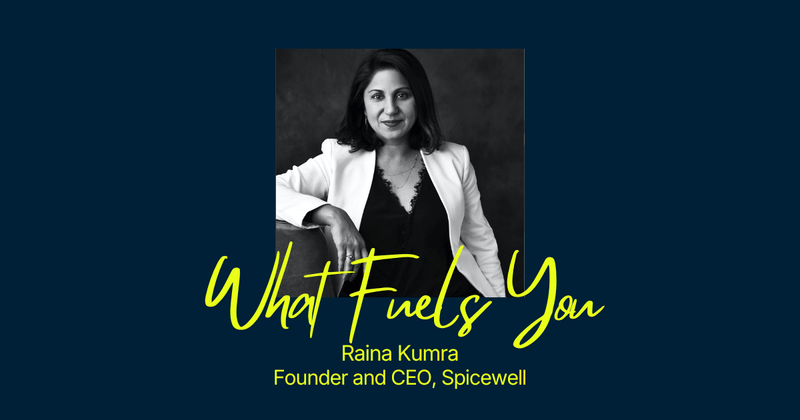
Founder and CEO of Spicewell
Salt and pepper have not changed in a hundred years, and Raina Kumra decided that was a problem worth solving during the worst week of her life. In 2021, her husband came home from knee surgery, and hours later her daughter and son were thrown from a cargo bike, breaking her daughter's collarbone. Kumra reached for the Ayurvedic remedies her grandmother had taught her, and out of that kitchen experiment came Spicewell.
In this episode of What Fuels You, host Shauna Swerland sits down with Kumra to trace a career that runs from Bartle Bogle Hegarty and the Obama Administration to Omidyar Network and a startup called Maven that reached 5 million users before an investor blew up a near acquisition by Google. Every stop, Kumra says, taught her the same lesson: take an idea out of your head and make it real.
📋 Episode Chapters
| 00:00 | Cold open: the magic of building something that did not exist before |
| 01:15 | Introducing Raina Kumra, founder and CEO of Spicewell |
| 02:30 | Rapid fire: turning into a morning person while living in Mumbai |
| 04:15 | Rapid fire: khichdi, turmeric in everything, and a lemon salt water ritual |
| 07:00 | Growing up on a street called Utopia Place in the Bay Area's garage era |
| 10:00 | Her father's Intel career and the decision to turn down Seattle |
| 12:30 | Being the blue drop in a yellow sea: Indian American identity |
| 15:30 | Ayurveda at home: cloves for toothaches and antibiotics as a last resort |
| 19:00 | Spelling bee kid, teenage rock star, and choosing Boston University |
| 22:30 | Learning to build websites by accident and landing a job in advertising |
| 25:30 | Filming a 9/11 memorial documentary with Errol Morris at BBH |
| 29:00 | Harvard Graduate School of Design and founding Juggernaut |
| 33:00 | The Obama Administration, Maven's 5 million users, and the Ethical OS framework |
| 39:00 | The bike accident that led to Spicewell and its 9 vegetable formula |
Raised on a Street Called Utopia
Kumra was born in Orange County to parents who arrived in the United States in 1974 as newlyweds. Her father took an engineering job at Burroughs in Chicago, then moved the family to Orange County for a role at Howard Hughes Aircraft Company before landing at Intel, which pulled them north into the Bay Area before Kumra turned two. She grew up in a Silicon Valley that, in her words, no longer exists: a place where people built startups out of their garages and everyone tinkered.
"I think I grew up on a street called Utopia Place. I'm not even kidding you."
-- Raina Kumra
Her father eventually turned down a company transfer to Seattle, telling his employer he was not moving somewhere so rainy. That refusal marked the start of his own entrepreneurial run, and he became one of the first people in California to build an independent wireless network. Kumra's younger sister also went on to found her own business, an interior design firm. Entrepreneurship, Kumra says, runs in the family.
The Blue Drop in a Yellow Sea
Kumra's grandparents lived with her family growing up, and Hindi and Punjabi were her first languages before English took over in preschool. She points to a distinction she has thought about often: Indian Americans, she argues, tend to freeze the culture their parents left behind rather than let it evolve the way India itself has.
She traces this to the psychology of being a minority holding onto something that is not shared by the culture around it.
"You have to like really retain your blue. You're like, I'm just gonna just keep the blue thing going here."
-- Raina Kumra
That same retention shows up in her family's approach to medicine. Her mother and grandmother practiced Ayurveda at home, treating toothaches with clove oil and upset stomachs with peppermint tea, blending it casually with Western medicine rather than treating either as doctrine. Kumra says her generation of American kids was overprescribed antibiotics, which she connects to gut health problems she now sees across her peers.
From Documentary Film to Bartle Bogle Hegarty
Kumra studied film production at Boston University, deliberately choosing the school furthest from home on her college application. She followed it with a master's in interactive telecommunications at NYU's Tisch School, a program she compares to a design and technology hybrid similar to the MIT Media Lab. After shooting a documentary for a year, she returned to an editing job to find the entire industry had moved online, and she decided she needed to understand the internet before it consumed everything.
She resisted advertising at first, until a temp placement landed her at Bartle Bogle Hegarty in New York during the Cindy Gallop era. Her first project was a Cantor Fitzgerald documentary commemorating lives lost on 9/11, directed by Errol Morris.
"It's not just selling crap, it's actually telling these really meaningful stories."
-- Raina Kumra
She went on to lead digital strategy at Wieden and Kennedy in New York, working across brands including Nike, Microsoft, Disney, and Burberry.
Five Million Users and the Investor Who Blew Up the Deal
After Harvard's Graduate School of Design, where she studied how digital screens were reshaping the urban environment, Kumra founded the agency Juggernaut and later joined a startup called Maven as CMO. Maven built an app engagement ecosystem across the US and India, rewarding users on prepaid mobile plans with data for downloading and sharing apps. The company ran for four years, reached 5 million users, generated revenue, and had roughly 100 apps live on the platform. It was in the process of closing a near acquisition by Google when an investor stepped in and blew up the deal, forcing a shutdown.
"It doesn't matter if you're young or old, like you just have to listen for who gives you the heebie-jeebies and keep them far away."
-- Raina Kumra
Kumra calls it a lesson business school cannot teach: never put someone on the cap table you do not fully trust.
Building the Ethical OS Before Tech Ethics Was a Field
From Maven, Kumra joined Omidyar Network to lead a portfolio focused on technology ethics, a subject she says nobody in Silicon Valley was discussing on purpose at the time. She built and launched the Ethical OS, a framework offering 8 lenses for technology makers to consider before shipping a product, and funded some of the first organizations working in the space.
The framework was free and never designed to generate revenue, but Kumra says its influence outlived the funding cycle that created it.
"I see that language even in ChatGPT privacy policies and ethics statements. I see the language like all over, all over the place."
-- Raina Kumra
The Ethical OS has now been downloaded more than a million times and turned into a recurring LinkedIn Learning course.
The Day Everything Broke: How Spicewell Was Born
In early 2021, Kumra brought her husband home from knee surgery. A few hours later, her daughter and son were thrown from a cargo bike, and her 5 year old daughter broke her collarbone. With the pandemic limiting outside help, Kumra and her 7 year old son spent days running drinks, snacks, and hydration between two family members who could not get out of bed. She decided every meal she cooked from that point forward would work toward their recovery, drawing on her mother's and grandmother's Ayurvedic recipes, turmeric, and ginger.
What started as kitchen experimentation turned into a product after buyers at retail stores and Dr. Mark Hyman took interest. Ann Veneman, the former US Secretary of Agriculture, became her first advisor.
"I never set out to start a company, but there was just some demand early on."
-- Raina Kumra
It took roughly six months to formulate a blend nutrient dense enough to matter without ruining the flavor. Tomato, in early tests, overwhelmed the taste and was cut.
"So now the formula is 9 vegetables, 1 full serving of vegetables in every half teaspoon."
-- Raina Kumra
Today Kumra runs Spicewell as CEO, creative director, COO, and head of communications at once, a workload she calls being a scrappy startup by design.
5 Key Takeaways
Frequently Asked Questions
Who is Raina Kumra?
Raina Kumra is the founder and CEO of Spicewell, a nutrient dense seasoning company she started after a 2021 family health crisis. She previously worked in the Obama Administration at the State Department and the Broadcasting Board of Governors, led digital strategy at Wieden and Kennedy in New York, and built the Ethical OS technology ethics framework at Omidyar Network. She currently advises Google X and leads the transformation agency Juggernaut.
What does Spicewell do?
Spicewell makes functional salt, pepper, and seasoning blends designed to close nutrient gaps in the American diet. Each half teaspoon packs 9 vegetables, including broccoli, kale, and broccoli sprouts, into a single serving, and it took Kumra roughly six months to formulate the blend so the vegetables would not overpower the flavor.
What did Raina Kumra say about her startup Maven?
Maven was an app engagement ecosystem Kumra ran as CMO across the US and India, reaching 5 million users and generating revenue before a near acquisition by Google collapsed after an investor intervened. She said the experience taught her never to put someone on the cap table she does not fully trust.
Why did Raina Kumra start Spicewell?
Kumra started Spicewell after her husband's knee surgery and her daughter's bike accident collided in a single day in 2021. She turned to her grandmother's Ayurvedic remedies to help her family heal and decided every meal she cooked would support that recovery. She calls Spicewell "an accidental company."
What is the Ethical OS framework Raina Kumra created?
The Ethical OS is a framework Kumra built while leading the tech ethics portfolio at Omidyar Network, offering 8 lenses for technology makers to consider before launching a product. It has been downloaded more than a million times, and Kumra says she now sees its language echoed in ChatGPT's privacy policies and other AI ethics statements.
Founder and CEO of Spicewell
Salt and pepper have not changed in a hundred years, and Raina Kumra decided that was a problem worth solving during the worst week of her life. In 2021, her husband came home from knee surgery, and hours later her daughter and son were thrown from a cargo bike, breaking her daughter's collarbone. Kumra reached for the Ayurvedic remedies her grandmother had taught her, and out of that kitchen experiment came Spicewell.
In this episode of What Fuels You, host Shauna Swerland sits down with Kumra to trace a career that runs from Bartle Bogle Hegarty and the Obama Administration to Omidyar Network and a startup called Maven that reached 5 million users before an investor blew up a near acquisition by Google. Every stop, Kumra says, taught her the same lesson: take an idea out of your head and make it real.
📋 Episode Chapters
| 00:00 | Cold open: the magic of building something that did not exist before |
| 01:15 | Introducing Raina Kumra, founder and CEO of Spicewell |
| 02:30 | Rapid fire: turning into a morning person while living in Mumbai |
| 04:15 | Rapid fire: khichdi, turmeric in everything, and a lemon salt water ritual |
| 07:00 | Growing up on a street called Utopia Place in the Bay Area's garage era |
| 10:00 | Her father's Intel career and the decision to turn down Seattle |
| 12:30 | Being the blue drop in a yellow sea: Indian American identity |
| 15:30 | Ayurveda at home: cloves for toothaches and antibiotics as a last resort |
| 19:00 | Spelling bee kid, teenage rock star, and choosing Boston University |
| 22:30 | Learning to build websites by accident and landing a job in advertising |
| 25:30 | Filming a 9/11 memorial documentary with Errol Morris at BBH |
| 29:00 | Harvard Graduate School of Design and founding Juggernaut |
| 33:00 | The Obama Administration, Maven's 5 million users, and the Ethical OS framework |
| 39:00 | The bike accident that led to Spicewell and its 9 vegetable formula |
Raised on a Street Called Utopia
Kumra was born in Orange County to parents who arrived in the United States in 1974 as newlyweds. Her father took an engineering job at Burroughs in Chicago, then moved the family to Orange County for a role at Howard Hughes Aircraft Company before landing at Intel, which pulled them north into the Bay Area before Kumra turned two. She grew up in a Silicon Valley that, in her words, no longer exists: a place where people built startups out of their garages and everyone tinkered.
"I think I grew up on a street called Utopia Place. I'm not even kidding you."
-- Raina Kumra
Her father eventually turned down a company transfer to Seattle, telling his employer he was not moving somewhere so rainy. That refusal marked the start of his own entrepreneurial run, and he became one of the first people in California to build an independent wireless network. Kumra's younger sister also went on to found her own business, an interior design firm. Entrepreneurship, Kumra says, runs in the family.
The Blue Drop in a Yellow Sea
Kumra's grandparents lived with her family growing up, and Hindi and Punjabi were her first languages before English took over in preschool. She points to a distinction she has thought about often: Indian Americans, she argues, tend to freeze the culture their parents left behind rather than let it evolve the way India itself has.
She traces this to the psychology of being a minority holding onto something that is not shared by the culture around it.
"You have to like really retain your blue. You're like, I'm just gonna just keep the blue thing going here."
-- Raina Kumra
That same retention shows up in her family's approach to medicine. Her mother and grandmother practiced Ayurveda at home, treating toothaches with clove oil and upset stomachs with peppermint tea, blending it casually with Western medicine rather than treating either as doctrine. Kumra says her generation of American kids was overprescribed antibiotics, which she connects to gut health problems she now sees across her peers.
From Documentary Film to Bartle Bogle Hegarty
Kumra studied film production at Boston University, deliberately choosing the school furthest from home on her college application. She followed it with a master's in interactive telecommunications at NYU's Tisch School, a program she compares to a design and technology hybrid similar to the MIT Media Lab. After shooting a documentary for a year, she returned to an editing job to find the entire industry had moved online, and she decided she needed to understand the internet before it consumed everything.
She resisted advertising at first, until a temp placement landed her at Bartle Bogle Hegarty in New York during the Cindy Gallop era. Her first project was a Cantor Fitzgerald documentary commemorating lives lost on 9/11, directed by Errol Morris.
"It's not just selling crap, it's actually telling these really meaningful stories."
-- Raina Kumra
She went on to lead digital strategy at Wieden and Kennedy in New York, working across brands including Nike, Microsoft, Disney, and Burberry.
Five Million Users and the Investor Who Blew Up the Deal
After Harvard's Graduate School of Design, where she studied how digital screens were reshaping the urban environment, Kumra founded the agency Juggernaut and later joined a startup called Maven as CMO. Maven built an app engagement ecosystem across the US and India, rewarding users on prepaid mobile plans with data for downloading and sharing apps. The company ran for four years, reached 5 million users, generated revenue, and had roughly 100 apps live on the platform. It was in the process of closing a near acquisition by Google when an investor stepped in and blew up the deal, forcing a shutdown.
"It doesn't matter if you're young or old, like you just have to listen for who gives you the heebie-jeebies and keep them far away."
-- Raina Kumra
Kumra calls it a lesson business school cannot teach: never put someone on the cap table you do not fully trust.
Building the Ethical OS Before Tech Ethics Was a Field
From Maven, Kumra joined Omidyar Network to lead a portfolio focused on technology ethics, a subject she says nobody in Silicon Valley was discussing on purpose at the time. She built and launched the Ethical OS, a framework offering 8 lenses for technology makers to consider before shipping a product, and funded some of the first organizations working in the space.
The framework was free and never designed to generate revenue, but Kumra says its influence outlived the funding cycle that created it.
"I see that language even in ChatGPT privacy policies and ethics statements. I see the language like all over, all over the place."
-- Raina Kumra
The Ethical OS has now been downloaded more than a million times and turned into a recurring LinkedIn Learning course.
The Day Everything Broke: How Spicewell Was Born
In early 2021, Kumra brought her husband home from knee surgery. A few hours later, her daughter and son were thrown from a cargo bike, and her 5 year old daughter broke her collarbone. With the pandemic limiting outside help, Kumra and her 7 year old son spent days running drinks, snacks, and hydration between two family members who could not get out of bed. She decided every meal she cooked from that point forward would work toward their recovery, drawing on her mother's and grandmother's Ayurvedic recipes, turmeric, and ginger.
What started as kitchen experimentation turned into a product after buyers at retail stores and Dr. Mark Hyman took interest. Ann Veneman, the former US Secretary of Agriculture, became her first advisor.
"I never set out to start a company, but there was just some demand early on."
-- Raina Kumra
It took roughly six months to formulate a blend nutrient dense enough to matter without ruining the flavor. Tomato, in early tests, overwhelmed the taste and was cut.
"So now the formula is 9 vegetables, 1 full serving of vegetables in every half teaspoon."
-- Raina Kumra
Today Kumra runs Spicewell as CEO, creative director, COO, and head of communications at once, a workload she calls being a scrappy startup by design.
5 Key Takeaways
Frequently Asked Questions
Who is Raina Kumra?
Raina Kumra is the founder and CEO of Spicewell, a nutrient dense seasoning company she started after a 2021 family health crisis. She previously worked in the Obama Administration at the State Department and the Broadcasting Board of Governors, led digital strategy at Wieden and Kennedy in New York, and built the Ethical OS technology ethics framework at Omidyar Network. She currently advises Google X and leads the transformation agency Juggernaut.
What does Spicewell do?
Spicewell makes functional salt, pepper, and seasoning blends designed to close nutrient gaps in the American diet. Each half teaspoon packs 9 vegetables, including broccoli, kale, and broccoli sprouts, into a single serving, and it took Kumra roughly six months to formulate the blend so the vegetables would not overpower the flavor.
What did Raina Kumra say about her startup Maven?
Maven was an app engagement ecosystem Kumra ran as CMO across the US and India, reaching 5 million users and generating revenue before a near acquisition by Google collapsed after an investor intervened. She said the experience taught her never to put someone on the cap table she does not fully trust.
Why did Raina Kumra start Spicewell?
Kumra started Spicewell after her husband's knee surgery and her daughter's bike accident collided in a single day in 2021. She turned to her grandmother's Ayurvedic remedies to help her family heal and decided every meal she cooked would support that recovery. She calls Spicewell "an accidental company."
What is the Ethical OS framework Raina Kumra created?
The Ethical OS is a framework Kumra built while leading the tech ethics portfolio at Omidyar Network, offering 8 lenses for technology makers to consider before launching a product. It has been downloaded more than a million times, and Kumra says she now sees its language echoed in ChatGPT's privacy policies and other AI ethics statements.