

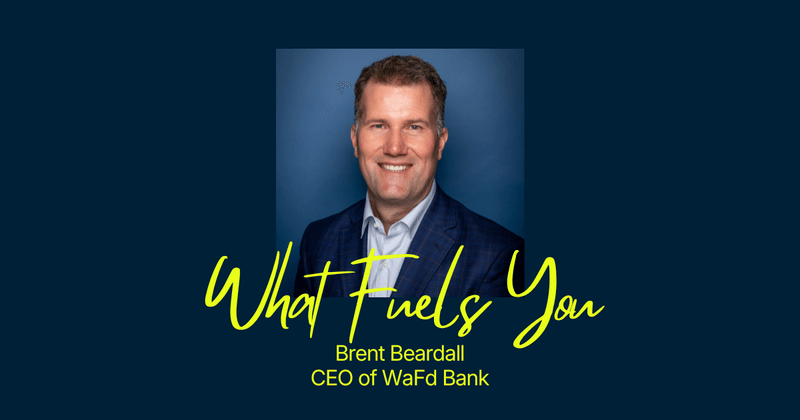
President and CEO of WaFd Bank
On January 2, 2023, a private jet carrying Brent Beardall, President and CEO of WaFd Bank, attempted to take off from a Utah runway on the way to the Rose Bowl. Seconds after liftoff, the plane rolled 12 to 15 times. The pilot, a friend and client, was killed on impact. The first responders on the scene chose not to intervene, believing Beardall would not survive. He asked them why they were standing there with their arms folded. He went back to work full time six weeks later.
In this episode of What Fuels You, host Shauna Swerland sits down with Beardall for a conversation that covers loss, gratitude, leadership under pressure, community banking in the age of AI, and what it means to call yourself the luckiest man alive after going through the unluckiest thing imaginable. The throughline is a man who has spent his entire career running toward challenges rather than away from them, and a near-death experience that only deepened that instinct.
📋 Episode Chapters
| 00:00 | Rapid fire intro: mountains vs. beach, water polo, early rising, and Depeche Mode at the LA Coliseum |
| 05:30 | What Beardall looks for in employees: authenticity, introspection, and willingness to learn over raw talent |
| 09:10 | Growing up in Southern California, working in bank collections at age 16, and losing his father at 15 |
| 15:20 | How becoming the man of the household at 15 built accountability and the internal switch between seriousness and joy |
| 19:45 | BYU, a Mormon mission in Mexico City, and why Beardall would require 2 years of service for every young person |
| 25:00 | Starting at Deloitte, joining WaFd in 2001, and why loyalty and running toward problems defined his rise |
| 29:30 | Mastering FASB 133, the accounting standard nobody wanted, and how that launched his path to CEO |
| 33:00 | AI in banking: how Beardall envisions every customer having a personal CFO in their pocket |
| 36:45 | WaFd's voice-authenticated wire transfer portal and why 4 years of zero fraud is their competitive edge |
| 39:20 | The Rose Bowl plane crash: what happened on January 2, 2023, and why first responders left Beardall to die |
| 44:00 | Survivor's guilt, faith, and an ICU nurse who told him it is okay not to be okay |
| 47:30 | Leading with love at work: why Beardall tells employees he loves them and how vulnerability builds stronger teams |
| 49:50 | Mass held at the Vatican in his name: what the crash revealed about human connection and shared values |
| 51:30 | What fuels Brent Beardall: leaving the campsite better than you found it |
The Kid Who Filed Pink Slips and Called Debtors at 16
Brent Beardall did not have a sheltered path into banking. His father was a banker in Southern California, which meant the expectation at home was not privilege but work. At 14, Beardall was filing car loan paperwork in a bank's file room. By 16, he was in the collections department, calling people to tell them their cars would be repossessed if they did not pay. He was in high school.
That experience reframed his entire understanding of money and people. He watched neighbors who looked wealthy, based on the cars they drove, turn out to be dangerously overextended. The lesson he took from those calls was not cynicism about people but clarity about economic reality. Living within your means was not abstract personal finance advice. It was the difference between keeping your car and losing it. That early immersion in real financial consequences for real people shaped how he would eventually think about banking as a profession and as a public good.
"I always thought, oh, you look at their car and based on their car, you can know how well they're doing in life. Not true. There were so many people that were living above their means."
-- Brent Beardall
Then, at 15, his father died. His brother was on a Mormon mission in Venezuela. His sister was in and out of college. Beardall was home with his mother, and the yard, the roof, the sprinklers, and every other household responsibility fell to a teenager who had no other option but to step up. He frames that period not as tragedy but as training. It gave him what he calls a switch: the ability to move between deep seriousness and genuine lightness depending on what a moment demands. That dual capacity has defined his leadership style ever since.
Running Toward Problems: From FASB 133 to the CEO Chair
Beardall arrived at WaFd Bank in 2001 after starting his career at Deloitte, where one of his audit clients was what was then called Washington Federal Savings and Loan Association. He has held only two jobs since graduating college. What kept him at WaFd for more than 25 years was not inertia but a deliberate philosophy about how careers get built. His approach is straightforward: find the problem nobody else wants to touch, and become the person who solves it.
The turning point came with FASB 133, the accounting standard governing derivatives. It was new, complex, and widely avoided. Beardall printed out all 1,232 pages, read them, highlighted them, and asked questions until he understood the standard better than anyone around him. He was not born an expert. He simply paid attention when others did not. That willingness to wade into complexity no one else wanted to handle is what he credits as the real driver of his rise from accountant to president and CEO, the sixth in the bank's 108-year history.
"That's the great thing about running towards challenges. Don't just do what everybody else has done. Run towards a challenge. And now all of a sudden you gain that expertise."
-- Brent Beardall
He turned down an early opportunity to join Amazon. He does not regret it. What he has built at WaFd, a top-50 bank by assets in a country with roughly 4,500 banks, and a culture he describes as one where trust is the actual currency, is what he considers the better path for who he is. Loyalty, he says, is a trait he carries almost to a fault.
Banking in the Age of AI: The Personal CFO in Your Pocket
Shauna Swerland asked Beardall directly what WaFd is doing to stay ahead in an environment reshaped by technology. His answer was neither defensive nor vague. He acknowledged that banking is one of the most regulated industries in the country, which makes rapid AI adoption complicated. Regulators scrutinize generative models because they learn dynamically, and that dynamic quality creates risk management headaches. But Beardall sees the wave coming regardless, and his view is that you either learn to ride it or it crushes you.
His vision for AI in banking is genuinely ambitious. He wants every WaFd customer to effectively have access to a personal CFO through their banking app, one capable of analyzing spending patterns, projecting financial outcomes, and offering the kind of objective guidance that used to require hiring someone. He makes a point of separating that vision from the surface-level AI features already common in consumer apps. Flagging duplicate Netflix subscriptions is not the goal. Changing the trajectory of someone's financial life is.
"Wouldn't it be cool if we all had this objective CEO to help us?"
-- Brent Beardall
He also described a proprietary wire transfer portal WaFd built that uses voice authentication tied to a specific phone number as a multi-factor security check. It has been running for four years without a single fraud incident. When Beardall talks about trust being WaFd's real currency, that product is a concrete example of what he means. Innovation at a community bank level, built around the actual pain points of high-net-worth customers, rather than features designed to look modern.
The Plane Crash That Killed His Friend and Almost Killed Him
It started as a joke. At a client event, a University of Utah board member teased Beardall and a colleague about their BYU loyalties, pointing out that while the Cougars were headed to a bowl game in Albuquerque, the Utes were going to Pasadena for the Rose Bowl. Beardall called the bluff: if you were really our favorite client, you would invite us to the 50-yard line. The client agreed on one condition: they had to wear Utah gear. A friend and fellow client named Nathan offered to fly them down and back the same day on his private jet.
On January 2, 2023, shortly after takeoff from a Utah runway, the plane took a hard turn down and to the left. The wingtip scraped the ground. The nose went directly into the earth. The plane rolled 12 to 15 times, severing the wings and engines in the process. That separation, gruesome as it was, is what kept the aircraft from catching fire. Nathan, the pilot, was ejected on impact and killed. Beardall was left inside the wreckage, bleeding severely. When he looked up, the first responders were standing nearby with their arms folded.
"We wanted to let you pass in peace. We didn't think there was anything we could do for you."
-- First responder, as recounted by Brent Beardall
He survived. His two sons had been scheduled to join him on the flight. Days before, his youngest said he did not feel right about it and asked his father not to go. Beardall went alone. He does not dwell on that detail, but he does not minimize it either. The blessing, he said, is not one he talks about very much.
It Is Okay Not to Be Okay: On Survivor's Guilt, Faith, and Telling People You Love Them
Recovery from the crash was physical and psychological simultaneously. An ICU nurse pulled Beardall aside early in his hospital stay and told him she knew his type. He was going to fight back. He was going to recover. But she warned him: there would be days when it was not okay, and that was allowed. Beardall repeats that message with conviction. He considers it one of the most important things he heard during the entire experience, and he has carried it back into his leadership at WaFd Bank.
He also sat with survivor's guilt. His friend died in the seat next to him. Beardall was spared. He is a religious man and describes a deepened awareness of his own mortality rather than a deepening of religious practice specifically. What changed was his relationship to time and to the people around him. He now tells employees he loves them when he means it. He does not soften the word or avoid it. Life, he argues, is too short to withhold that from the people who make a difference in it, and the pandemic of loneliness and disconnection visible in the culture around him reinforces that belief.
"If the listeners get nothing else from this podcast, but know my firm belief that it's okay not to be okay. Every one of us is not okay from time to time, from the CEOs of the largest corporations to the janitors, to school teachers, to you name it."
-- Brent Beardall
A friend called him from the hospital and told him he had reached out to an archbishop at the Vatican. A mass was held in Beardall's name in Rome. He is a Mormon from Sammamish, Washington. The archbishop had married the friend's family. For Beardall, that moment crystallized something he now returns to often: the vast majority of what humans share is held in common. The differences get most of the attention. He thinks that allocation is backward.
Leave the Campsite Better Than You Found It
Shauna Swerland closed the conversation by asking Beardall the question the podcast always ends with: what fuels you? He did not hesitate. He was a Boy Scout as a kid, and he came back to that: you always leave the campsite better than you found it. The plane crash gave him what he calls a mulligan, extra innings, extra time. He does not intend to waste any of it.
That orientation toward giving back runs all the way through the episode. It shaped how he talked about banking as a noble profession when done well, about the mission trip to Mexico City that first showed him real poverty, about returning from the crash to lead a $28 billion institution, and about the employees he tells he loves. He described success not as a Porsche 911 or a beach house, which is what it looked like to him in high school, but as having lifted other people up. Whether it is a zero-fraud wire transfer portal that protects a client's life savings or a mass at the Vatican for a Mormon banker from Washington State, his through line is the same: what can I do for someone else today?
"I want to try to leave this world a little bit better than I found it. There's so much in this world we can't control. But there's a lot we can control. And let's start with the little things we can control and make it better."
-- Brent Beardall
5 Key Takeaways
Frequently Asked Questions
What happened to Brent Beardall in the 2023 plane crash?
On January 2, 2023, Brent Beardall was aboard a private jet piloted by a friend and client that crashed shortly after takeoff in Utah on the way to the Rose Bowl. The plane rolled 12 to 15 times on impact. The pilot was killed. Beardall was left severely injured, and first responders initially believed he would not survive. He returned to full-time duties as CEO of WaFd Bank approximately six weeks later.
How does Brent Beardall describe his leadership philosophy at WaFd Bank?
Beardall describes his leadership style as built on authenticity, vulnerability, and running toward problems other people avoid. He tells employees he loves them when he means it, a practice he calls the most contrarian thing he has done in a work environment. He also prioritizes accountability alongside empathy, and says that being real is the prerequisite for any team that genuinely works together.
What is WaFd Bank's approach to AI and financial technology?
Beardall envisions AI as a way to give every WaFd customer access to a personal CFO through their banking app, one capable of analyzing spending patterns and projecting financial outcomes rather than just flagging minor redundancies. He acknowledges that banking regulators view generative AI cautiously, but frames the choice as ride the wave or get crushed by it. WaFd has also built a proprietary voice-authenticated wire transfer portal that has recorded zero fraud incidents in four years of operation.
Why does Brent Beardall call himself the luckiest man alive?
Beardall put that phrase on his LinkedIn profile when he became CEO of WaFd Bank in 2017, years before the plane crash. It reflects his genuine love for the work he does and the people he does it with. After surviving the crash that killed his friend, the phrase took on an additional layer: he describes himself as someone who was granted a mulligan, extra innings, and he is determined not to waste a single day of it.
What does Brent Beardall say people should look for in a banker?
Beardall says the most important question is whether you can have one banker who can actually get things done for you. He distinguishes that from being handed a 1-800 number. After personal access, the second priority is the quality of the bank's technology, specifically tools that make daily financial life simpler. He cited WaFd's wire transfer portal as the kind of concrete problem-solving that defines what a community bank should offer that a larger institution cannot.
President and CEO of WaFd Bank
On January 2, 2023, a private jet carrying Brent Beardall, President and CEO of WaFd Bank, attempted to take off from a Utah runway on the way to the Rose Bowl. Seconds after liftoff, the plane rolled 12 to 15 times. The pilot, a friend and client, was killed on impact. The first responders on the scene chose not to intervene, believing Beardall would not survive. He asked them why they were standing there with their arms folded. He went back to work full time six weeks later.
In this episode of What Fuels You, host Shauna Swerland sits down with Beardall for a conversation that covers loss, gratitude, leadership under pressure, community banking in the age of AI, and what it means to call yourself the luckiest man alive after going through the unluckiest thing imaginable. The throughline is a man who has spent his entire career running toward challenges rather than away from them, and a near-death experience that only deepened that instinct.
📋 Episode Chapters
| 00:00 | Rapid fire intro: mountains vs. beach, water polo, early rising, and Depeche Mode at the LA Coliseum |
| 05:30 | What Beardall looks for in employees: authenticity, introspection, and willingness to learn over raw talent |
| 09:10 | Growing up in Southern California, working in bank collections at age 16, and losing his father at 15 |
| 15:20 | How becoming the man of the household at 15 built accountability and the internal switch between seriousness and joy |
| 19:45 | BYU, a Mormon mission in Mexico City, and why Beardall would require 2 years of service for every young person |
| 25:00 | Starting at Deloitte, joining WaFd in 2001, and why loyalty and running toward problems defined his rise |
| 29:30 | Mastering FASB 133, the accounting standard nobody wanted, and how that launched his path to CEO |
| 33:00 | AI in banking: how Beardall envisions every customer having a personal CFO in their pocket |
| 36:45 | WaFd's voice-authenticated wire transfer portal and why 4 years of zero fraud is their competitive edge |
| 39:20 | The Rose Bowl plane crash: what happened on January 2, 2023, and why first responders left Beardall to die |
| 44:00 | Survivor's guilt, faith, and an ICU nurse who told him it is okay not to be okay |
| 47:30 | Leading with love at work: why Beardall tells employees he loves them and how vulnerability builds stronger teams |
| 49:50 | Mass held at the Vatican in his name: what the crash revealed about human connection and shared values |
| 51:30 | What fuels Brent Beardall: leaving the campsite better than you found it |
The Kid Who Filed Pink Slips and Called Debtors at 16
Brent Beardall did not have a sheltered path into banking. His father was a banker in Southern California, which meant the expectation at home was not privilege but work. At 14, Beardall was filing car loan paperwork in a bank's file room. By 16, he was in the collections department, calling people to tell them their cars would be repossessed if they did not pay. He was in high school.
That experience reframed his entire understanding of money and people. He watched neighbors who looked wealthy, based on the cars they drove, turn out to be dangerously overextended. The lesson he took from those calls was not cynicism about people but clarity about economic reality. Living within your means was not abstract personal finance advice. It was the difference between keeping your car and losing it. That early immersion in real financial consequences for real people shaped how he would eventually think about banking as a profession and as a public good.
"I always thought, oh, you look at their car and based on their car, you can know how well they're doing in life. Not true. There were so many people that were living above their means."
-- Brent Beardall
Then, at 15, his father died. His brother was on a Mormon mission in Venezuela. His sister was in and out of college. Beardall was home with his mother, and the yard, the roof, the sprinklers, and every other household responsibility fell to a teenager who had no other option but to step up. He frames that period not as tragedy but as training. It gave him what he calls a switch: the ability to move between deep seriousness and genuine lightness depending on what a moment demands. That dual capacity has defined his leadership style ever since.
Running Toward Problems: From FASB 133 to the CEO Chair
Beardall arrived at WaFd Bank in 2001 after starting his career at Deloitte, where one of his audit clients was what was then called Washington Federal Savings and Loan Association. He has held only two jobs since graduating college. What kept him at WaFd for more than 25 years was not inertia but a deliberate philosophy about how careers get built. His approach is straightforward: find the problem nobody else wants to touch, and become the person who solves it.
The turning point came with FASB 133, the accounting standard governing derivatives. It was new, complex, and widely avoided. Beardall printed out all 1,232 pages, read them, highlighted them, and asked questions until he understood the standard better than anyone around him. He was not born an expert. He simply paid attention when others did not. That willingness to wade into complexity no one else wanted to handle is what he credits as the real driver of his rise from accountant to president and CEO, the sixth in the bank's 108-year history.
"That's the great thing about running towards challenges. Don't just do what everybody else has done. Run towards a challenge. And now all of a sudden you gain that expertise."
-- Brent Beardall
He turned down an early opportunity to join Amazon. He does not regret it. What he has built at WaFd, a top-50 bank by assets in a country with roughly 4,500 banks, and a culture he describes as one where trust is the actual currency, is what he considers the better path for who he is. Loyalty, he says, is a trait he carries almost to a fault.
Banking in the Age of AI: The Personal CFO in Your Pocket
Shauna Swerland asked Beardall directly what WaFd is doing to stay ahead in an environment reshaped by technology. His answer was neither defensive nor vague. He acknowledged that banking is one of the most regulated industries in the country, which makes rapid AI adoption complicated. Regulators scrutinize generative models because they learn dynamically, and that dynamic quality creates risk management headaches. But Beardall sees the wave coming regardless, and his view is that you either learn to ride it or it crushes you.
His vision for AI in banking is genuinely ambitious. He wants every WaFd customer to effectively have access to a personal CFO through their banking app, one capable of analyzing spending patterns, projecting financial outcomes, and offering the kind of objective guidance that used to require hiring someone. He makes a point of separating that vision from the surface-level AI features already common in consumer apps. Flagging duplicate Netflix subscriptions is not the goal. Changing the trajectory of someone's financial life is.
"Wouldn't it be cool if we all had this objective CEO to help us?"
-- Brent Beardall
He also described a proprietary wire transfer portal WaFd built that uses voice authentication tied to a specific phone number as a multi-factor security check. It has been running for four years without a single fraud incident. When Beardall talks about trust being WaFd's real currency, that product is a concrete example of what he means. Innovation at a community bank level, built around the actual pain points of high-net-worth customers, rather than features designed to look modern.
The Plane Crash That Killed His Friend and Almost Killed Him
It started as a joke. At a client event, a University of Utah board member teased Beardall and a colleague about their BYU loyalties, pointing out that while the Cougars were headed to a bowl game in Albuquerque, the Utes were going to Pasadena for the Rose Bowl. Beardall called the bluff: if you were really our favorite client, you would invite us to the 50-yard line. The client agreed on one condition: they had to wear Utah gear. A friend and fellow client named Nathan offered to fly them down and back the same day on his private jet.
On January 2, 2023, shortly after takeoff from a Utah runway, the plane took a hard turn down and to the left. The wingtip scraped the ground. The nose went directly into the earth. The plane rolled 12 to 15 times, severing the wings and engines in the process. That separation, gruesome as it was, is what kept the aircraft from catching fire. Nathan, the pilot, was ejected on impact and killed. Beardall was left inside the wreckage, bleeding severely. When he looked up, the first responders were standing nearby with their arms folded.
"We wanted to let you pass in peace. We didn't think there was anything we could do for you."
-- First responder, as recounted by Brent Beardall
He survived. His two sons had been scheduled to join him on the flight. Days before, his youngest said he did not feel right about it and asked his father not to go. Beardall went alone. He does not dwell on that detail, but he does not minimize it either. The blessing, he said, is not one he talks about very much.
It Is Okay Not to Be Okay: On Survivor's Guilt, Faith, and Telling People You Love Them
Recovery from the crash was physical and psychological simultaneously. An ICU nurse pulled Beardall aside early in his hospital stay and told him she knew his type. He was going to fight back. He was going to recover. But she warned him: there would be days when it was not okay, and that was allowed. Beardall repeats that message with conviction. He considers it one of the most important things he heard during the entire experience, and he has carried it back into his leadership at WaFd Bank.
He also sat with survivor's guilt. His friend died in the seat next to him. Beardall was spared. He is a religious man and describes a deepened awareness of his own mortality rather than a deepening of religious practice specifically. What changed was his relationship to time and to the people around him. He now tells employees he loves them when he means it. He does not soften the word or avoid it. Life, he argues, is too short to withhold that from the people who make a difference in it, and the pandemic of loneliness and disconnection visible in the culture around him reinforces that belief.
"If the listeners get nothing else from this podcast, but know my firm belief that it's okay not to be okay. Every one of us is not okay from time to time, from the CEOs of the largest corporations to the janitors, to school teachers, to you name it."
-- Brent Beardall
A friend called him from the hospital and told him he had reached out to an archbishop at the Vatican. A mass was held in Beardall's name in Rome. He is a Mormon from Sammamish, Washington. The archbishop had married the friend's family. For Beardall, that moment crystallized something he now returns to often: the vast majority of what humans share is held in common. The differences get most of the attention. He thinks that allocation is backward.
Leave the Campsite Better Than You Found It
Shauna Swerland closed the conversation by asking Beardall the question the podcast always ends with: what fuels you? He did not hesitate. He was a Boy Scout as a kid, and he came back to that: you always leave the campsite better than you found it. The plane crash gave him what he calls a mulligan, extra innings, extra time. He does not intend to waste any of it.
That orientation toward giving back runs all the way through the episode. It shaped how he talked about banking as a noble profession when done well, about the mission trip to Mexico City that first showed him real poverty, about returning from the crash to lead a $28 billion institution, and about the employees he tells he loves. He described success not as a Porsche 911 or a beach house, which is what it looked like to him in high school, but as having lifted other people up. Whether it is a zero-fraud wire transfer portal that protects a client's life savings or a mass at the Vatican for a Mormon banker from Washington State, his through line is the same: what can I do for someone else today?
"I want to try to leave this world a little bit better than I found it. There's so much in this world we can't control. But there's a lot we can control. And let's start with the little things we can control and make it better."
-- Brent Beardall
5 Key Takeaways
Frequently Asked Questions
What happened to Brent Beardall in the 2023 plane crash?
On January 2, 2023, Brent Beardall was aboard a private jet piloted by a friend and client that crashed shortly after takeoff in Utah on the way to the Rose Bowl. The plane rolled 12 to 15 times on impact. The pilot was killed. Beardall was left severely injured, and first responders initially believed he would not survive. He returned to full-time duties as CEO of WaFd Bank approximately six weeks later.
How does Brent Beardall describe his leadership philosophy at WaFd Bank?
Beardall describes his leadership style as built on authenticity, vulnerability, and running toward problems other people avoid. He tells employees he loves them when he means it, a practice he calls the most contrarian thing he has done in a work environment. He also prioritizes accountability alongside empathy, and says that being real is the prerequisite for any team that genuinely works together.
What is WaFd Bank's approach to AI and financial technology?
Beardall envisions AI as a way to give every WaFd customer access to a personal CFO through their banking app, one capable of analyzing spending patterns and projecting financial outcomes rather than just flagging minor redundancies. He acknowledges that banking regulators view generative AI cautiously, but frames the choice as ride the wave or get crushed by it. WaFd has also built a proprietary voice-authenticated wire transfer portal that has recorded zero fraud incidents in four years of operation.
Why does Brent Beardall call himself the luckiest man alive?
Beardall put that phrase on his LinkedIn profile when he became CEO of WaFd Bank in 2017, years before the plane crash. It reflects his genuine love for the work he does and the people he does it with. After surviving the crash that killed his friend, the phrase took on an additional layer: he describes himself as someone who was granted a mulligan, extra innings, and he is determined not to waste a single day of it.
What does Brent Beardall say people should look for in a banker?
Beardall says the most important question is whether you can have one banker who can actually get things done for you. He distinguishes that from being handed a 1-800 number. After personal access, the second priority is the quality of the bank's technology, specifically tools that make daily financial life simpler. He cited WaFd's wire transfer portal as the kind of concrete problem-solving that defines what a community bank should offer that a larger institution cannot.