

From Tech to Turmeric: Raina Kumra's Fuel for Innovation
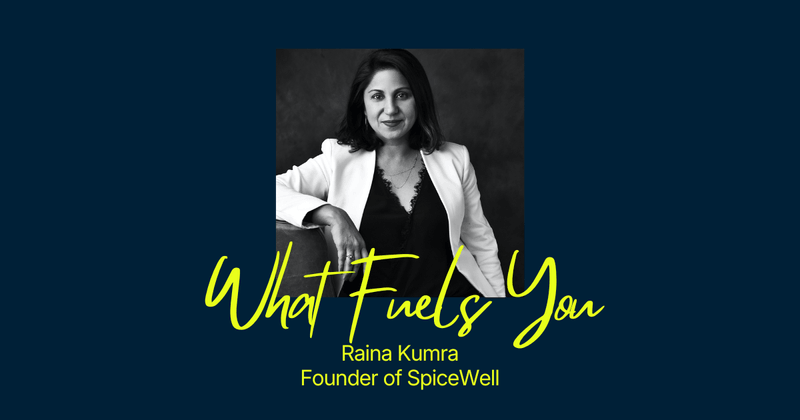
Raina Kumra, Founder of SpiceWell & Advisor to Google X
Raina Kumra has advised Google X, modernized media for the Obama administration, and launched one of the most widely-used technology ethics frameworks in the world. Then a family health crisis during the pandemic sent her back to her grandmother's Ayurvedic recipes — and accidentally started a company. In this episode, SpiceWell founder Raina Kumra joins Fuel Talent CEO Shauna Sperland to talk about growing up on a street called Utopia Place, building movements before there were fields to put them in, and why creating things that haven't existed yet is her ultimate fuel.
One afternoon in 2021, Raina Kumra brought her husband home from knee surgery -- LCL, MCL, everything replaced -- and within hours her two kids were thrown from a cargo bike. Her five-year-old daughter broke her collarbone. Her son was seven. It was the middle of the pandemic, and she was essentially alone. What came out of those first chaotic days was a decision: every single thing that went into her family's bodies would promote their healing. She went back to her grandmother's Ayurvedic recipes, layered in what she knew from Chinese medicine and nutrition, and started seasoning their meals with a dense, vegetable-packed blend she was making in her kitchen. She called it Spicebomb. Eventually, it became SpiceWell.
In this episode of What Fuels You, host Shauna Swerland sits down with Raina Kumra -- founder of SpiceWell, CEO of the transformation bureau Juggernaut, former Obama administration Senior New Media Advisor, former head of digital at Wieden+Kennedy, and creator of the Ethical OS framework at Omidyar Network -- for a conversation that covers growing up on Silicon Valley's Utopia Place, studying film at Boston University, building the internet skills that nobody else had at ad agencies in post-9/11 New York, pushing tech ethics into the mainstream before it was a field, and starting a food-as-medicine company completely by accident. The throughline across all of it is the same: take an idea from your head and make it real in the world, as fast as possible, as many times as possible.
📋 Episode Chapters
| 00:00 | Opening: what fuels Raina Kumra -- taking ideas from thought to reality |
| 01:30 | Rapid fire: morning vs. night person, Mumbai monsoons, kitchari as comfort food, and turmeric in everything |
| 05:00 | Daily wellness ritual: warm water, lemon, and salt before coffee -- and why it's dehydration, not caffeine, driving grogginess |
| 07:00 | Growing up on Utopia Place: Silicon Valley childhood, dad at Intel, the decision not to move to Seattle, and a family of entrepreneurs |
| 11:00 | Indian American identity: why immigrant families preserve a frozen snapshot of culture while India itself kept evolving |
| 14:00 | Grandmother's Ayurveda: cloves for toothaches, peppermint for upset stomachs, and blending Eastern and Western medicine at home |
| 17:00 | Creative childhood: spelling bees, classical Indian music, CalArts classes, and wanting to be a rock star in high school |
| 21:00 | Boston University to NYU Tisch: film production, documentary work, discovering the internet, and becoming one of the only people who could build a website |
| 25:00 | Advertising at Bartle Bogle Hegarty: a 9/11 Cantor Fitzgerald documentary directed by Errol Morris as the first project, and discovering that advertising can tell meaningful stories |
| 28:00 | Juggernaut and Harvard GSD: building the agency, working with Nike, Microsoft, Disney, and Burberry, and studying how screens were changing the urban environment |
| 31:00 | Obama administration and the Ethical OS: from State Department senior advisor to funding the first AI ethics frameworks at Omidyar Network |
| 35:00 | The 2021 health crisis: husband's knee surgery, a cargo bike accident, a broken collarbone, and the decision that changed everything about how Raina feeds her family |
| 38:00 | SpiceWell: 9 vegetables per half teaspoon, 6 months of formulation, Dr. Mark Hyman's endorsement, and the accidental company that grew its own legs |
| 41:00 | What fuels Raina Kumra: creating things that haven't existed, and the endless magic of taking an idea into the real world |
Utopia Place: Growing Up Where Everyone Was Tinkering in Their Garage
Raina Kumra was born in Orange County and grew up in a Silicon Valley that she describes as one that no longer exists -- a place where people were genuinely building startups out of their garages and everyone was tinkering. Her street was literally called Utopia Place, which she confirmed is still there. Her father came to the United States from India in 1974 as a newlywed engineer, first at Burroughs in Chicago, then at Howard Hughes Aircraft Company in Orange County, then at Intel -- which is how the family landed in the Bay Area. At one point Intel wanted to transfer him to Seattle. He turned it down because it was too rainy, and instead launched his own entrepreneurial venture, becoming one of the first people to build an independent wireless network in California. Her younger sister is a founder too, running an interior design business after a prior media company. The pattern, Raina said with a laugh, runs in the blood.
Raina's grandparents lived with the family, and her first languages were Hindi and Punjabi before English. Classical Indian music was part of her upbringing. She was a spelling bee kid who loved language arts, music, and the arts broadly, and was petrified of math -- a self-described liberal arts kid. Her high school crew was deeply serious about becoming artists: they took classes at CalArts, drove up to San Francisco for extra classes, and spent their time on photography and filmmaking. For a while, her plan was to be a rock star. She was in a couple of bands. She meant it.
"I grew up on a street called Utopia Place. I'm not even kidding you."
-- Raina Kumra
From Film School to the Internet: How a Documentary Filmmaker Became a Digital Pioneer
Raina headed to Boston University to study film production, choosing it specifically because she wanted to leave the West Coast -- she had clicked whatever universal application checkbox got her as far from home as possible. Once in Boston, she realized she had never actually been to the East Coast before, and that Boston was not the same as New York. She started craving New York, which was the center of everything she cared about: design, music, culture. When she finished her undergraduate program she shot a documentary for a year, came back to edit it, and discovered that all the equipment she had trained on for three years had migrated online. Her response was not to resist it. She enrolled in the Interactive Telecommunications Program at NYU's Tisch School of the Arts, which she describes as the equivalent of the MIT Media Lab for NYU -- half technology, half art.
That program made her, in her words, one of the only people in many rooms who knew how to make a website or had ever made one. That skill was the direct reason she got her first advertising job. She walked into Bartle Bogle Hegarty -- which happened to be across the street from her apartment -- as a fresh graduate with digital knowledge that the agency desperately needed. Her first project there was not a banner ad or a product campaign. It was a documentary called E! Speed, a Cantor Fitzgerald film in memoriam of the lives lost on September 11th, directed by Errol Morris. That project reframed what advertising could mean for her entirely.
"It was really meaningful. It was directed by Errol Morris. So it was just like this incredible project -- incredible first bridge into advertising where I was like, oh, it's not just selling crap, it's actually telling these really meaningful stories."
-- Raina Kumra
Juggernaut, Harvard, and the Ethics Nobody in Silicon Valley Was Talking About
After advertising, Raina launched Juggernaut, the transformation bureau she still runs today, and went back to school at Harvard's Graduate School of Design -- not to become an architect or urban planner, but to be the person bringing the digital layer into conversations about the built environment. She was watching screens multiply in New York's urban landscape and asking what that onslaught of information was doing to human brains. She considered a neuropsychology program. She chose GSD instead.
Juggernaut attracted clients including Nike, Microsoft, Disney, and Burberry. From there, Raina moved through the Obama administration as a Senior New Media Advisor at the State Department -- a shoulder tap from a friend named Katie Stanton -- and then on to co-lead innovation at the Broadcasting Board of Governors, where she spent her time dragging five legacy radio and television networks into the digital era, putting them on SoundCloud and iTunes. When she left government, she eventually landed at Omidyar Network, running a portfolio focused on technology ethics -- a field she describes as not yet existing when she arrived. Nobody at Omidyar had been funded to work on it. She and her team funded some of the first people who did. Out of that work came the Ethical OS, an eight-lens framework designed to help technology makers develop foresight about how their products could be misused or cause harm. It was free, never intended to make money, and has now been downloaded over a million times. LinkedIn turned it into a course that hundreds of people still take every month. Raina said she can see its language and framework embedded in ChatGPT's own privacy policies and ethics statements today -- without a watermark, but she knows.
"I see that language even in ChatGPT privacy policies and ethics statements. I see the language like all over, all over the place. And like, I know that I did that. I just can't tell you, like, I don't get to -- I don't have a watermark on it, you know."
-- Raina Kumra
Between government and Omidyar, she also served as CMO of a startup called Maven -- an app engagement ecosystem split between India and the US, where users on prepaid mobile plans could earn free data by downloading and sharing apps. Maven reached 5 million users and was in the process of launching an enterprise product in the US when an investor blew up a near-acquisition from Google by stepping in at the wrong moment. The company shut down despite having revenue and momentum. The lesson Raina took was direct and permanent: never put someone on the cap table you do not 100% trust.
"There are things you cannot learn in business school. You can only learn on the mean streets of Palo Alto."
-- Raina Kumra
One Afternoon in 2021: How a Family Health Crisis Created an Accidental Company
In early 2021, Raina brought her husband home from a major knee surgery -- LCL, MCL, and everything else replaced -- and within hours her two children were thrown from a cargo bike outside. Her five-year-old daughter came screaming into the house with a broken collarbone. EMTs filled the living room. Raina rushed back to the hospital with her daughter, after having spent the entire day there with her husband. It was the middle of the pandemic. She was largely on her own.
The first few days were, in her words, absolutely insane. Her son was seven. Between the two of them, they ran drinks, snacks, and hydration to a husband and daughter who could not get out of bed. And during those days, Raina made a decision. Every single minute and every ounce of food going into her family's bodies was going to promote their healing -- so that she would no longer have to take care of them. She went back to her mother's and grandmother's recipes. She drew on Ayurvedic standbys: turmeric, ginger, and dense herbal combinations. She paired those with what she knew from Chinese medicine and nutrition. She started seasoning every meal with a vegetable-heavy blend she was building in her kitchen. She called it Spicebomb. Then buyers at stores started showing interest. Then Dr. Mark Hyman tried the prototype -- a plastic baggie with a roughly printed nutritional label that a mutual friend helped connect -- and said he would support it. And what had started as a kitchen experiment grew its own legs entirely.
"I still to this day say it was an accidental company. I never set out to start a company, but there was just some demand early on. And then eventually buyers at stores were interested and Mark Hyman was interested, and it grew its own legs."
-- Raina Kumra
SpiceWell: Nine Vegetables, One Full Serving, and Half a Teaspoon
SpiceWell is Raina's food-as-medicine startup, focused on bringing everyday Ayurveda into the American diet, closing nutrient gaps, and addressing planetary health. The formulation took about six months. The goal from the start was maximum nutrient density without impacting flavor: broccoli, kale, Brussels sprouts, and broccoli sprouts in particular -- which Raina identified as even more nutrient dense than standard broccoli. She experimented with proportions until vegetables like tomato, which had been noticeably changing the taste, were dialed back enough to disappear into the seasoning rather than override it. The current formula packs nine vegetables and a full serving of vegetables into every half teaspoon. The pepper is blended with turmeric. The salt is low sodium.
Raina described her current role at SpiceWell in terms that will feel familiar to anyone who has run a scrappy early-stage company: she is CEO, chief creative director, COO, and head of communications, with some helpers along the way. The business is bootstrapped. New products are in development, including a return of the brand's most-requested item, a highly nutrient-dense taco seasoning that will also carry roughly a full serving of vegetables per packet. Former USDA Secretary Ann Veneman was the company's first advisor. The listener discount code for the episode is WHATFUELSYOU for 25% off at spicewell.com.
"I think I wouldn't have started this business if I knew this business really well. So I think you have to have just a little bit of, a little bit more wonder and excitement rather than deep knowledge about what you're entering into in order to crack through and make something new in that category."
-- Raina Kumra
5 Key Takeaways
Frequently Asked Questions
What is SpiceWell and how did Raina Kumra start it?
SpiceWell is a food-as-medicine startup founded by Raina Kumra that focuses on bringing everyday Ayurveda into the American diet by packing nine vegetables and a full serving of vegetables into every half teaspoon of seasoning. Kumra described it as an accidental company: she created the first blend in her kitchen during the pandemic while caring for her husband recovering from knee surgery and her daughter who had broken her collarbone in a cargo bike accident. She was determined that every meal she fed her family would promote healing. Early retail buyer interest and an endorsement from Dr. Mark Hyman -- who tried a prototype from a plastic baggie Kumra handed him -- helped the product grow into a company on its own.
What is the Ethical OS and who created it?
The Ethical OS is a free framework created by Raina Kumra during her time at Omidyar Network, designed to help technology makers evaluate products through eight different lenses before shipping -- asking questions like what happens if this gets into harmful hands or how it could impact vulnerable populations. Kumra said the framework was built before AI ethics was a recognized field, and that Omidyar funded some of the first researchers working on these questions. The Ethical OS has been downloaded over a million times and turned into a LinkedIn Learning course used hundreds of times a month. Kumra noted that its language and framework now appear in ChatGPT's own ethics and privacy documentation.
What did Raina Kumra learn from the failure of Maven?
Maven was a mobile app engagement startup that operated in India and the US, rewarding users on prepaid plans with free data for downloading and sharing apps. The company reached 5 million users, had revenue, and was mid-launch on a US enterprise product when an investor stepped in and blocked a near-acquisition from Google, leading to the company's shutdown. Kumra said the lesson was permanent: "never going to repeat, like putting someone on the cap table that I don't 100% trust." She described it as a lesson available only on "the mean streets of Palo Alto," not in any business school.
What is Raina Kumra's view on what makes a successful entrepreneur?
Kumra said she believes too much industry knowledge can actually prevent founders from breaking into a category and making something genuinely new. She described the right starting position as having "a little bit more wonder and excitement rather than deep knowledge about what you're entering into." Beyond that, she said entrepreneurship fundamentally comes down to being organized and being intentional about where every dollar goes and what it is doing for the business. Risk appetite, she added, also has to be present -- you cannot take a leap like founding a company without it.
What did Raina Kumra do in the Obama administration and at Omidyar Network?
Kumra served as a Senior New Media Advisor at the U.S. State Department during the Obama administration, a role she described as a shoulder tap from a friend who had recently left Google. She subsequently co-led innovation at the Broadcasting Board of Governors, modernizing five legacy radio and television networks and placing them on platforms like SoundCloud and iTunes. At Omidyar Network, she led a portfolio focused on technology ethics, funding some of the first researchers in the field before AI ethics was a recognized discipline, and creating the Ethical OS framework that has since been downloaded more than a million times.
From Tech to Turmeric: Raina Kumra's Fuel for Innovation
Raina Kumra, Founder of SpiceWell & Advisor to Google X
Raina Kumra has advised Google X, modernized media for the Obama administration, and launched one of the most widely-used technology ethics frameworks in the world. Then a family health crisis during the pandemic sent her back to her grandmother's Ayurvedic recipes — and accidentally started a company. In this episode, SpiceWell founder Raina Kumra joins Fuel Talent CEO Shauna Sperland to talk about growing up on a street called Utopia Place, building movements before there were fields to put them in, and why creating things that haven't existed yet is her ultimate fuel.
One afternoon in 2021, Raina Kumra brought her husband home from knee surgery -- LCL, MCL, everything replaced -- and within hours her two kids were thrown from a cargo bike. Her five-year-old daughter broke her collarbone. Her son was seven. It was the middle of the pandemic, and she was essentially alone. What came out of those first chaotic days was a decision: every single thing that went into her family's bodies would promote their healing. She went back to her grandmother's Ayurvedic recipes, layered in what she knew from Chinese medicine and nutrition, and started seasoning their meals with a dense, vegetable-packed blend she was making in her kitchen. She called it Spicebomb. Eventually, it became SpiceWell.
In this episode of What Fuels You, host Shauna Swerland sits down with Raina Kumra -- founder of SpiceWell, CEO of the transformation bureau Juggernaut, former Obama administration Senior New Media Advisor, former head of digital at Wieden+Kennedy, and creator of the Ethical OS framework at Omidyar Network -- for a conversation that covers growing up on Silicon Valley's Utopia Place, studying film at Boston University, building the internet skills that nobody else had at ad agencies in post-9/11 New York, pushing tech ethics into the mainstream before it was a field, and starting a food-as-medicine company completely by accident. The throughline across all of it is the same: take an idea from your head and make it real in the world, as fast as possible, as many times as possible.
📋 Episode Chapters
| 00:00 | Opening: what fuels Raina Kumra -- taking ideas from thought to reality |
| 01:30 | Rapid fire: morning vs. night person, Mumbai monsoons, kitchari as comfort food, and turmeric in everything |
| 05:00 | Daily wellness ritual: warm water, lemon, and salt before coffee -- and why it's dehydration, not caffeine, driving grogginess |
| 07:00 | Growing up on Utopia Place: Silicon Valley childhood, dad at Intel, the decision not to move to Seattle, and a family of entrepreneurs |
| 11:00 | Indian American identity: why immigrant families preserve a frozen snapshot of culture while India itself kept evolving |
| 14:00 | Grandmother's Ayurveda: cloves for toothaches, peppermint for upset stomachs, and blending Eastern and Western medicine at home |
| 17:00 | Creative childhood: spelling bees, classical Indian music, CalArts classes, and wanting to be a rock star in high school |
| 21:00 | Boston University to NYU Tisch: film production, documentary work, discovering the internet, and becoming one of the only people who could build a website |
| 25:00 | Advertising at Bartle Bogle Hegarty: a 9/11 Cantor Fitzgerald documentary directed by Errol Morris as the first project, and discovering that advertising can tell meaningful stories |
| 28:00 | Juggernaut and Harvard GSD: building the agency, working with Nike, Microsoft, Disney, and Burberry, and studying how screens were changing the urban environment |
| 31:00 | Obama administration and the Ethical OS: from State Department senior advisor to funding the first AI ethics frameworks at Omidyar Network |
| 35:00 | The 2021 health crisis: husband's knee surgery, a cargo bike accident, a broken collarbone, and the decision that changed everything about how Raina feeds her family |
| 38:00 | SpiceWell: 9 vegetables per half teaspoon, 6 months of formulation, Dr. Mark Hyman's endorsement, and the accidental company that grew its own legs |
| 41:00 | What fuels Raina Kumra: creating things that haven't existed, and the endless magic of taking an idea into the real world |
Utopia Place: Growing Up Where Everyone Was Tinkering in Their Garage
Raina Kumra was born in Orange County and grew up in a Silicon Valley that she describes as one that no longer exists -- a place where people were genuinely building startups out of their garages and everyone was tinkering. Her street was literally called Utopia Place, which she confirmed is still there. Her father came to the United States from India in 1974 as a newlywed engineer, first at Burroughs in Chicago, then at Howard Hughes Aircraft Company in Orange County, then at Intel -- which is how the family landed in the Bay Area. At one point Intel wanted to transfer him to Seattle. He turned it down because it was too rainy, and instead launched his own entrepreneurial venture, becoming one of the first people to build an independent wireless network in California. Her younger sister is a founder too, running an interior design business after a prior media company. The pattern, Raina said with a laugh, runs in the blood.
Raina's grandparents lived with the family, and her first languages were Hindi and Punjabi before English. Classical Indian music was part of her upbringing. She was a spelling bee kid who loved language arts, music, and the arts broadly, and was petrified of math -- a self-described liberal arts kid. Her high school crew was deeply serious about becoming artists: they took classes at CalArts, drove up to San Francisco for extra classes, and spent their time on photography and filmmaking. For a while, her plan was to be a rock star. She was in a couple of bands. She meant it.
"I grew up on a street called Utopia Place. I'm not even kidding you."
-- Raina Kumra
From Film School to the Internet: How a Documentary Filmmaker Became a Digital Pioneer
Raina headed to Boston University to study film production, choosing it specifically because she wanted to leave the West Coast -- she had clicked whatever universal application checkbox got her as far from home as possible. Once in Boston, she realized she had never actually been to the East Coast before, and that Boston was not the same as New York. She started craving New York, which was the center of everything she cared about: design, music, culture. When she finished her undergraduate program she shot a documentary for a year, came back to edit it, and discovered that all the equipment she had trained on for three years had migrated online. Her response was not to resist it. She enrolled in the Interactive Telecommunications Program at NYU's Tisch School of the Arts, which she describes as the equivalent of the MIT Media Lab for NYU -- half technology, half art.
That program made her, in her words, one of the only people in many rooms who knew how to make a website or had ever made one. That skill was the direct reason she got her first advertising job. She walked into Bartle Bogle Hegarty -- which happened to be across the street from her apartment -- as a fresh graduate with digital knowledge that the agency desperately needed. Her first project there was not a banner ad or a product campaign. It was a documentary called E! Speed, a Cantor Fitzgerald film in memoriam of the lives lost on September 11th, directed by Errol Morris. That project reframed what advertising could mean for her entirely.
"It was really meaningful. It was directed by Errol Morris. So it was just like this incredible project -- incredible first bridge into advertising where I was like, oh, it's not just selling crap, it's actually telling these really meaningful stories."
-- Raina Kumra
Juggernaut, Harvard, and the Ethics Nobody in Silicon Valley Was Talking About
After advertising, Raina launched Juggernaut, the transformation bureau she still runs today, and went back to school at Harvard's Graduate School of Design -- not to become an architect or urban planner, but to be the person bringing the digital layer into conversations about the built environment. She was watching screens multiply in New York's urban landscape and asking what that onslaught of information was doing to human brains. She considered a neuropsychology program. She chose GSD instead.
Juggernaut attracted clients including Nike, Microsoft, Disney, and Burberry. From there, Raina moved through the Obama administration as a Senior New Media Advisor at the State Department -- a shoulder tap from a friend named Katie Stanton -- and then on to co-lead innovation at the Broadcasting Board of Governors, where she spent her time dragging five legacy radio and television networks into the digital era, putting them on SoundCloud and iTunes. When she left government, she eventually landed at Omidyar Network, running a portfolio focused on technology ethics -- a field she describes as not yet existing when she arrived. Nobody at Omidyar had been funded to work on it. She and her team funded some of the first people who did. Out of that work came the Ethical OS, an eight-lens framework designed to help technology makers develop foresight about how their products could be misused or cause harm. It was free, never intended to make money, and has now been downloaded over a million times. LinkedIn turned it into a course that hundreds of people still take every month. Raina said she can see its language and framework embedded in ChatGPT's own privacy policies and ethics statements today -- without a watermark, but she knows.
"I see that language even in ChatGPT privacy policies and ethics statements. I see the language like all over, all over the place. And like, I know that I did that. I just can't tell you, like, I don't get to -- I don't have a watermark on it, you know."
-- Raina Kumra
Between government and Omidyar, she also served as CMO of a startup called Maven -- an app engagement ecosystem split between India and the US, where users on prepaid mobile plans could earn free data by downloading and sharing apps. Maven reached 5 million users and was in the process of launching an enterprise product in the US when an investor blew up a near-acquisition from Google by stepping in at the wrong moment. The company shut down despite having revenue and momentum. The lesson Raina took was direct and permanent: never put someone on the cap table you do not 100% trust.
"There are things you cannot learn in business school. You can only learn on the mean streets of Palo Alto."
-- Raina Kumra
One Afternoon in 2021: How a Family Health Crisis Created an Accidental Company
In early 2021, Raina brought her husband home from a major knee surgery -- LCL, MCL, and everything else replaced -- and within hours her two children were thrown from a cargo bike outside. Her five-year-old daughter came screaming into the house with a broken collarbone. EMTs filled the living room. Raina rushed back to the hospital with her daughter, after having spent the entire day there with her husband. It was the middle of the pandemic. She was largely on her own.
The first few days were, in her words, absolutely insane. Her son was seven. Between the two of them, they ran drinks, snacks, and hydration to a husband and daughter who could not get out of bed. And during those days, Raina made a decision. Every single minute and every ounce of food going into her family's bodies was going to promote their healing -- so that she would no longer have to take care of them. She went back to her mother's and grandmother's recipes. She drew on Ayurvedic standbys: turmeric, ginger, and dense herbal combinations. She paired those with what she knew from Chinese medicine and nutrition. She started seasoning every meal with a vegetable-heavy blend she was building in her kitchen. She called it Spicebomb. Then buyers at stores started showing interest. Then Dr. Mark Hyman tried the prototype -- a plastic baggie with a roughly printed nutritional label that a mutual friend helped connect -- and said he would support it. And what had started as a kitchen experiment grew its own legs entirely.
"I still to this day say it was an accidental company. I never set out to start a company, but there was just some demand early on. And then eventually buyers at stores were interested and Mark Hyman was interested, and it grew its own legs."
-- Raina Kumra
SpiceWell: Nine Vegetables, One Full Serving, and Half a Teaspoon
SpiceWell is Raina's food-as-medicine startup, focused on bringing everyday Ayurveda into the American diet, closing nutrient gaps, and addressing planetary health. The formulation took about six months. The goal from the start was maximum nutrient density without impacting flavor: broccoli, kale, Brussels sprouts, and broccoli sprouts in particular -- which Raina identified as even more nutrient dense than standard broccoli. She experimented with proportions until vegetables like tomato, which had been noticeably changing the taste, were dialed back enough to disappear into the seasoning rather than override it. The current formula packs nine vegetables and a full serving of vegetables into every half teaspoon. The pepper is blended with turmeric. The salt is low sodium.
Raina described her current role at SpiceWell in terms that will feel familiar to anyone who has run a scrappy early-stage company: she is CEO, chief creative director, COO, and head of communications, with some helpers along the way. The business is bootstrapped. New products are in development, including a return of the brand's most-requested item, a highly nutrient-dense taco seasoning that will also carry roughly a full serving of vegetables per packet. Former USDA Secretary Ann Veneman was the company's first advisor. The listener discount code for the episode is WHATFUELSYOU for 25% off at spicewell.com.
"I think I wouldn't have started this business if I knew this business really well. So I think you have to have just a little bit of, a little bit more wonder and excitement rather than deep knowledge about what you're entering into in order to crack through and make something new in that category."
-- Raina Kumra
5 Key Takeaways
Frequently Asked Questions
What is SpiceWell and how did Raina Kumra start it?
SpiceWell is a food-as-medicine startup founded by Raina Kumra that focuses on bringing everyday Ayurveda into the American diet by packing nine vegetables and a full serving of vegetables into every half teaspoon of seasoning. Kumra described it as an accidental company: she created the first blend in her kitchen during the pandemic while caring for her husband recovering from knee surgery and her daughter who had broken her collarbone in a cargo bike accident. She was determined that every meal she fed her family would promote healing. Early retail buyer interest and an endorsement from Dr. Mark Hyman -- who tried a prototype from a plastic baggie Kumra handed him -- helped the product grow into a company on its own.
What is the Ethical OS and who created it?
The Ethical OS is a free framework created by Raina Kumra during her time at Omidyar Network, designed to help technology makers evaluate products through eight different lenses before shipping -- asking questions like what happens if this gets into harmful hands or how it could impact vulnerable populations. Kumra said the framework was built before AI ethics was a recognized field, and that Omidyar funded some of the first researchers working on these questions. The Ethical OS has been downloaded over a million times and turned into a LinkedIn Learning course used hundreds of times a month. Kumra noted that its language and framework now appear in ChatGPT's own ethics and privacy documentation.
What did Raina Kumra learn from the failure of Maven?
Maven was a mobile app engagement startup that operated in India and the US, rewarding users on prepaid plans with free data for downloading and sharing apps. The company reached 5 million users, had revenue, and was mid-launch on a US enterprise product when an investor stepped in and blocked a near-acquisition from Google, leading to the company's shutdown. Kumra said the lesson was permanent: "never going to repeat, like putting someone on the cap table that I don't 100% trust." She described it as a lesson available only on "the mean streets of Palo Alto," not in any business school.
What is Raina Kumra's view on what makes a successful entrepreneur?
Kumra said she believes too much industry knowledge can actually prevent founders from breaking into a category and making something genuinely new. She described the right starting position as having "a little bit more wonder and excitement rather than deep knowledge about what you're entering into." Beyond that, she said entrepreneurship fundamentally comes down to being organized and being intentional about where every dollar goes and what it is doing for the business. Risk appetite, she added, also has to be present -- you cannot take a leap like founding a company without it.
What did Raina Kumra do in the Obama administration and at Omidyar Network?
Kumra served as a Senior New Media Advisor at the U.S. State Department during the Obama administration, a role she described as a shoulder tap from a friend who had recently left Google. She subsequently co-led innovation at the Broadcasting Board of Governors, modernizing five legacy radio and television networks and placing them on platforms like SoundCloud and iTunes. At Omidyar Network, she led a portfolio focused on technology ethics, funding some of the first researchers in the field before AI ethics was a recognized discipline, and creating the Ethical OS framework that has since been downloaded more than a million times.