

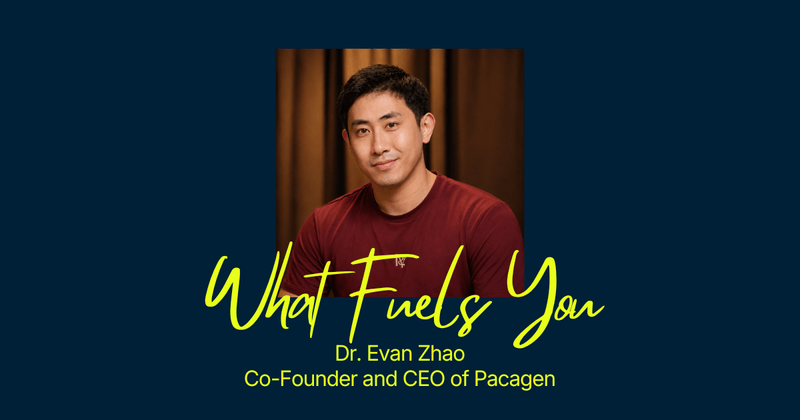
Evan Zhao - Co-Founder and CEO of Pacagen
He spent two years as chief science officer at a beauty company doing $600 million a year, watched it IPO two months after he joined, then walked away to start over with a company that sprays alpaca-inspired proteins on cats.
In this episode of What Fuels You, host Shauna Swerland sits down with Dr. Evan Zhao, Co-Founder and CEO of Pacagen, for a conversation that covers Revela, Oddity's IPO, ADHD as an operating style, and a lesson from Costco's co-founder about why companies should never parachute in leadership from outside. Underneath all of it is a founder who says money was never the point, beating the companies he thinks have gotten lazy is.
📋 Episode Chapters
| 00:00 | Introducing Dr. Evan Zhao, from Chief Science Officer at Oddity to founding Pacagen |
| 04:00 | Rapid fire: Sherlock Holmes, biggest pet peeve, and why he hates when candidates say "strategy" |
| 09:00 | An ADHD diagnosis in college and using it as an operating style, not an excuse |
| 15:00 | Growing up between Beijing and Buffalo, and choosing football friends over getting bullied |
| 28:00 | Caltech, a PhD in chemical engineering at Princeton, and controlling chemical production with light |
| 40:00 | Becoming a Schmidt Science Fellow and meeting a mentor who is the former CFO of Google |
| 48:00 | Meeting his co-founder David at McDonald's during COVID and starting Revela |
| 54:00 | Turning down beauty industry buyers and building Revela to $50 million in revenue |
| 59:00 | Life as Oddity's Chief Science Officer through its IPO |
| 64:00 | Founding Pacagen and neutralizing pet allergens with alpaca-inspired protein technology |
| 68:00 | A dinner with Costco co-founder Jim Sinegal and a lesson about never airdropping in leadership |
| 71:00 | What fuels Dr. Evan Zhao |
From Princeton Optogenetics to a Chance Meeting at McDonald's
Evan Zhao earned his PhD in chemical engineering at Princeton, working on a form of synthetic biology that used light to control when engineered bacteria produced chemicals instead of simply growing. That research led him to a Schmidt Science Fellowship at the Wyss Institute at Harvard, working under Dr. James Collins, and to a mentor relationship with Patrick Pichette, the former chief financial officer of Google, who had asked him a question during his fellowship interview that stuck with him: why was he doing this work in academia instead of industry.
He met his eventual co-founder, David, the same way most founding stories do not start: at McDonald's, during the early months of COVID, when it was one of the only places open for lunch near their lab.
"I would always say my biggest strength is I always ask why not."
-- Dr. Evan Zhao
Turning Down Beauty Industry Buyers and Building Revela to $50 Million
Zhao and David originally planned to license their biotechnology to existing beauty companies. Mentors told them that path would not work, that beauty companies would rather market old ingredients as new than pay real money for genuine innovation. So they built their own brand instead: Revela, a hair thinning serum built around a molecule they discovered, sold direct to consumer starting in December 2022 at $98 a bottle.
"We decided to start our own brand because it was almost like no other option."
-- Dr. Evan Zhao
By the time Oddity acquired the company, Revela was generating roughly $50 million a year at 25 percent margins.
"We were doing around $50 million a year."
-- Dr. Evan Zhao
Two Months to IPO as Oddity's Chief Science Officer
Oddity acquired Revela primarily for its discovery technology, and Zhao and David joined as employees rather than continuing to run their own brand. Zhao became Chief Science Officer, and the company went public roughly two months after he joined, a compressed timeline that gave him a fast education in what it means to run a lab inside a public company.
"It kind of sucks being a public company."
-- Dr. Evan Zhao
Two years later, he and David left to start something of their own again, this time outside beauty entirely.
Founding Pacagen and Betting on Pet Allergens
About a year and a half after joining Oddity, Zhao and David left to start Pacagen, applying the same targeted protein technology they had used in beauty to a different problem: pet allergens. The company's sprays are built around a technology inspired by antibodies found in alpacas, which gives the company its name, PACA, for alpaca, plus Gen, for generated.
Zhao funded the company by returning to his old investor base from Revela, then brought on Maveron, the consumer-focused fund founded by Howard Schultz, with Jason Stoffer and Jerry Lu on the Pacagen relationship, and Digitalis Ventures, which invests in animal health in partnership with Mars Petcare. Pacagen has raised roughly $30 million and currently has 20 active research and development projects running at once, most of which will not make it to launch.
"I almost exclusively work on recruiting and training talent."
-- Dr. Evan Zhao
A Dinner With Jim Sinegal and a Lesson About Airdropping in Leadership
One of the more concrete lessons Zhao brought back from his investor network came from a dinner with Costco co-founder Jim Sinegal, arranged before Revela launched. Zhao pressed his team to get him a seat at the table, and what he took away was less about Costco's margins than about how the company treats its people. Sinegal told the group that when Costco has to close a warehouse, it works to place employees in other roles rather than laying them off, and that the company avoids bringing in outside leadership over teams that have been with the company for years.
"You should never airdrop in leadership."
-- Dr. Evan Zhao
Zhao said the lesson reshaped how he thinks about his own team at Pacagen: if he wants loyalty, his job is to make sure the people already there can become the company's next leaders.
What Fuels a Founder Who Wants to Keep Companies Up at Night
Zhao said the financial outcome of Revela was never the real driver for him. What motivates him is a belief that large, established companies have stopped innovating because they have no incentive to disrupt their own business, and that consumers are the ones paying for it. He compares the moment to where the auto industry stood before Tesla: the technology to build electric vehicles already existed, but no legacy manufacturer had a reason to be the one to cannibalize its own sales.
"I would love to make some of these large companies lose sleep."
-- Dr. Evan Zhao
5 Key Takeaways
Frequently Asked Questions
Who is Evan Zhao and what is Pacagen?
Dr. Evan Zhao is the Co-Founder and CEO of Pacagen, a biotechnology company that makes sprays to neutralize pet allergens using technology inspired by proteins found in alpacas. He previously co-founded and sold Revela to Oddity, where he then served as Chief Science Officer through the company's IPO.
What did Evan Zhao say about building Revela?
Zhao said he and his co-founder built Revela into a direct-to-consumer beauty brand after mentors told them beauty companies would not pay real money for genuinely new ingredients. He said the company was generating around $50 million a year at 25 percent margins before it was acquired by Oddity.
What did Evan Zhao learn from Costco co-founder Jim Sinegal?
Zhao said Sinegal told him that Costco avoids installing outside leaders over teams that have already been with the company for years, which Sinegal credited as a key reason for Costco's low turnover. Zhao said the lesson is that you cannot expect loyalty from your team if you do not build a path for them to lead.
How did Evan Zhao's ADHD diagnosis shape how he works?
Zhao was diagnosed with ADHD in college and said he mostly uses it as a way of pushing people to communicate faster and more directly with him. He described himself as someone who tracks many things at once and gets to the bottom line quickly rather than working through long, linear explanations.
What is Evan Zhao's view on why he started Pacagen?
Zhao said his motivation is not primarily financial. He said he wants to build companies that force larger, established competitors to lose market share and innovate, describing it as similar to what Tesla did to legacy car manufacturers that already knew how to build electric vehicles but had no incentive to do so.
Evan Zhao - Co-Founder and CEO of Pacagen
He spent two years as chief science officer at a beauty company doing $600 million a year, watched it IPO two months after he joined, then walked away to start over with a company that sprays alpaca-inspired proteins on cats.
In this episode of What Fuels You, host Shauna Swerland sits down with Dr. Evan Zhao, Co-Founder and CEO of Pacagen, for a conversation that covers Revela, Oddity's IPO, ADHD as an operating style, and a lesson from Costco's co-founder about why companies should never parachute in leadership from outside. Underneath all of it is a founder who says money was never the point, beating the companies he thinks have gotten lazy is.
📋 Episode Chapters
| 00:00 | Introducing Dr. Evan Zhao, from Chief Science Officer at Oddity to founding Pacagen |
| 04:00 | Rapid fire: Sherlock Holmes, biggest pet peeve, and why he hates when candidates say "strategy" |
| 09:00 | An ADHD diagnosis in college and using it as an operating style, not an excuse |
| 15:00 | Growing up between Beijing and Buffalo, and choosing football friends over getting bullied |
| 28:00 | Caltech, a PhD in chemical engineering at Princeton, and controlling chemical production with light |
| 40:00 | Becoming a Schmidt Science Fellow and meeting a mentor who is the former CFO of Google |
| 48:00 | Meeting his co-founder David at McDonald's during COVID and starting Revela |
| 54:00 | Turning down beauty industry buyers and building Revela to $50 million in revenue |
| 59:00 | Life as Oddity's Chief Science Officer through its IPO |
| 64:00 | Founding Pacagen and neutralizing pet allergens with alpaca-inspired protein technology |
| 68:00 | A dinner with Costco co-founder Jim Sinegal and a lesson about never airdropping in leadership |
| 71:00 | What fuels Dr. Evan Zhao |
From Princeton Optogenetics to a Chance Meeting at McDonald's
Evan Zhao earned his PhD in chemical engineering at Princeton, working on a form of synthetic biology that used light to control when engineered bacteria produced chemicals instead of simply growing. That research led him to a Schmidt Science Fellowship at the Wyss Institute at Harvard, working under Dr. James Collins, and to a mentor relationship with Patrick Pichette, the former chief financial officer of Google, who had asked him a question during his fellowship interview that stuck with him: why was he doing this work in academia instead of industry.
He met his eventual co-founder, David, the same way most founding stories do not start: at McDonald's, during the early months of COVID, when it was one of the only places open for lunch near their lab.
"I would always say my biggest strength is I always ask why not."
-- Dr. Evan Zhao
Turning Down Beauty Industry Buyers and Building Revela to $50 Million
Zhao and David originally planned to license their biotechnology to existing beauty companies. Mentors told them that path would not work, that beauty companies would rather market old ingredients as new than pay real money for genuine innovation. So they built their own brand instead: Revela, a hair thinning serum built around a molecule they discovered, sold direct to consumer starting in December 2022 at $98 a bottle.
"We decided to start our own brand because it was almost like no other option."
-- Dr. Evan Zhao
By the time Oddity acquired the company, Revela was generating roughly $50 million a year at 25 percent margins.
"We were doing around $50 million a year."
-- Dr. Evan Zhao
Two Months to IPO as Oddity's Chief Science Officer
Oddity acquired Revela primarily for its discovery technology, and Zhao and David joined as employees rather than continuing to run their own brand. Zhao became Chief Science Officer, and the company went public roughly two months after he joined, a compressed timeline that gave him a fast education in what it means to run a lab inside a public company.
"It kind of sucks being a public company."
-- Dr. Evan Zhao
Two years later, he and David left to start something of their own again, this time outside beauty entirely.
Founding Pacagen and Betting on Pet Allergens
About a year and a half after joining Oddity, Zhao and David left to start Pacagen, applying the same targeted protein technology they had used in beauty to a different problem: pet allergens. The company's sprays are built around a technology inspired by antibodies found in alpacas, which gives the company its name, PACA, for alpaca, plus Gen, for generated.
Zhao funded the company by returning to his old investor base from Revela, then brought on Maveron, the consumer-focused fund founded by Howard Schultz, with Jason Stoffer and Jerry Lu on the Pacagen relationship, and Digitalis Ventures, which invests in animal health in partnership with Mars Petcare. Pacagen has raised roughly $30 million and currently has 20 active research and development projects running at once, most of which will not make it to launch.
"I almost exclusively work on recruiting and training talent."
-- Dr. Evan Zhao
A Dinner With Jim Sinegal and a Lesson About Airdropping in Leadership
One of the more concrete lessons Zhao brought back from his investor network came from a dinner with Costco co-founder Jim Sinegal, arranged before Revela launched. Zhao pressed his team to get him a seat at the table, and what he took away was less about Costco's margins than about how the company treats its people. Sinegal told the group that when Costco has to close a warehouse, it works to place employees in other roles rather than laying them off, and that the company avoids bringing in outside leadership over teams that have been with the company for years.
"You should never airdrop in leadership."
-- Dr. Evan Zhao
Zhao said the lesson reshaped how he thinks about his own team at Pacagen: if he wants loyalty, his job is to make sure the people already there can become the company's next leaders.
What Fuels a Founder Who Wants to Keep Companies Up at Night
Zhao said the financial outcome of Revela was never the real driver for him. What motivates him is a belief that large, established companies have stopped innovating because they have no incentive to disrupt their own business, and that consumers are the ones paying for it. He compares the moment to where the auto industry stood before Tesla: the technology to build electric vehicles already existed, but no legacy manufacturer had a reason to be the one to cannibalize its own sales.
"I would love to make some of these large companies lose sleep."
-- Dr. Evan Zhao
5 Key Takeaways
Frequently Asked Questions
Who is Evan Zhao and what is Pacagen?
Dr. Evan Zhao is the Co-Founder and CEO of Pacagen, a biotechnology company that makes sprays to neutralize pet allergens using technology inspired by proteins found in alpacas. He previously co-founded and sold Revela to Oddity, where he then served as Chief Science Officer through the company's IPO.
What did Evan Zhao say about building Revela?
Zhao said he and his co-founder built Revela into a direct-to-consumer beauty brand after mentors told them beauty companies would not pay real money for genuinely new ingredients. He said the company was generating around $50 million a year at 25 percent margins before it was acquired by Oddity.
What did Evan Zhao learn from Costco co-founder Jim Sinegal?
Zhao said Sinegal told him that Costco avoids installing outside leaders over teams that have already been with the company for years, which Sinegal credited as a key reason for Costco's low turnover. Zhao said the lesson is that you cannot expect loyalty from your team if you do not build a path for them to lead.
How did Evan Zhao's ADHD diagnosis shape how he works?
Zhao was diagnosed with ADHD in college and said he mostly uses it as a way of pushing people to communicate faster and more directly with him. He described himself as someone who tracks many things at once and gets to the bottom line quickly rather than working through long, linear explanations.
What is Evan Zhao's view on why he started Pacagen?
Zhao said his motivation is not primarily financial. He said he wants to build companies that force larger, established competitors to lose market share and innovate, describing it as similar to what Tesla did to legacy car manufacturers that already knew how to build electric vehicles but had no incentive to do so.