

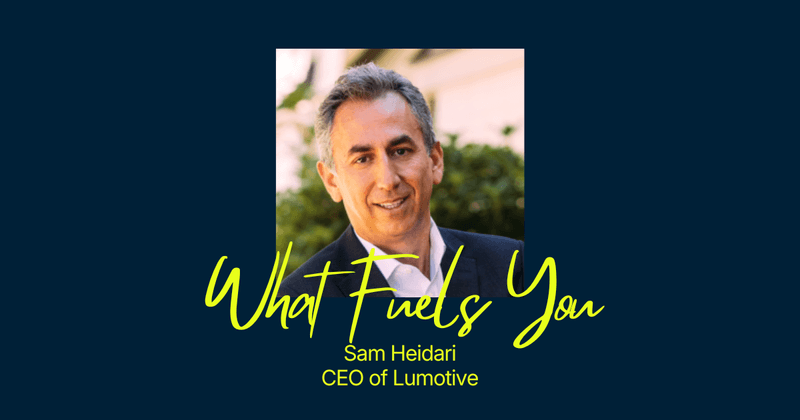
CEO of Lumotive
He left Iran at 17, alone, during the Iran-Iraq War, writing one letter home per week and waking at 4 a.m. to dial a phone line for ninety minutes in hopes of reaching his family for five minutes. Decades later he took a Wi-Fi semiconductor startup from near-zero revenue to $220 million in sales, an IPO on Nasdaq, and a $1.1 billion acquisition. Then he turned down every subsequent CEO offer he received, decided he was done with startups, and took a startup job anyway because a Redmond, Washington company was doing something that, in 30 years of working in the industry, he had never seen anyone crack: controlling light electronically, with no moving parts, at semiconductor scale.
In this episode of What Fuels You, host Shauna Swerland sits down with Dr. Sam Heidari, CEO of Lumotive, for a conversation that covers growing up by the Caspian Sea, the ant-to-mouse-to-lion framework he used to think about competitive survival at Quantenna Communications, why he fired multiple executive coaches before one finally got through to him, what it means to find a win-win in a negotiation when the relationship will last for years, and what sense of responsibility actually gets him out of bed every morning.
📋 Episode Chapters
| 00:00 | Opening: sense of responsibility, making the most of every hour, and the daily fuel that drives a founder-CEO |
| 02:00 | Rapid fire: bucket list travel to Africa and Central Asia, Pink Floyd as a life philosophy, setting personal bars rather than competing with others |
| 06:30 | What he is proud of: raising his kids to be better people over making money, and a personal mission around children globally he prefers not to discuss publicly |
| 09:30 | Leaving Iran alone at 17 during the Iran-Iraq War: writing letters that took two weeks to arrive, dialing home at 4 a.m. for 90 minutes to get 5 minutes of connection |
| 14:00 | Childhood in Gilan province and Tehran: summers on the Caspian Sea, a community built on his father's peer network, and how Iranian culture values something bigger than yourself |
| 18:00 | Why he almost became a medical doctor: the uncle who told him to get an engineering degree first as a fallback, and how events turned that detour into a 30-year career |
| 22:00 | American vs. Iranian education: why Iranian schooling was richer in knowledge but thin on thinking methods, and what he most appreciated about learning to connect the dots analytically |
| 25:30 | First job out of his PhD: hired as lead systems engineer for a satellite startup with two questions, "What is a systems engineer?" and "What is a satellite?" |
| 29:00 | Who belongs in a startup: the ant-mouse-lion survival framework, why lifestyle fit matters more than salary, and what makes startup culture genuinely different from big company politics |
| 33:00 | Quantenna Communications: joining as VP of Engineering into a company in turmoil, raising his hand as interim CEO, taking it from near-zero revenue to $220M and a $1.1B exit |
| 38:00 | The executive coaches he fired: why recipe-based leadership advice failed him, and the one coach who finally cut through with a single question about his core values |
| 42:00 | Why he joined Lumotive after vowing never to do another startup: the difference between better design and a paradigm shift, and why mechanical light control is the Flintstones of optics |
| 46:30 | Lumotive's technology and customers: LCM chips in production, Hokuyo in Japan, customers in Korea and Saudi Arabia, and Bill Gates as the largest individual investor |
| 50:00 | What fuels Sam Heidari: the word "fair" over "nice," a sense of responsibility to every person he has made a commitment to, and a longer-horizon mission around children globally |
From the Caspian Sea to California: Leaving Iran Alone at 17
Sam Heidari grew up in the province of Gilan in northern Iran, a community built around his father's peer group, with summers spent thirty minutes from the Caspian Sea at his grandparents' place near the beach. It was, by his own account, a genuinely good childhood: bicycles, swimming pools, the particular texture of growing up in a tight-knit neighborhood where everyone knew everyone. The family later moved to Tehran for his final three years before emigrating. Iran at the time had a culture that prized education deeply, and something else he found harder to name precisely but returned to several times in the conversation: the idea that life is more than just about you, that what you do for other people is what makes a difference. He was brought up, he says, in a business world but raised with values that pointed somewhere beyond making money.
In 1979, the Islamic Revolution reshaped Iran. By the early 1980s, the Iran-Iraq War was underway. At 17, facing the prospect of military conscription at 18, Sam left for the United States to finish his last year of high school, staying with two uncles in Northern California. His parents and brother stayed behind. Communication was reduced to letters written once a week that took another week or two to arrive. On bad weeks, when the war intensified and phone lines were unreliable, he would wake at 4 a.m. and spend ninety minutes dialing, over and over, for the chance at a five-minute conversation with his family. He was, by his own description, a deeply introverted kid who had been accustomed to the stability of home. Adjusting to a new country alone was hard. The harder part was the uncertainty of what was happening on the other side of a phone line he could rarely reach.
"There were times that things at the war got really bad and the communication was hard and I would get up at 4am and dial the phone many times for like an hour and a half at 3am because that was the best way to get through to have like a 5 minutes conversation with my folks back home."
-- Dr. Sam Heidari
His uncle in California was a medical doctor, and Sam arrived planning to follow that path. When his uncle explained that American medical school required a bachelor's degree first, Sam asked what degree would be safest to get if he did not make it into medicine. The uncle suggested engineering: engineers could find work regardless. So Sam enrolled in electrical engineering at Northeastern University, intending it as a stepping stone to medical school. Engineering took over. The stepping stone became the path.
The Analytical Mind in a Business World: What Engineering Actually Teaches You About Leading People
Sam earned his MS and PhD in electrical engineering from the University of Southern California, and by the time he finished, he had developed a specific view about what education had actually given him versus what it had withheld. His Iranian schooling was extraordinarily rich in content, he says, significantly more knowledge per year than what American higher education delivered. What American education gave him in return was something different and, in his estimation, ultimately more valuable: a structured way of thinking. Not what to know, but how to connect what you know to problems that do not come with answer keys.
That analytical instinct followed him into the CEO role. When he sits across from a customer in a negotiation, his first move is not to optimize for Lumotive's outcome. It is to ask what the customer actually wants, where their pain points are, and how to find the place where both parties win. He frames this as a direct product of engineering training: you have a problem statement, you do not have a predetermined answer, and you work through the variables methodically. The difference in business is that the variables include human beings who are not predictable machines, which requires adding empathy to the analytical toolkit. His phrasing for this discipline is putting yourself in the other person's shoes and then coming back to your own.
"Being able to connect the dots is what I think that I can do well as an engineer, and you can apply the same skills in business. You don't have a problem statement, you know, and you have to solve a problem and you go back to your analytical skills, how to do that with a combination of the fact that humans are not necessarily predictable machines."
-- Dr. Sam Heidari
His first job after completing his PhD was as lead systems engineer at a satellite startup. He arrived knowing the theory of satellite communications and essentially nothing about how to function in a company. He asked two questions before accepting: what does a systems engineer do, and what is a satellite? He tells the story with humor but also with a point: the gap between academic knowledge and operational competence is real, and the only way across it is to show up and figure it out. That willingness to start without a complete map has characterized every role he has taken since.
Quantenna Communications: From the Room Where Nobody Raised Their Hand to a $1.1 Billion Exit
Sam joined Quantenna Communications three years into its existence as VP of Engineering. The company was in trouble. The board and CEO had decided to part ways, and in the meeting that followed, there was a pause and a question: could anyone serve as interim CEO while they searched for the right permanent hire? Nobody raised a hand. Sam had run a smaller startup before Quantenna that sold in eighteen months, so he had some experience in the seat. He raised his hand.
What followed was a decade of the kind of pressure he describes in vivid physical terms: waking at 4 a.m. with sweat, thinking through competitive threats and strategic moves in a loop that never really stopped. Quantenna's thesis was that Wi-Fi could be made as reliable and fast as a wired connection. The major incumbents did not believe it, or at least were not building for it. Quantenna proved them wrong. The company grew from near-zero revenue and negative thirty percent margins to $220 million in revenue and better than fifty percent margins. It went public on Nasdaq in 2016 and was acquired by ON Semiconductor for $1.1 billion in 2019. Sam describes the experience as not just a financial outcome but a proof point: a small startup changed the standards for an entire industry and forced every large Wi-Fi company to catch up.
"Not only we overshadow all these big guys by creating products which was better than them, but also we changed the whole ecosystem of Wi-Fi. We set the bar for everyone else to catch up."
-- Dr. Sam Heidari
He uses a framework to describe the competitive lifecycle of a startup that is worth understanding on its own terms. When you are an ant eating bread crumbs, nobody cares. When you become a mouse, you get noticed, and the cat wants to eat you. You must become a lion very quickly from that point, because the window between visible-but-vulnerable and large-enough-to-defend-yourself is short. Going from ant to mouse requires the same magnitude of growth as going from mouse to lion, but the second transition must happen far faster because you now have targets on your back and the resources of large competitors pointed at you. The laws of physics and market appetite do not always cooperate with the pace you need. That reality was one of the major reasons he vowed after Quantenna that he was done with startups.
The Executive Coaches He Fired, the One Who Got Through, and the Core Values He Found Inside Himself
After taking over a struggling organization at one point in his career, Sam and his executive team brought in a series of professional coaches to help rebuild the company's culture and leadership. He terminated each engagement after a short time. His diagnosis of why was consistent: the coaches were delivering generic frameworks, giving him books to read and pointing to celebrated CEOs as models. He had looked at Jack Welch, Larry Page, Steve Jobs, and Elon Musk and concluded that there was nothing similar between any of them. They were radically different people who had built radically different companies. If there was no common template among those four, a recipe for great CEOs was probably fictional.
The last coach he engaged pushed back on this directly. She told him he was wrong. There was, in fact, one thing all of those leaders shared: each of them had a set of principles they took seriously, articulated clearly to their organizations, and refused to compromise on. The question she put to him was not which book he had read but what his own core values actually were. He knew they existed. He had been making decisions based on them for years, instinctively returning to something inside himself when he needed to know what the right call was. He had just never written them down. He had never said them out loud.
"It took me two to three weeks of writing things down and thinking about it to come up with certain values that I thought made sense for the organization, what we were as a company about, and for behaviors with the people, which was a reflection of what my core values were and try to get that into organization."
-- Dr. Sam Heidari
He spent two to three weeks writing. He brought the result to his executive team expecting skepticism. They engaged seriously, made refinements, and the document became the company's stated core values. He then presented it to the whole company. His long-time colleague and friend, the man who had worked with him across three companies and always reported to him, once told him something he has never forgotten: "Sam, you're not nice, but you're fair." Sam considers fair the higher compliment. Nice requires only agreeableness. Fair requires judgment, courage, and the willingness to tell the truth about how someone is actually doing.
Lumotive and the Paradigm Shift He Could Not Say No To
After Quantenna, Sam was sought out repeatedly for CEO roles. He declined all of them. His reasoning was clear-eyed and based on what he had seen across a career of working exclusively in startups: the vast majority of startups are competing on incremental improvement. They make something better than what already exists, get a head start, and then spend years trying to stay ahead of better-resourced competitors following the same direction. The laws of physics and market timing eventually constrain how fast you can innovate. The cat catches the mouse before it becomes the lion. He did not want to run that race again.
Then a call came from a small, largely unknown startup in Seattle asking if he would come talk to them about a CEO role. They were working in lidar, which overlapped with another opportunity he was already evaluating. He went to listen. What he heard was not a better version of something that already existed. Lumotive had developed the Light Control Metasurface, a semiconductor chip that controls light electronically, with no moving parts, no motors, no mirrors rotating on a mechanical axis. Every existing method of steering or shaping a beam of light, whether in a lidar sensor, a data center optical switch, or a fiber communications system, requires physical motion to redirect that light. Lumotive's LCM chip replaces all of that with software-defined electronics. Sam describes the gap between current optical control and what Lumotive does as the Flintstones versus modern engineering.
"Lumotive is a paradigm shift. Lumotive is introducing a way of doing things that us as humans have not been able to crack. Not till Lumotive came along. If you see how we manipulate the light today, you think of Flintstones and still the stone age kind of things. We use motors and mirrors to move the light around."
-- Dr. Sam Heidari
He took the job, accepting a compensation package that was an order of magnitude below what the public company alternative offered. Three years into his tenure at the time of recording, Lumotive had moved from science project to commercial product. The company had shipped design wins with Hokuyo in Japan, customers in Korea and Saudi Arabia, and North American customers either shipping samples or in the final stages of product design. Bill Gates, whose initial check was among the first money into the company, remains Lumotive's largest individual investor, alongside Samsung Ventures, MetaVC Partners, and Quan Funds. The company had raised close to $100 million at Series B and was focused on moving from proven commercial viability to mass deployment across 3D sensing, data center optical switching, satellite communications, and applications that, Sam argues, nobody has even conceived of yet.
Fair Over Nice, Win-Win Over Transactional, and the Sense of Responsibility That Gets Him Out of Bed
Sam Heidari sets his standards against himself, not against other people. He describes his competitive orientation as personal rather than comparative: he has bars he has set for himself, and those bars are what drives him, independently of what anyone else is doing. Pink Floyd's "Time" comes to mind when he thinks about the framework for his life, not because he is morbid about mortality but because the awareness of limited time focuses the question of what to do with it.
His answer to that question has two layers. The first is immediate: a daily commitment to getting the maximum value out of every hour, driven by the obligations he has taken on to his team, his investors, his customers, and the people who have bet on him to deliver. The second is longer: a mission around children, not only his own four kids but a broader and more global cause he talks about with care and without detail, because it is, he says, something he does for his own soul rather than for recognition. He is raising his children with a specific priority that he worries society undervalues: teaching them how to be better people, not just how to be financially successful. Society, in his view, already provides plenty of tools for the latter. The former requires intention.
"Every day you gotta just think about how am I going to do today the best way possible. What am I going to get a maximum out of every hour that I have today for making this push forward?"
-- Dr. Sam Heidari
In business, this translates into a negotiating posture that is resolutely non-transactional. When he walks into a customer meeting, he spends the drive over thinking about what the customer wants, what their pain is, and where the middle ground is that makes both sides successful. Lumotive's business model requires this orientation structurally: the company only generates revenue when customers ship products using its chips. That means a signed agreement is the beginning of a relationship, not the conclusion of one. Winning a design with a customer is, as Sam puts it, like starting a marriage. And marriages require continuous investment in the other person's success. He does some of the thinking for them. He shows them how to build systems around the chip that neither of them has built before, because the architecture is new enough that no prior history exists to learn from. The win-win is not just a philosophy. It is the business model.
5 Key Takeaways
Frequently Asked Questions
What does Lumotive's Light Control Metasurface technology actually do?
Lumotive's Light Control Metasurface, or LCM, is a semiconductor chip that controls light electronically without any moving parts. Every existing method of steering or redirecting a beam of light, including the rotating lidar sensors visible on self-driving cars, relies on physical motors or mirrors that move mechanically. Lumotive's LCM replaces all of that with software-defined electronics, allowing engineers to steer, split, focus, or redirect a beam of light entirely through programming. Applications include 3D sensing and lidar, data center optical switching, satellite and free-space optical communications, and AI computing.
How did Dr. Sam Heidari turn Quantenna Communications into a $1.1 billion acquisition?
Sam Heidari joined Quantenna Communications three years into its existence as VP of Engineering, at a moment when the board and CEO had parted ways and no one was volunteering to step into the CEO role. He raised his hand for the interim position and ultimately took it permanently. Over ten years, he led the company from near-zero revenue and negative thirty percent margins to $220 million in revenue at better than fifty percent margins. Quantenna proved that Wi-Fi could match the reliability of wired connections and reset the standards for the entire industry. The company went public on Nasdaq in 2016 and was acquired by ON Semiconductor for $1.1 billion in 2019.
Why did Sam Heidari join Lumotive after vowing to stop doing startups?
After Quantenna, Sam turned down every startup CEO offer he received. His reasoning was that most startups compete on incremental product improvement, which eventually runs into the problem of better-resourced competitors catching up. What changed his mind about Lumotive was the nature of the technology: controlling light electronically at semiconductor scale without any moving parts was not an improvement on existing methods. It was a fundamentally different approach that humans had not previously managed to commercialize. He describes that distinction, between better design and a true paradigm shift, as the reason he took the job at a compensation level far below what other opportunities offered.
What is the ant-mouse-lion framework Sam Heidari uses to think about startup competition?
Sam Heidari uses the ant-mouse-lion framework to describe how the competitive dynamics of a startup shift at different stages of growth. When a startup is small, it operates like an ant: below the radar, eating bread crumbs, with no one paying attention. When it grows large enough to be visible, it becomes a mouse: now the cat, meaning large well-resourced competitors, wants to eat it. The startup must grow into a lion very quickly from that point, because the window between being visible and being defensible is short. The growth required to go from mouse to lion is the same order of magnitude as going from ant to mouse, but the second transition must happen much faster because the target on the startup's back is now visible to everyone.
What did Sam Heidari learn from cycling through multiple executive coaches?
Sam Heidari terminated several executive coaching engagements because the coaches were delivering generic leadership frameworks rather than guidance tailored to who he actually was. His objection: Jack Welch, Larry Page, Steve Jobs, and Elon Musk are completely different people who built completely different companies, so there is no common template for great CEO leadership. The one coach who finally reached him reframed the conversation entirely. She told him that what those leaders did share was a set of principles they took seriously, articulated to their organizations, and refused to compromise on. Her question to Sam was: what are yours? It took him two to three weeks of deliberate writing to surface and name them.
CEO of Lumotive
He left Iran at 17, alone, during the Iran-Iraq War, writing one letter home per week and waking at 4 a.m. to dial a phone line for ninety minutes in hopes of reaching his family for five minutes. Decades later he took a Wi-Fi semiconductor startup from near-zero revenue to $220 million in sales, an IPO on Nasdaq, and a $1.1 billion acquisition. Then he turned down every subsequent CEO offer he received, decided he was done with startups, and took a startup job anyway because a Redmond, Washington company was doing something that, in 30 years of working in the industry, he had never seen anyone crack: controlling light electronically, with no moving parts, at semiconductor scale.
In this episode of What Fuels You, host Shauna Swerland sits down with Dr. Sam Heidari, CEO of Lumotive, for a conversation that covers growing up by the Caspian Sea, the ant-to-mouse-to-lion framework he used to think about competitive survival at Quantenna Communications, why he fired multiple executive coaches before one finally got through to him, what it means to find a win-win in a negotiation when the relationship will last for years, and what sense of responsibility actually gets him out of bed every morning.
📋 Episode Chapters
| 00:00 | Opening: sense of responsibility, making the most of every hour, and the daily fuel that drives a founder-CEO |
| 02:00 | Rapid fire: bucket list travel to Africa and Central Asia, Pink Floyd as a life philosophy, setting personal bars rather than competing with others |
| 06:30 | What he is proud of: raising his kids to be better people over making money, and a personal mission around children globally he prefers not to discuss publicly |
| 09:30 | Leaving Iran alone at 17 during the Iran-Iraq War: writing letters that took two weeks to arrive, dialing home at 4 a.m. for 90 minutes to get 5 minutes of connection |
| 14:00 | Childhood in Gilan province and Tehran: summers on the Caspian Sea, a community built on his father's peer network, and how Iranian culture values something bigger than yourself |
| 18:00 | Why he almost became a medical doctor: the uncle who told him to get an engineering degree first as a fallback, and how events turned that detour into a 30-year career |
| 22:00 | American vs. Iranian education: why Iranian schooling was richer in knowledge but thin on thinking methods, and what he most appreciated about learning to connect the dots analytically |
| 25:30 | First job out of his PhD: hired as lead systems engineer for a satellite startup with two questions, "What is a systems engineer?" and "What is a satellite?" |
| 29:00 | Who belongs in a startup: the ant-mouse-lion survival framework, why lifestyle fit matters more than salary, and what makes startup culture genuinely different from big company politics |
| 33:00 | Quantenna Communications: joining as VP of Engineering into a company in turmoil, raising his hand as interim CEO, taking it from near-zero revenue to $220M and a $1.1B exit |
| 38:00 | The executive coaches he fired: why recipe-based leadership advice failed him, and the one coach who finally cut through with a single question about his core values |
| 42:00 | Why he joined Lumotive after vowing never to do another startup: the difference between better design and a paradigm shift, and why mechanical light control is the Flintstones of optics |
| 46:30 | Lumotive's technology and customers: LCM chips in production, Hokuyo in Japan, customers in Korea and Saudi Arabia, and Bill Gates as the largest individual investor |
| 50:00 | What fuels Sam Heidari: the word "fair" over "nice," a sense of responsibility to every person he has made a commitment to, and a longer-horizon mission around children globally |
From the Caspian Sea to California: Leaving Iran Alone at 17
Sam Heidari grew up in the province of Gilan in northern Iran, a community built around his father's peer group, with summers spent thirty minutes from the Caspian Sea at his grandparents' place near the beach. It was, by his own account, a genuinely good childhood: bicycles, swimming pools, the particular texture of growing up in a tight-knit neighborhood where everyone knew everyone. The family later moved to Tehran for his final three years before emigrating. Iran at the time had a culture that prized education deeply, and something else he found harder to name precisely but returned to several times in the conversation: the idea that life is more than just about you, that what you do for other people is what makes a difference. He was brought up, he says, in a business world but raised with values that pointed somewhere beyond making money.
In 1979, the Islamic Revolution reshaped Iran. By the early 1980s, the Iran-Iraq War was underway. At 17, facing the prospect of military conscription at 18, Sam left for the United States to finish his last year of high school, staying with two uncles in Northern California. His parents and brother stayed behind. Communication was reduced to letters written once a week that took another week or two to arrive. On bad weeks, when the war intensified and phone lines were unreliable, he would wake at 4 a.m. and spend ninety minutes dialing, over and over, for the chance at a five-minute conversation with his family. He was, by his own description, a deeply introverted kid who had been accustomed to the stability of home. Adjusting to a new country alone was hard. The harder part was the uncertainty of what was happening on the other side of a phone line he could rarely reach.
"There were times that things at the war got really bad and the communication was hard and I would get up at 4am and dial the phone many times for like an hour and a half at 3am because that was the best way to get through to have like a 5 minutes conversation with my folks back home."
-- Dr. Sam Heidari
His uncle in California was a medical doctor, and Sam arrived planning to follow that path. When his uncle explained that American medical school required a bachelor's degree first, Sam asked what degree would be safest to get if he did not make it into medicine. The uncle suggested engineering: engineers could find work regardless. So Sam enrolled in electrical engineering at Northeastern University, intending it as a stepping stone to medical school. Engineering took over. The stepping stone became the path.
The Analytical Mind in a Business World: What Engineering Actually Teaches You About Leading People
Sam earned his MS and PhD in electrical engineering from the University of Southern California, and by the time he finished, he had developed a specific view about what education had actually given him versus what it had withheld. His Iranian schooling was extraordinarily rich in content, he says, significantly more knowledge per year than what American higher education delivered. What American education gave him in return was something different and, in his estimation, ultimately more valuable: a structured way of thinking. Not what to know, but how to connect what you know to problems that do not come with answer keys.
That analytical instinct followed him into the CEO role. When he sits across from a customer in a negotiation, his first move is not to optimize for Lumotive's outcome. It is to ask what the customer actually wants, where their pain points are, and how to find the place where both parties win. He frames this as a direct product of engineering training: you have a problem statement, you do not have a predetermined answer, and you work through the variables methodically. The difference in business is that the variables include human beings who are not predictable machines, which requires adding empathy to the analytical toolkit. His phrasing for this discipline is putting yourself in the other person's shoes and then coming back to your own.
"Being able to connect the dots is what I think that I can do well as an engineer, and you can apply the same skills in business. You don't have a problem statement, you know, and you have to solve a problem and you go back to your analytical skills, how to do that with a combination of the fact that humans are not necessarily predictable machines."
-- Dr. Sam Heidari
His first job after completing his PhD was as lead systems engineer at a satellite startup. He arrived knowing the theory of satellite communications and essentially nothing about how to function in a company. He asked two questions before accepting: what does a systems engineer do, and what is a satellite? He tells the story with humor but also with a point: the gap between academic knowledge and operational competence is real, and the only way across it is to show up and figure it out. That willingness to start without a complete map has characterized every role he has taken since.
Quantenna Communications: From the Room Where Nobody Raised Their Hand to a $1.1 Billion Exit
Sam joined Quantenna Communications three years into its existence as VP of Engineering. The company was in trouble. The board and CEO had decided to part ways, and in the meeting that followed, there was a pause and a question: could anyone serve as interim CEO while they searched for the right permanent hire? Nobody raised a hand. Sam had run a smaller startup before Quantenna that sold in eighteen months, so he had some experience in the seat. He raised his hand.
What followed was a decade of the kind of pressure he describes in vivid physical terms: waking at 4 a.m. with sweat, thinking through competitive threats and strategic moves in a loop that never really stopped. Quantenna's thesis was that Wi-Fi could be made as reliable and fast as a wired connection. The major incumbents did not believe it, or at least were not building for it. Quantenna proved them wrong. The company grew from near-zero revenue and negative thirty percent margins to $220 million in revenue and better than fifty percent margins. It went public on Nasdaq in 2016 and was acquired by ON Semiconductor for $1.1 billion in 2019. Sam describes the experience as not just a financial outcome but a proof point: a small startup changed the standards for an entire industry and forced every large Wi-Fi company to catch up.
"Not only we overshadow all these big guys by creating products which was better than them, but also we changed the whole ecosystem of Wi-Fi. We set the bar for everyone else to catch up."
-- Dr. Sam Heidari
He uses a framework to describe the competitive lifecycle of a startup that is worth understanding on its own terms. When you are an ant eating bread crumbs, nobody cares. When you become a mouse, you get noticed, and the cat wants to eat you. You must become a lion very quickly from that point, because the window between visible-but-vulnerable and large-enough-to-defend-yourself is short. Going from ant to mouse requires the same magnitude of growth as going from mouse to lion, but the second transition must happen far faster because you now have targets on your back and the resources of large competitors pointed at you. The laws of physics and market appetite do not always cooperate with the pace you need. That reality was one of the major reasons he vowed after Quantenna that he was done with startups.
The Executive Coaches He Fired, the One Who Got Through, and the Core Values He Found Inside Himself
After taking over a struggling organization at one point in his career, Sam and his executive team brought in a series of professional coaches to help rebuild the company's culture and leadership. He terminated each engagement after a short time. His diagnosis of why was consistent: the coaches were delivering generic frameworks, giving him books to read and pointing to celebrated CEOs as models. He had looked at Jack Welch, Larry Page, Steve Jobs, and Elon Musk and concluded that there was nothing similar between any of them. They were radically different people who had built radically different companies. If there was no common template among those four, a recipe for great CEOs was probably fictional.
The last coach he engaged pushed back on this directly. She told him he was wrong. There was, in fact, one thing all of those leaders shared: each of them had a set of principles they took seriously, articulated clearly to their organizations, and refused to compromise on. The question she put to him was not which book he had read but what his own core values actually were. He knew they existed. He had been making decisions based on them for years, instinctively returning to something inside himself when he needed to know what the right call was. He had just never written them down. He had never said them out loud.
"It took me two to three weeks of writing things down and thinking about it to come up with certain values that I thought made sense for the organization, what we were as a company about, and for behaviors with the people, which was a reflection of what my core values were and try to get that into organization."
-- Dr. Sam Heidari
He spent two to three weeks writing. He brought the result to his executive team expecting skepticism. They engaged seriously, made refinements, and the document became the company's stated core values. He then presented it to the whole company. His long-time colleague and friend, the man who had worked with him across three companies and always reported to him, once told him something he has never forgotten: "Sam, you're not nice, but you're fair." Sam considers fair the higher compliment. Nice requires only agreeableness. Fair requires judgment, courage, and the willingness to tell the truth about how someone is actually doing.
Lumotive and the Paradigm Shift He Could Not Say No To
After Quantenna, Sam was sought out repeatedly for CEO roles. He declined all of them. His reasoning was clear-eyed and based on what he had seen across a career of working exclusively in startups: the vast majority of startups are competing on incremental improvement. They make something better than what already exists, get a head start, and then spend years trying to stay ahead of better-resourced competitors following the same direction. The laws of physics and market timing eventually constrain how fast you can innovate. The cat catches the mouse before it becomes the lion. He did not want to run that race again.
Then a call came from a small, largely unknown startup in Seattle asking if he would come talk to them about a CEO role. They were working in lidar, which overlapped with another opportunity he was already evaluating. He went to listen. What he heard was not a better version of something that already existed. Lumotive had developed the Light Control Metasurface, a semiconductor chip that controls light electronically, with no moving parts, no motors, no mirrors rotating on a mechanical axis. Every existing method of steering or shaping a beam of light, whether in a lidar sensor, a data center optical switch, or a fiber communications system, requires physical motion to redirect that light. Lumotive's LCM chip replaces all of that with software-defined electronics. Sam describes the gap between current optical control and what Lumotive does as the Flintstones versus modern engineering.
"Lumotive is a paradigm shift. Lumotive is introducing a way of doing things that us as humans have not been able to crack. Not till Lumotive came along. If you see how we manipulate the light today, you think of Flintstones and still the stone age kind of things. We use motors and mirrors to move the light around."
-- Dr. Sam Heidari
He took the job, accepting a compensation package that was an order of magnitude below what the public company alternative offered. Three years into his tenure at the time of recording, Lumotive had moved from science project to commercial product. The company had shipped design wins with Hokuyo in Japan, customers in Korea and Saudi Arabia, and North American customers either shipping samples or in the final stages of product design. Bill Gates, whose initial check was among the first money into the company, remains Lumotive's largest individual investor, alongside Samsung Ventures, MetaVC Partners, and Quan Funds. The company had raised close to $100 million at Series B and was focused on moving from proven commercial viability to mass deployment across 3D sensing, data center optical switching, satellite communications, and applications that, Sam argues, nobody has even conceived of yet.
Fair Over Nice, Win-Win Over Transactional, and the Sense of Responsibility That Gets Him Out of Bed
Sam Heidari sets his standards against himself, not against other people. He describes his competitive orientation as personal rather than comparative: he has bars he has set for himself, and those bars are what drives him, independently of what anyone else is doing. Pink Floyd's "Time" comes to mind when he thinks about the framework for his life, not because he is morbid about mortality but because the awareness of limited time focuses the question of what to do with it.
His answer to that question has two layers. The first is immediate: a daily commitment to getting the maximum value out of every hour, driven by the obligations he has taken on to his team, his investors, his customers, and the people who have bet on him to deliver. The second is longer: a mission around children, not only his own four kids but a broader and more global cause he talks about with care and without detail, because it is, he says, something he does for his own soul rather than for recognition. He is raising his children with a specific priority that he worries society undervalues: teaching them how to be better people, not just how to be financially successful. Society, in his view, already provides plenty of tools for the latter. The former requires intention.
"Every day you gotta just think about how am I going to do today the best way possible. What am I going to get a maximum out of every hour that I have today for making this push forward?"
-- Dr. Sam Heidari
In business, this translates into a negotiating posture that is resolutely non-transactional. When he walks into a customer meeting, he spends the drive over thinking about what the customer wants, what their pain is, and where the middle ground is that makes both sides successful. Lumotive's business model requires this orientation structurally: the company only generates revenue when customers ship products using its chips. That means a signed agreement is the beginning of a relationship, not the conclusion of one. Winning a design with a customer is, as Sam puts it, like starting a marriage. And marriages require continuous investment in the other person's success. He does some of the thinking for them. He shows them how to build systems around the chip that neither of them has built before, because the architecture is new enough that no prior history exists to learn from. The win-win is not just a philosophy. It is the business model.
5 Key Takeaways
Frequently Asked Questions
What does Lumotive's Light Control Metasurface technology actually do?
Lumotive's Light Control Metasurface, or LCM, is a semiconductor chip that controls light electronically without any moving parts. Every existing method of steering or redirecting a beam of light, including the rotating lidar sensors visible on self-driving cars, relies on physical motors or mirrors that move mechanically. Lumotive's LCM replaces all of that with software-defined electronics, allowing engineers to steer, split, focus, or redirect a beam of light entirely through programming. Applications include 3D sensing and lidar, data center optical switching, satellite and free-space optical communications, and AI computing.
How did Dr. Sam Heidari turn Quantenna Communications into a $1.1 billion acquisition?
Sam Heidari joined Quantenna Communications three years into its existence as VP of Engineering, at a moment when the board and CEO had parted ways and no one was volunteering to step into the CEO role. He raised his hand for the interim position and ultimately took it permanently. Over ten years, he led the company from near-zero revenue and negative thirty percent margins to $220 million in revenue at better than fifty percent margins. Quantenna proved that Wi-Fi could match the reliability of wired connections and reset the standards for the entire industry. The company went public on Nasdaq in 2016 and was acquired by ON Semiconductor for $1.1 billion in 2019.
Why did Sam Heidari join Lumotive after vowing to stop doing startups?
After Quantenna, Sam turned down every startup CEO offer he received. His reasoning was that most startups compete on incremental product improvement, which eventually runs into the problem of better-resourced competitors catching up. What changed his mind about Lumotive was the nature of the technology: controlling light electronically at semiconductor scale without any moving parts was not an improvement on existing methods. It was a fundamentally different approach that humans had not previously managed to commercialize. He describes that distinction, between better design and a true paradigm shift, as the reason he took the job at a compensation level far below what other opportunities offered.
What is the ant-mouse-lion framework Sam Heidari uses to think about startup competition?
Sam Heidari uses the ant-mouse-lion framework to describe how the competitive dynamics of a startup shift at different stages of growth. When a startup is small, it operates like an ant: below the radar, eating bread crumbs, with no one paying attention. When it grows large enough to be visible, it becomes a mouse: now the cat, meaning large well-resourced competitors, wants to eat it. The startup must grow into a lion very quickly from that point, because the window between being visible and being defensible is short. The growth required to go from mouse to lion is the same order of magnitude as going from ant to mouse, but the second transition must happen much faster because the target on the startup's back is now visible to everyone.
What did Sam Heidari learn from cycling through multiple executive coaches?
Sam Heidari terminated several executive coaching engagements because the coaches were delivering generic leadership frameworks rather than guidance tailored to who he actually was. His objection: Jack Welch, Larry Page, Steve Jobs, and Elon Musk are completely different people who built completely different companies, so there is no common template for great CEO leadership. The one coach who finally reached him reframed the conversation entirely. She told him that what those leaders did share was a set of principles they took seriously, articulated to their organizations, and refused to compromise on. Her question to Sam was: what are yours? It took him two to three weeks of deliberate writing to surface and name them.